Algeria
 Egypt
 Libya
 Morocco
 Sudan
 Tunisia
 Benin
 Burkina Faso
 Cabo Verde
 Côte d'Ivoire
 Ghana
 Guinea
 Guinea-Bissau
 Liberia
 Mali
 Mauritania
 Niger
 Nigeria
 Senegal
 Sierra Leone
 The Gambia
 Togo
 Cameroon
 Central African Republic
 DR Congo
 Equatorial Guinea
 Gabon
 Republic of the Congo
 São Tomé and Príncipe
 Burundi
 Comoros
 Djibouti
 Eritrea
 Ethiopia
 Kenya
 Madagascar
 Malawi
 Mauritius
 Mozambique
 Rwanda
 Seychelles
 Somalia
 South Sudan
 Tanzania
 Uganda
 Angola
 Botswana
 Eswatini
 Lesotho
 Namibia
 South Africa
 Zambia
 Zimbabwe
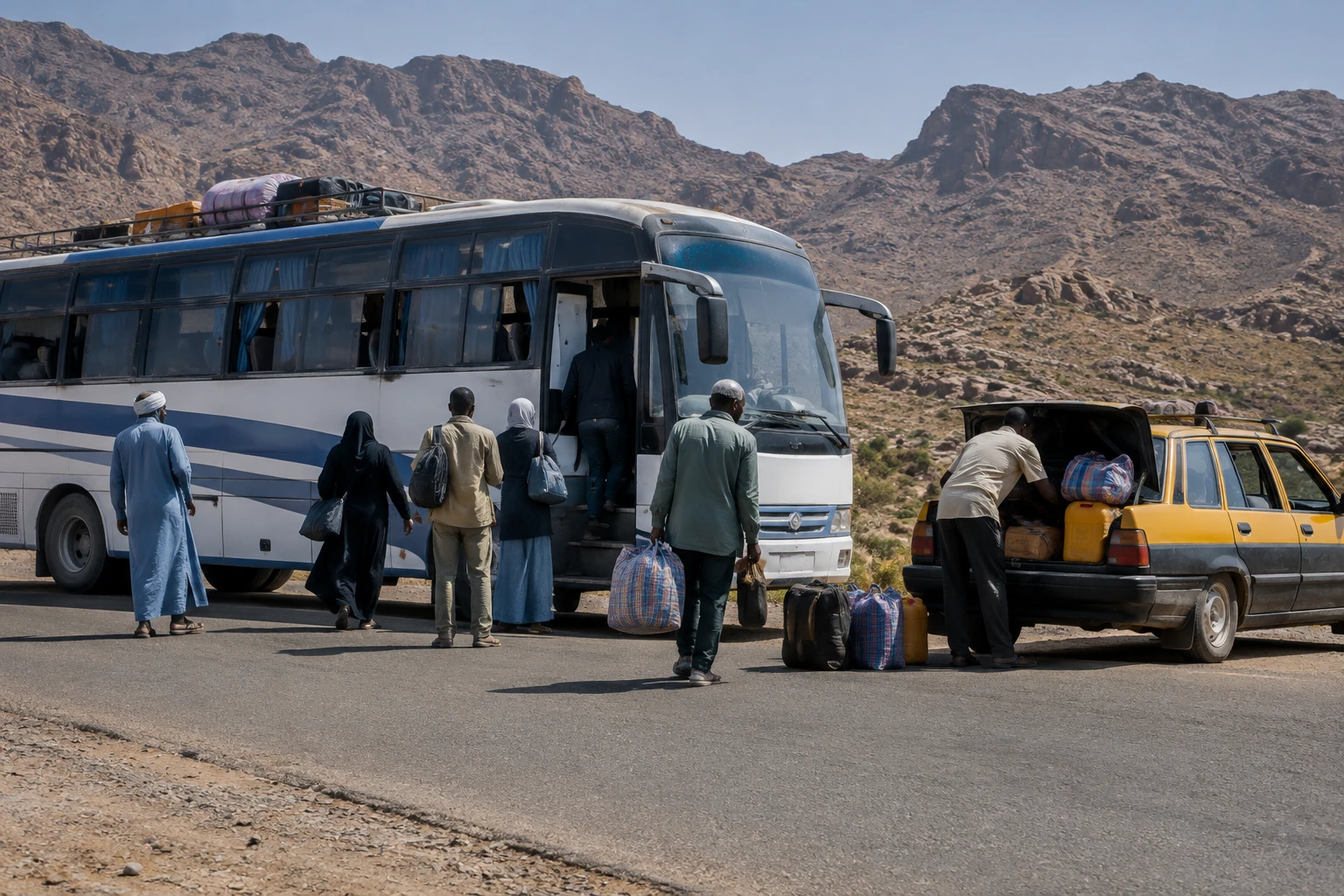
In Tibesti, peace around gold depends as much on security as on trust in the rules governing its extraction. Clashes reported in Miski on 14 October have revived a question at the heart of the conflict: who decides access to resources and how the benefits are shared with local residents?
A peace deal put to the test
Miski is in Chad’s Tibesti province, in the north-west of the country, far from N’Djamena. In this gold-bearing area, tensions over mining have fuelled several years of conflict between the authorities and the local Self-Defence Committee. The issue goes beyond control of a site: it concerns the state’s presence, community security and the distribution of revenue from the subsoil.
On 20 April 2025, the Chadian government and the Self-Defence Committee signed an agreement in Bardaï aimed at ending hostilities. The text provides, among other things, for an amnesty for the 2019 and 2020 clashes, the integration of fighters into the defence forces after training, and the cancellation of existing mining permits. It also provides for the suspension of mining activities in Miski and its surrounding areas pending environmental, social and mapping studies. The details of the provisions in the Miski agreement show that mining was at the heart of the compromise.
The settlement was also intended to be supported by a joint commission tasked with monitoring its implementation and by the resumption of administrative and social services in the department of Emi-Koussi. The agreement therefore set out a multifaceted way out of the crisis: disarmament, reintegration, the return of the administration and regulation of mining activity. Its signing did not, however, erase disagreements; it set commitments whose implementation was to be verified.
Two soldiers killed, nine injured, says army
On 14 October 2026, personnel from the National Brigade for the Control of Mining Activities were attacked at their position in the Miski area. According to a statement by the Chadian military chief of staff, two officers were killed and nine soldiers injured. The army blamed the attack on the Miski Self-Defence Committee. This toll and attribution come from the military statement, as reported by media; they should be understood as the authorities’ account, as no independent confirmation was available at the time of writing. The report on the announcement by the military chief of staff also recounts the army’s call for the immediate surrender of weapons.
The military chief of staff warned that failure to comply with the order could be considered an act of rebellion. The statement signals a hard line. It comes as the 2025 agreement provided for a process of disarmament and integration, as well as commitments concerning gold mining. The available information does not establish the precise trigger for the clashes or independently confirm the circumstances of the casualties.
According to reports, the committee expressed regret over the deaths and offered its condolences, while reiterating its demands. In particular, it is calling for the mining brigade’s coordinator to be removed, accusing him of involvement in gold mining, and demanding that the agreement be implemented. This accusation has not been independently established. The disagreement between the army and the committee therefore concerns both responsibility for the violence and implementation of the compromise.
Gold, security and local benefits
In a region far from the capital, the deployment of a brigade responsible for gold-mining sites may be presented by the state as a security measure. For local residents, the central question also remains one of rules: who may mine, under what oversight and with what benefits for local communities? The cancellation of permits and temporary suspension provided for in the agreement were intended to address these concerns, notably through preliminary studies. As long as these commitments are disputed or difficult to verify, an armed presence around the sites risks becoming another source of friction.
The consequences are not shared equally. Deployed forces and members of the committee are directly exposed to the clashes. Residents of the localities concerned may face travel restrictions, the suspension of mining activities or disruption to services that are already hard to access. Gold operators and workers are also affected by uncertainty over permits and access conditions. At national level, a resurgence of violence complicates the authorities’ efforts to restore their presence in Tibesti without abandoning the commitments negotiated.
Another recent episode highlights the fragility of the local climate, without establishing a direct link to the fighting in Miski. On 8 October, 14 people held in the Tourkou mountains were released after 72 hours, following mediation involving government officials and traditional authorities. Chadian media linked the case to tensions following the death of a mining entrepreneur. The account of the release in Tourkou describes another flashpoint in the province, but there is no basis for conflating the two events.
A Chadian issue with regional repercussions
The issue falls first and foremost to Chadian institutions and the communities concerned. At regional level, Chad is a member of CEMAC, the Economic and Monetary Community of Central Africa. The clashes in Miski do not, on their own, constitute a regional crisis. However, control of mineral resources, security in remote areas and trust in peace agreements all matter for stability in Central Africa.
The next step will be less about making another declaration than about concrete verification: is the ceasefire holding, is the monitoring commission functioning, and are the agreement’s mining provisions being implemented? It will also be necessary to distinguish confirmed facts from accusations traded between the parties, and to establish the conditions under which the Mining Brigade operates. In Miski, lasting security will depend as much on protecting people as on the credibility of commitments made over gold.