Algeria
 Egypt
 Libya
 Sudan
 Tunisia
 Benin
 Burkina Faso
 Cabo Verde
 Côte d'Ivoire
 Ghana
 Guinea
 Guinea-Bissau
 Liberia
 Mali
 Mauritania
 Niger
 Nigeria
 Senegal
 Sierra Leone
 The Gambia
 Togo
 Cameroon
 Central African Republic
 Chad
 DR Congo
 Equatorial Guinea
 Gabon
 Republic of the Congo
 São Tomé and Príncipe
 Burundi
 Comoros
 Djibouti
 Eritrea
 Ethiopia
 Kenya
 Madagascar
 Malawi
 Mauritius
 Mozambique
 Rwanda
 Seychelles
 Somalia
 South Sudan
 Tanzania
 Uganda
 Angola
 Botswana
 Eswatini
 Lesotho
 Namibia
 South Africa
 Zambia
 Zimbabwe
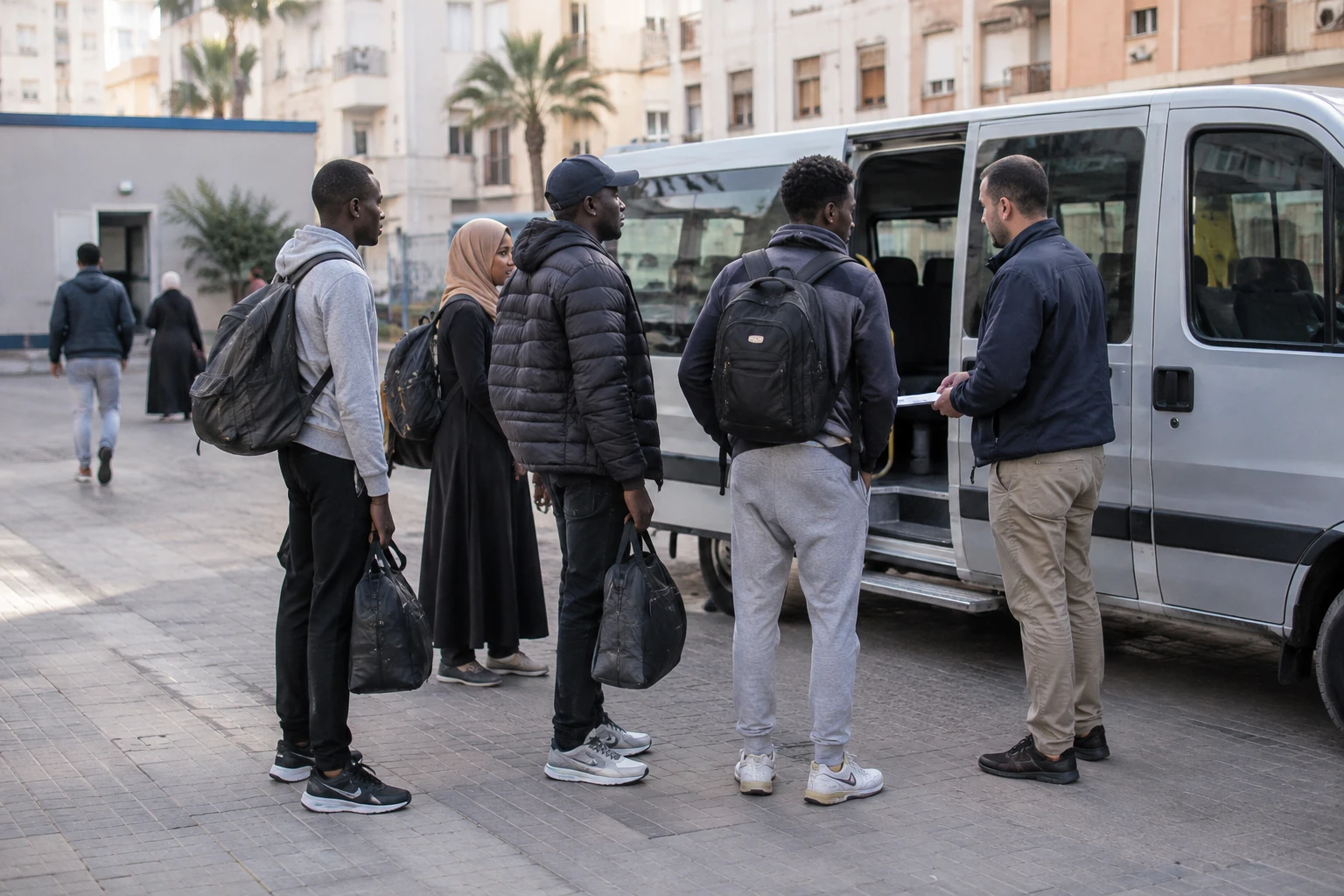
In Ceuta, clearing the tents does not end the waiting. Hundreds of people were moved on Sunday 11 October from the El Guano site, as reception capacity in this Spanish city in North Africa remains under pressure and some migrants are still sleeping outdoors.
A border city between Spain and Morocco
Ceuta is a Spanish autonomous city on Morocco’s northern coast. Together with Melilla, it is one of the two Spanish enclaves on the African continent. Rabat claims sovereignty over both cities, while Madrid administers them as Spanish territories. The border thus concentrates migration, diplomatic and political issues that extend beyond the local authorities alone.
The current pressure intensified after the mass arrivals on 30 and 31 July 2026, by land and sea from Morocco. Those concerned have different journeys and circumstances: some are minors, some wish to apply for asylum, while others are seeking to join relatives or continue their journey. An overall figure is therefore not enough to describe everyone’s needs or the steps they must take.
Spanish authorities had already cleared several encampment sites since the end of September. According to reports from the area, the operations targeted the desalination plant area, Benítez beach, and then El Trampolín on 4 and 5 October. After these relocations, some people settled at El Guano. The sequence shows how an evacuation can shift people’s presence in public spaces without resolving the shortage of accommodation.
At El Guano, evacuation and administrative referrals
The operation began at about 8am on Sunday. More than 350 officers were reportedly deployed, including national police, civil guards, local police and military personnel, according to authorities cited by the Spanish press. Vehicles and buses were used to transport those still present. Officers separated adults from minors so they could be referred to different procedures.
Adults were to be taken to the Temporary Centre for Foreigners, near the El Tarajal border crossing. The centre is used in particular for identification and referral to other services. Minors, meanwhile, were to go through police services before being taken into care by the available child protection facilities. These are administrative steps: they do not in themselves determine the right to remain in Spain or the outcome of an asylum application.
Reports published on Sunday put the number of people taken into care during the operation at about 150, while others had left before law enforcement arrived. Spanish authorities describe some departures to Morocco as “voluntary returns”. That description alone does not establish the conditions in which each person made their decision. Nor do the available accounts explain what became of everyone who left the encampment.
Authorities justified the operation on grounds of security, identification and sanitary conditions, as well as the cleaning and restoration of the esplanade. These are the reasons given in their official statements. At the same time, accounts cited by Spanish media say that people remained homeless in neighbourhoods such as El Príncipe and Los Rosales, or around the warehouses at El Tarajal.
The central question: where to accommodate those displaced?
The point of tension now lies as much in accommodation capacity as in border control. Temporary places have been distributed across several sites, but administrative sources cited in the press also describe centres as nearly full. A new emergency facility, announced near Fuerte Mendizábal prison, could accommodate about 1,000 people. Its opening date had not been confirmed by Sunday.
This pressure affects displaced people unevenly. Adults must go through identification and accommodation procedures; minors depend on specific services, whose availability can vary. Those wishing to seek asylum need their cases to be examined. In the meantime, the lack of stable housing makes it harder to access information, healthcare and legal support. Associations and volunteers provide help on the ground, but cannot replace public services.
For Ceuta’s residents, the succession of encampments and evictions is transforming several coastal and neighbourhood areas. For local authorities, it highlights the limits of a response based solely on police operations and temporary capacity. Moving people from one beach to another, then to the streets or a centre, does not resolve the need for a lasting solution and individual consideration of each case.
Royal visit amid diplomatic disagreement
King Felipe VI and Queen Letizia are due to visit Ceuta on Tuesday 13 October, followed by Melilla on 14 October. The visit comes at a sensitive time, but the available information does not show that the El Guano evacuation was ordered because of their trip. The close timing raises questions; it is not enough to establish a causal link.
The 2007 precedent is a reminder of the diplomatic dimension of the issue. The visit by King Juan Carlos and Queen Sofia to Ceuta and Melilla prompted a strong reaction from Rabat, which recalled its ambassador to Madrid for consultations. The current situation should be considered in its own context: a Moroccan media outlet noted that Rabat had not immediately reacted publicly to the announcement of Felipe VI’s visit. That silence alone does not allow any conclusion to be drawn about a change in its position on the sovereignty it claims.
At the regional level, the management of Ceuta also depends on cooperation between Spain and Morocco, neighbouring countries whose relations combine economic ties, border control and a territorial dispute. For people arriving from Morocco, these state-to-state relations translate into practical questions of accommodation, procedures and returns. Following the dismantling of El Guano, the next indicators will be whether new places actually open, the situation of those still on the streets and how the authorities handle individual applications.
Details of the operation and reception conditions were cross-checked against separate reports published in Spain. To provide context from Morocco, a media outlet in the country also reported on expected diplomatic reactions to the royal visit. Details of the evacuation and reception capacity in Ceuta, local reporting on those displaced and the Moroccan perspective on the diplomatic context offer complementary insights.