
 Algeria
 Egypt
 Libya
 Morocco
 Sudan
 Tunisia
 Benin
 Burkina Faso
 Cabo Verde
 Côte d'Ivoire
 Ghana
 Guinea
 Guinea-Bissau
 Liberia
 Mali
 Mauritania
 Niger
 Nigeria
 Senegal
 Sierra Leone
 The Gambia
 Togo
 Cameroon
 Central African Republic
 Chad
 Equatorial Guinea
 Gabon
 Republic of the Congo
 São Tomé and Príncipe
 Burundi
 Comoros
 Djibouti
 Eritrea
 Ethiopia
 Kenya
 Madagascar
 Malawi
 Mauritius
 Mozambique
 Rwanda
 Seychelles
 Somalia
 South Sudan
 Tanzania
 Uganda
 Angola
 Botswana
 Eswatini
 Lesotho
 Namibia
 South Africa
 Zambia
 Zimbabwe
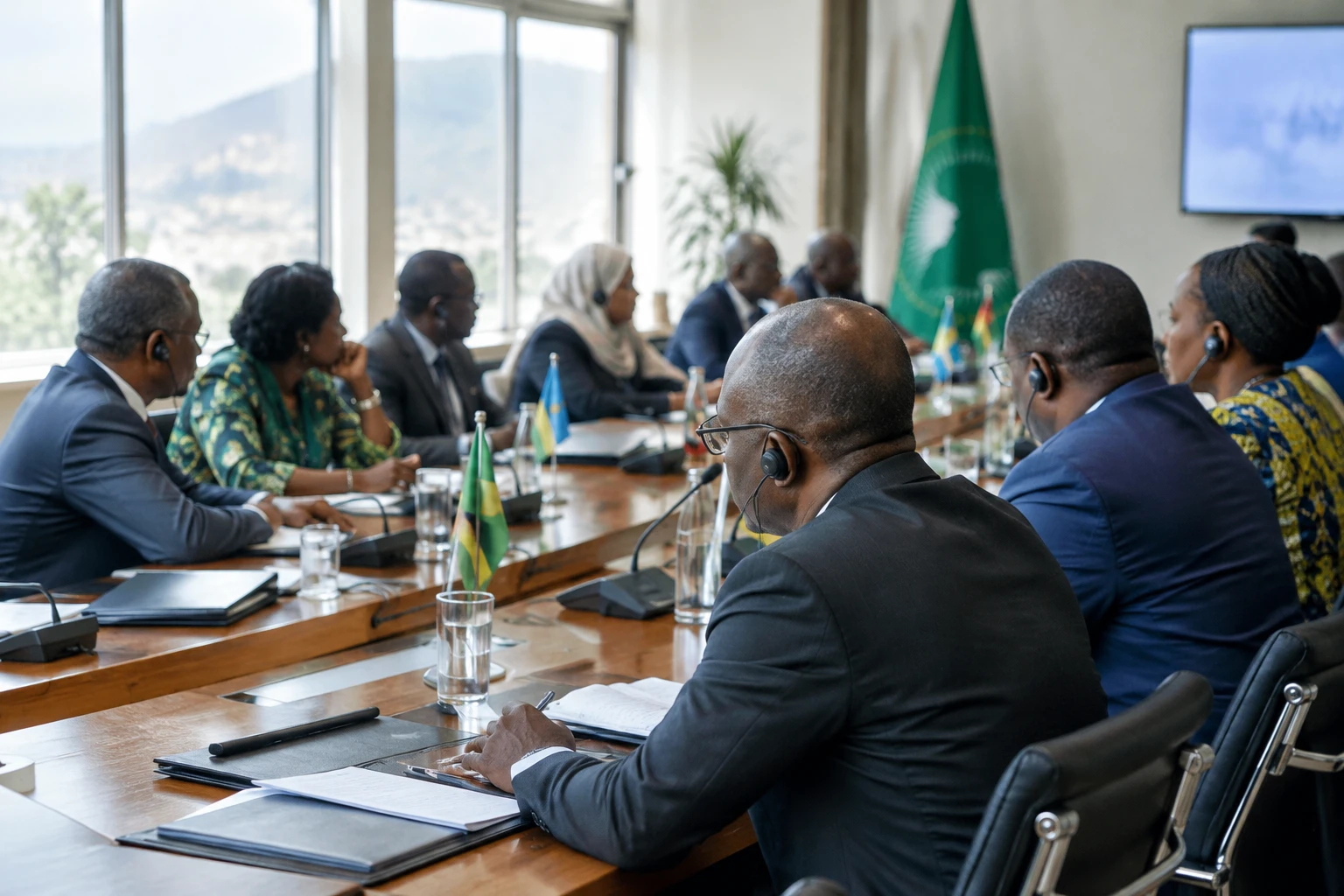
In Goma, African diplomacy faced a practical question: how can a ceasefire be enforced when armed actors hold their positions and residents remain exposed to fighting? The visit by African Union facilitators helped re-establish contacts. At this stage, it announced neither a new agreement nor any verifiable progress on the ground.
Mediation engaging directly with the actors
On 5 October 2026, a delegation from the African Union Panel of Facilitators held consultations in Goma, in North Kivu. It was led by Sahle-Work Zewde, former president of Ethiopia, alongside Uhuru Kenyatta, former president of Kenya, and Mokgweetsi Masisi, former president of Botswana.
The discussions brought together representatives of MONUSCO, the United Nations peacekeeping mission in DR Congo, the UN Office for the Coordination of Humanitarian Affairs, the International Committee of the Red Cross, a joint security verification mechanism and AFC/M23. In its statement of 7 October, the African Union said the consultations aimed to gather their views on peace, security and the humanitarian situation. The panel is to submit its conclusions to the AU mediator and the Congolese government.
The delegation also continued its consultations in Kigali, according to Congolese media outlet Actualite.cd. This step highlights the regional dimension of the conflict: relations between Kinshasa and Kigali have a direct bearing on prospects for de-escalation, while accusations that Rwanda supports AFC/M23 are disputed by Kigali. It is important to distinguish these accusations from established facts and attribute them to those making them.
Peace processes to be linked
This initiative is taking place against a crowded diplomatic backdrop. The Doha process aims to foster dialogue between the government of the Democratic Republic of the Congo and AFC/M23. In parallel, the Washington talks concern relations between Kinshasa and Kigali. The African Union is seeking to coordinate these tracks rather than treat them as separate negotiations.
In July, the panel and a joint secretariat drew up a six-month roadmap in Gaborone, covering the period from July to December 2026. It provides, in particular, for political and security coordination, humanitarian access, dialogue with armed groups, regional economic co-operation and the participation of civil society, women and young people. The challenge now is to turn this framework into commitments that can be implemented and monitored.
DR Congo belongs to the Southern African Development Community (SADC) and the East African Community (EAC), two regional organisations involved in diplomatic efforts. The Great Lakes region adds another layer of coordination, with closely linked borders and security interests. The African Union therefore announced in July that it intended to align its action with the Doha and Washington initiatives, as well as with regional organisations.
The ceasefire, an immediate test
In Goma, the panel called on the parties to strictly honour their ceasefire commitments, co-operate with verification mechanisms and avoid actions that could undermine the discussions. It also stressed the protection of civilians, particularly women and girls, the prevention of sexual violence, accountability for violations and unimpeded humanitarian access.
These calls highlight the gap between negotiations and daily life. For residents of affected areas, the credibility of a peace process is measured by the safety of travel, the continuity of healthcare and schooling, and the ability to receive aid. For the authorities in Kinshasa, sovereignty and territorial integrity also remain at stake. For the actors present in Goma, the discussion is about their place in a political settlement. These priorities are not the same.
AFC/M23’s control of Goma gives any meeting in the city particular political significance. But a consultation with the movement amounts neither to recognition of its authority nor to an agreement with Kinshasa. The AU statement explicitly reaffirms the sovereignty, unity and territorial integrity of DR Congo. It also says these principles must translate into concrete improvements for affected communities.
A step, not yet a breakthrough
The presence of African facilitators in Goma could help maintain a channel of dialogue and bring diplomatic timetables closer together. However, the public statements available make no mention of an agreement signed during the visit, or of a new withdrawal or disarmament mechanism. The AU speaks of consultations and confidence-building measures to be strengthened. Describing this step as a breakthrough would therefore go beyond the established facts.
Follow-up will depend on implementing the roadmap and on the parties’ ability to have their commitments verified. It will also be necessary to see whether calls for a ceasefire and humanitarian access have an effect in the areas concerned. For the African Union, the challenge is twofold: to maintain mediation led by African actors and secure genuine co-ordination with the external and regional initiatives already under way.
For DR Congo and its neighbours, the stakes go beyond a single meeting. As long as diplomatic arrangements do not reduce risks to civilians and clarify the parties’ responsibilities, the proliferation of processes may yield no tangible results. The next meaningful milestone will therefore be less a new statement than a verifiable sign of respect for the ceasefire and continuity in the discussions.
Sources for verification: statement by the African Union Panel of Facilitators, Actualite.cd on consultations in Goma and Kigali, Dépêche.cd on the mission to Goma and African Union roadmap for July–December 2026.



