Algeria
 Egypt
 Libya
 Morocco
 Sudan
 Tunisia
 Benin
 Burkina Faso
 Cabo Verde
 Côte d'Ivoire
 Ghana
 Guinea
 Guinea-Bissau
 Liberia
 Mali
 Mauritania
 Niger
 Nigeria
 Sierra Leone
 The Gambia
 Togo
 Cameroon
 Central African Republic
 Chad
 DR Congo
 Equatorial Guinea
 Gabon
 Republic of the Congo
 São Tomé and Príncipe
 Burundi
 Comoros
 Djibouti
 Eritrea
 Ethiopia
 Kenya
 Madagascar
 Malawi
 Mauritius
 Mozambique
 Rwanda
 Seychelles
 Somalia
 South Sudan
 Tanzania
 Uganda
 Angola
 Botswana
 Eswatini
 Lesotho
 Namibia
 South Africa
 Zambia
 Zimbabwe
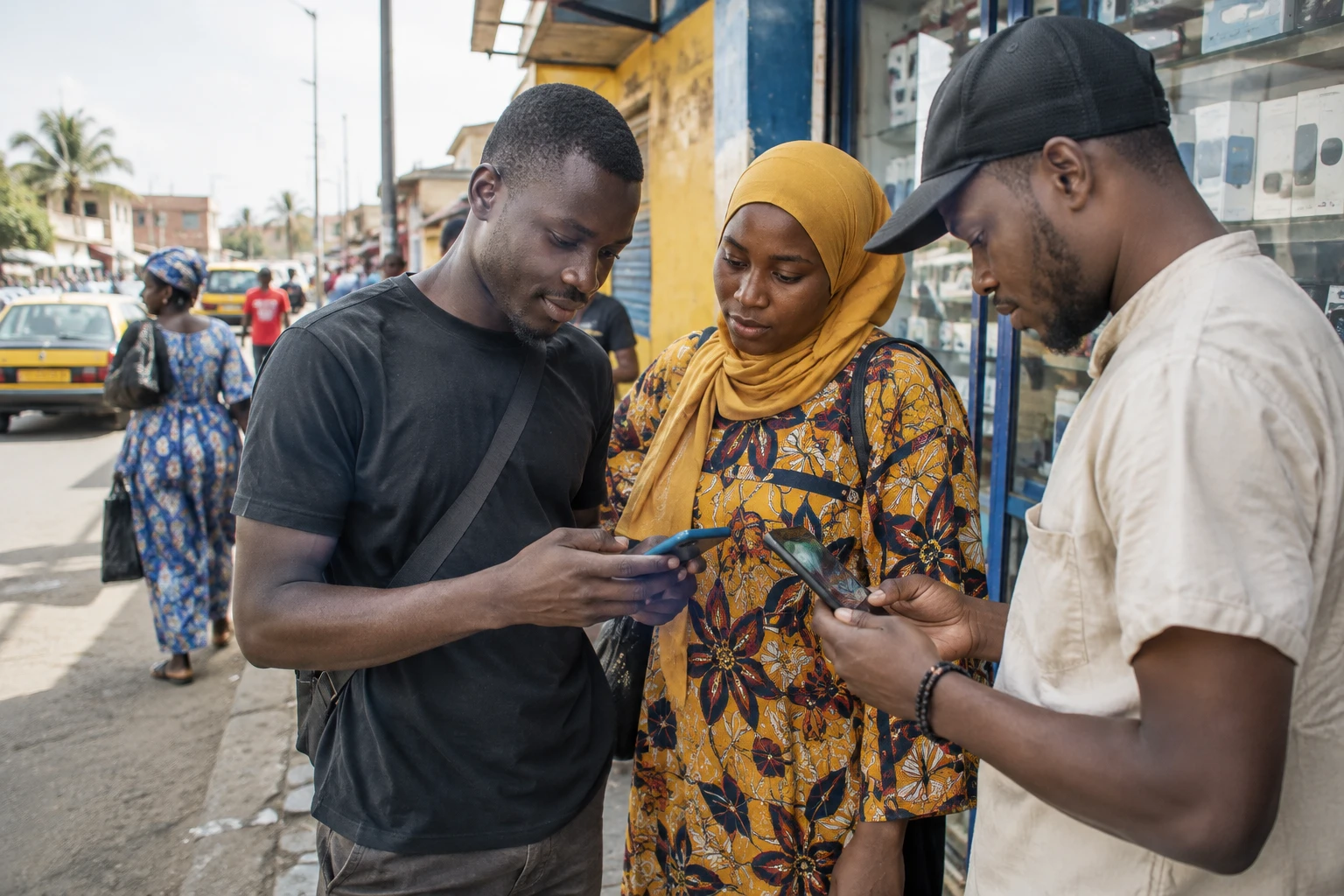
A mobile network can cover almost an entire country without everyone being able to benefit from it. In Senegal, the gap between the availability of 4G and access to a suitable device has put local production at the heart of the debate on digital inclusion.
Connectivity is not enough
Senegal has an estimated 4G coverage of 97% of the population. Yet, according to figures released by the Ministry of Telecommunications and Digital Affairs, 54% of Senegalese people do not own suitable equipment to access digital services fully. The figures point to a gap between the available infrastructure and its practical use.
The distinction matters: coverage means that a network is available in an area, not that every resident has a smartphone or computer, or the means to connect. The cost of the device, as well as data and electricity, weighs on access. People in rural areas and low-income households may therefore remain excluded even where there is a signal.
This priority forms part of the New Deal technologique, launched by the Senegalese authorities in 2025 to make digital technology a driver of economic and social transformation. Its Senegal Digital Factory programme aims to strengthen national capacity, from equipment production to the development of technological solutions. The strategy also seeks to reduce dependence on imports in a country where Dakar accounts for a large share of economic activity and services.
A $150 million partnership
On 6 October 2026, in Dakar, the ministry signed a partnership valued at $150 million, or nearly 88 billion CFA francs, with the Global Council for Investment and Business in Africa and Indian company Blue Cloud Softech Solutions. The agreement is part of Senegal Digital Factory. The Senegalese Press Agency and RTS confirmed the date, partners and announced amount.
The scheme provides, among other things, for equipment assembly, quality control, the manufacture of accessories, certification and activities related to intellectual property. It adds to efforts involving local players, including SunuCorp, which operates a computer assembly plant at Keur Ndiaye Lo in the Dakar region.
The signing marks an intention and establishes a partnership framework. On its own, it does not reveal the implementation timetable, the share of funds actually mobilised, or the volume of equipment to be produced. These factors will be crucial in assessing the project’s industrial scale and its benefits for consumers.
What will it take to assemble in Senegal?
Local manufacturing can shorten some import routes and support jobs in assembly, maintenance and quality control. It can also create opportunities for Senegalese technicians and companies. But producing locally does not automatically guarantee a lower final price.
At many African sites, devices are assembled from kits of components manufactured elsewhere. Transport costs and customs duties can therefore continue to push up costs. Energy, workforce training, access to finance and the regularity of orders also affect factories’ competitiveness.
A 2025 study by the International Telecommunication Union on ICT equipment manufacturing in Uganda also found that reliance on imported components raises costs and limits competitiveness. This does not directly describe Senegal, but it highlights a challenge shared by industrial strategies in the sector: local assembly is no substitute for a more complete supply chain.
Taxation is another lever. The GSMA, a global association of mobile operators, estimates that taxes can account for more than 30% of the cost of a phone in some sub-Saharan African countries. Lower prices will therefore also depend on duties applied to devices or their components, distribution margins and competition between suppliers.
For households, the test will be the price in shops, not the number of units assembled. For businesses, the issue also involves reliable supplies and the availability of spare parts. In public services, affordable equipment can facilitate access to online procedures, provided people also have a connection and the necessary skills.
A regional industrial challenge
Senegal is a member of ECOWAS, the Economic Community of West African States. Competitive production could serve a market beyond Senegal’s borders if companies can meet standards, control costs and organise regional distribution. The project therefore speaks to a pan-African question: how to create more value on the continent rather than importing almost all finished equipment.
Progress should be assessed against concrete indicators: investments actually committed, the proportion of components purchased locally, jobs and skills created, and changes in device prices. It will also be important to see whether the equipment produced meets the needs of schools, small businesses and users far from Dakar.
Senegal’s bet will therefore not be measured solely by the opening of a factory. It will depend on the ability to turn an announced partnership into sustainable production, and then into genuinely more accessible devices. Only then can digital coverage translate into everyday use for more Senegalese people.