Egypt
 Libya
 Morocco
 Sudan
 Tunisia
 Benin
 Burkina Faso
 Cabo Verde
 Côte d'Ivoire
 Ghana
 Guinea
 Guinea-Bissau
 Liberia
 Mali
 Mauritania
 Niger
 Nigeria
 Senegal
 Sierra Leone
 The Gambia
 Togo
 Cameroon
 Central African Republic
 Chad
 DR Congo
 Equatorial Guinea
 Gabon
 Republic of the Congo
 São Tomé and Príncipe
 Burundi
 Comoros
 Djibouti
 Eritrea
 Ethiopia
 Kenya
 Madagascar
 Malawi
 Mauritius
 Mozambique
 Rwanda
 Seychelles
 Somalia
 South Sudan
 Tanzania
 Uganda
 Angola
 Botswana
 Eswatini
 Lesotho
 Namibia
 South Africa
 Zambia
 Zimbabwe
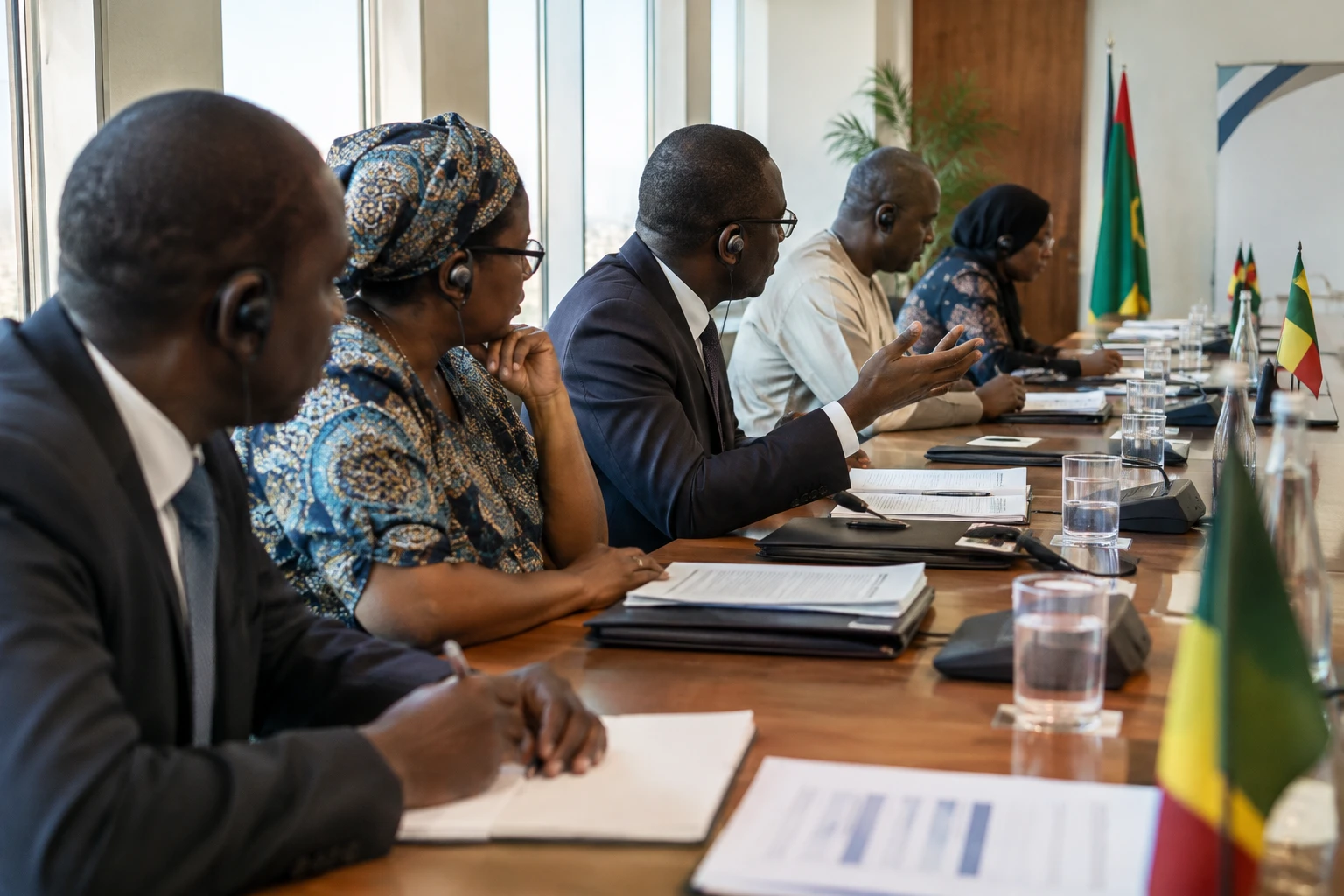
For Mauritania, discussions on Western Sahara concern not only the future of a neighbouring territory. They also affect its borders, its relations with Rabat and Algiers, and the stability of the Maghreb. Meetings held in 2026 brought Nouakchott back to the table, without resolving the fundamental disagreements.
Dialogue resumes after several years of interruption
The conflict pits Morocco against the Polisario Front, which seeks independence for Western Sahara. Algeria supports the Polisario and hosts Sahrawi refugee camps. Mauritania, which neighbours the territory, takes part in diplomatic exchanges but is not one of the two main parties to the conflict.
The process is unfolding against a fragile regional backdrop. Relations between Morocco and Algeria have been severed since 2021. The Arab Maghreb Union, which brings together the two countries, Mauritania, Tunisia and Libya, remains largely paralysed. Each resumption of dialogue can therefore matter, but is not enough to restore regional cooperation.
The Security Council has extended the mandate of MINURSO, the UN mission established in 1991 in connection with the referendum plan, until 31 October 2026. Its presence is a reminder that no political settlement has yet been accepted by the parties. UN debates in 2026 on Western Sahara and MINURSO also show how contested the interpretation of this resolution remains.
Autonomy, transition and border guarantees
In his report dated 1 October, UN Secretary-General António Guterres describes three rounds of discussions held in Washington and Madrid between January and February 2026. Morocco presented an expanded version of its 2007 autonomy plan. The plan provides for local administration of the territory under Moroccan sovereignty, while the Polisario continues to defend the Sahrawis’ right to choose their status, including independence.
Participants also considered creating a transitional council. At their request, the UN and the United States prepared a draft framework agreement for this phase. The report describes proposals under discussion, not an agreement already reached. Nothing in the available information suggests that the parties have agreed on the territory’s final status.
Mauritania, for its part, raised a question directly linked to its security. According to an account of the report relayed by the Mauritanian media outlet Yibaldi, Foreign Minister Mohamed Salem Ould Merzoug called for a commission to be set up to define, by consensus, the definitive international borders of the disputed territory. The request reflects Nouakchott’s concern that its own territorial boundaries be clearly guaranteed. It relates in particular to Lagouira, near Nouadhibou, whose status is raised in the regional debate. This information is reported by a Mauritanian media source and should be understood as such.
Mauritania’s participation therefore has practical significance: Nouakchott is seeking to prevent any eventual arrangement between the protagonists from leaving its border interests uncertain. For the authorities, the issue concerns sovereignty and stability. For people in border areas and economic actors, clarity over boundaries can affect movement, trade and the security of commercial activities.
Talks resumed, but no compromise announced
The return to direct meetings is notable after several years without a comparable round of talks. However, renewed contact does not mean that positions are drawing closer. Morocco advocates autonomy under its sovereignty. The Polisario calls for a self-determination process that includes the option of independence. Algeria challenges Morocco’s framing, while Mauritania is insisting, in particular, on territorial guarantees.
The wording used by the UN itself carries political weight. Resolution 2797, adopted in 2025, calls for discussions using Morocco’s autonomy proposal as a basis, while seeking a mutually acceptable political solution and self-determination for the people of Western Sahara. Interpretations of the text differ. Some delegations present it as support for Morocco’s plan; others stress that it does not, by itself, determine the territory’s final status. The precedent of Security Council debates on MINURSO’s mandate is a reminder that successive resolutions have called for dialogue without resolving the dispute.
Guterres’s report records no major breakthrough. Instead, it documents a shift from general discussions to specific institutional questions: a transition period, a possible council and the guarantees to be provided. This development could open up room for negotiation. It could also make each delegation’s red lines clearer.
A Maghreb-wide issue extending beyond the negotiating table
For Mauritania, maintaining a channel with its two major neighbours is a diplomatic balancing act. An agreement accepted by the parties could ease a lasting source of tension between Rabat and Algiers. Conversely, negotiations seen as imposing an outcome in advance could harden positions and constrain Nouakchott’s room for manoeuvre.
The stakes extend beyond the capitals. The conflict directly affects the Sahrawis concerned, separated families and people living in refugee camps near Tindouf. A solution discussed by governments will be durable only if the rights and consent of the populations concerned remain at the centre of the process. MINURSO remains a UN presence and monitoring mechanism, while its historic referendum mandate has not been fulfilled.
The next immediate deadline is the renewal of the mission’s mandate, expected before 31 October 2026. Until then, it remains to be seen whether the draft framework agreement returns to the discussions and whether the guarantees sought by Mauritania are examined. For now, the meetings have restored dialogue among four parties, but have not brought positions close enough to announce a settlement.