Algeria
 Egypt
 Libya
 Morocco
 Sudan
 Tunisia
 Benin
 Burkina Faso
 Cabo Verde
 Côte d'Ivoire
 Ghana
 Guinea
 Guinea-Bissau
 Liberia
 Mali
 Mauritania
 Nigeria
 Senegal
 Sierra Leone
 The Gambia
 Togo
 Cameroon
 Central African Republic
 Chad
 DR Congo
 Equatorial Guinea
 Gabon
 Republic of the Congo
 São Tomé and Príncipe
 Burundi
 Comoros
 Djibouti
 Eritrea
 Ethiopia
 Kenya
 Madagascar
 Malawi
 Mauritius
 Mozambique
 Rwanda
 Seychelles
 Somalia
 South Sudan
 Tanzania
 Uganda
 Angola
 Botswana
 Eswatini
 Lesotho
 Namibia
 South Africa
 Zambia
 Zimbabwe
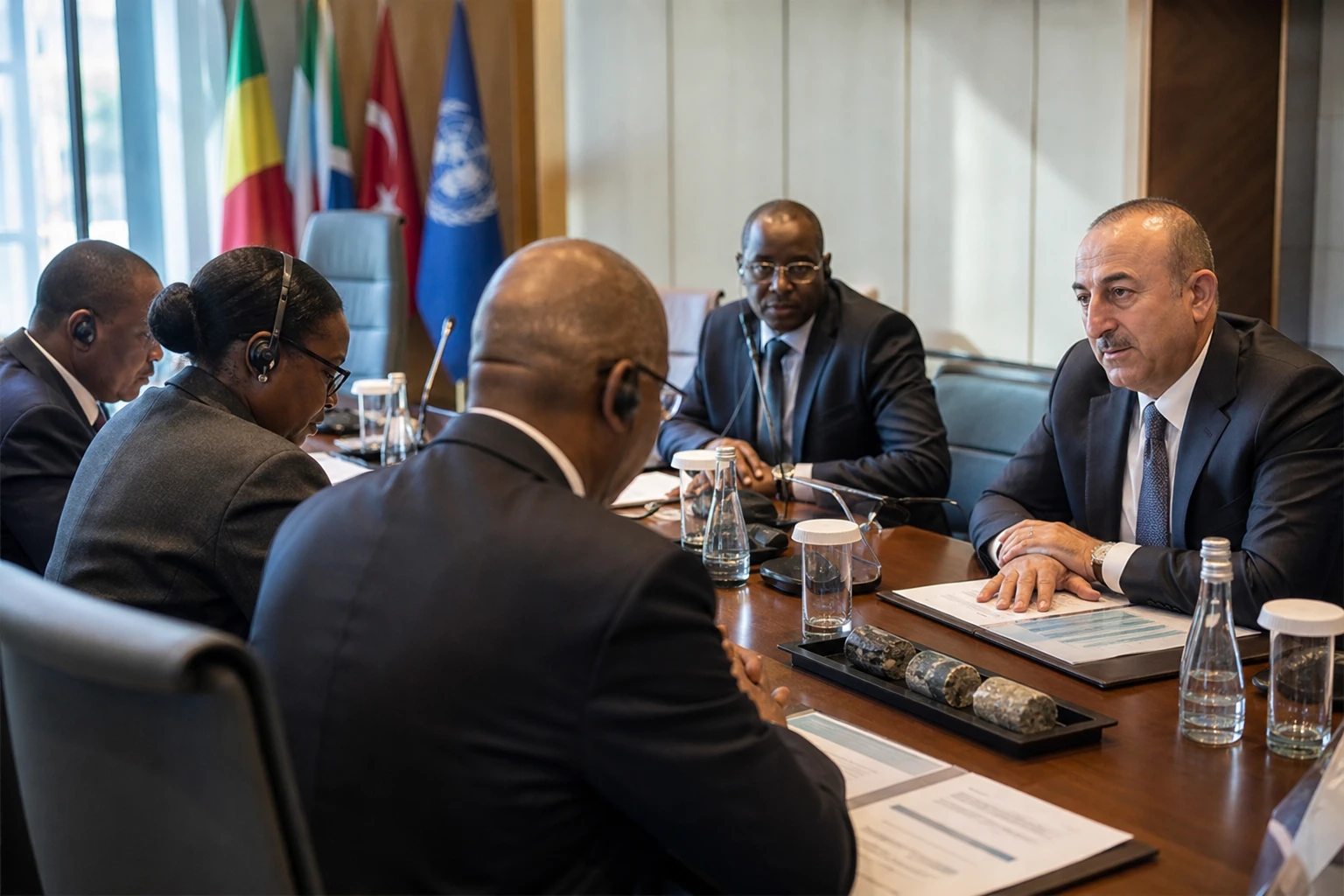
For Ankara, its African engagement is no longer limited to infrastructure projects, trade or defence contracts. Turkey is now seeking to secure direct access to minerals, from gold exploration permits in Niger to discussions with Angola and agreements with Nigeria and Senegal.
A mining diplomacy that is expanding step by step
The move is part of the African policy Turkey launched in the early 2000s. Since then, Ankara has stepped up official visits, air links, construction projects and industrial partnerships. The extractive sector adds a strategic dimension to this economic presence.
Turkey’s approach is based first on memorandums of understanding. These texts establish a framework for cooperation, but do not automatically guarantee investment or mining production. Rather, they pave the way for geological surveys, data-sharing, training and the search for joint projects.
On 6 October 2026, in Luanda, Turkey’s ambassador to Angola, Özgür Uludüz, met Angola’s Minister of Mineral Resources, Petroleum and Gas, Diamantino Azevedo. Discussions covered oil, gas, energy and mineral resources. The two sides also discussed existing projects and future partnership opportunities, without announcing any major mining commitments at this stage. Angolan media reported on the meeting in Luanda.
This cautious approach contrasts with the level of development reached in Niger. In the Sahelian country, Turkish state-owned company MTA International Mining, or MTAIC, is working with Niger’s Geological and Mining Research Centre. Its Nigerien subsidiary holds three gold exploration permits in the Tillabéri and Agadez regions. Information published by MTAIC details the permits and the work carried out.
From exploration permit to industrial project
Operations in Niger began in 2021, after the subsidiary was established under an agreement signed in 2020. They include geological mapping, geochemical sampling, geophysical surveys, trenching and core drilling.
Two permits are in the Liptako region, about 120 kilometres north-west of Niamey. A third is near Agadez, in the north of the country. MTAIC says it has commissioned pre-feasibility and feasibility studies. These stages help determine whether a discovery can become a profitable mine that is technically viable and compliant with regulatory requirements.
The Niger project nevertheless remains at the exploration stage. No Turkish commercial production has been announced at these sites. Moving from an exploration permit to mining still requires certified resources, substantial investment, infrastructure, national authorisation and an agreement with the communities concerned.
Sudan illustrates the difficulties of this transition. MTAIC established a company there in 2018 and obtained two permits in Red Sea State, north-east of Port Sudan. Drilling was carried out between 2020 and 2022. The Turkish company says, however, that no economically viable mineralisation was identified in one of the areas and that its activities were suspended for security reasons. MTAIC presents the technical results of its operations in Sudan.
Nigeria and Senegal, two complementary levers
Nigeria offers Ankara a different kind of partnership. On 21 May 2026, Turkey’s energy minister and Nigeria’s minister of solid minerals development signed a memorandum in Istanbul. The text updates an agreement concluded in 2021 and provides for cooperation in exploration, geological surveys, laboratories, data-sharing, beneficiation technologies and training.
The document also refers to promoting investment, safe mining practices and the activities of artisanal miners. For Abuja, the aim is to reduce the mining sector’s dependence on the oil industry and improve knowledge of the subsoil. For Ankara, Nigeria is also a gateway to the West African market, given the size of its economy and its regional influence.
Nigeria’s Federal Ministry of Information confirmed the signing and the agreement’s main areas of focus. Turkey’s energy ministry published a similar description of the framework. The official Turkish version specifies, in particular, the provisions on technology and skills development.
In Senegal, the framework is broader. On 31 October 2024, the two countries signed several agreements covering urban planning, agriculture, energy, hydrocarbons and higher education. Energy cooperation includes hydrocarbon exploration and production, as well as critical minerals and rare earths.
This focus is of particular interest to Dakar. Senegal already produces phosphate and has a heavy-mineral mining industry. In 2024, the country was among the world’s leading producers of ilmenite and zirconium concentrates. Turkey is therefore seeking not simply access to a resource, but a partnership with a country that already has an organised mining sector. Senegal’s prime minister’s office listed the agreements signed with Ankara.
A competitive market and African expectations
Turkey’s strategy is driven by concerns over security of supply. Ankara is seeking to guarantee access to minerals needed by its industry, while creating opportunities for its state-owned and private companies. Turkey itself has a substantial mining base. It is a major producer of borate, chromite, feldspar and perlite, among other minerals. United States Geological Survey data show the importance of these outputs.
Africa attracts Ankara because of the breadth of its resources and the still largely undocumented potential of several countries’ subsoil. But competition is fierce. China, the United States, the European Union, Australia, Canada and several Gulf states are also seeking partnerships in critical minerals.
For the African countries concerned, the point is not simply to welcome another foreign player. Governments expect concrete results: mapping of the subsoil, skilled jobs, skills transfer, public revenue, local processing and improved safety at mining sites.
The central question will therefore be implementation. In Niger, MTAIC’s ability to turn its exploration work into certified resources will have to be assessed. In Nigeria, the agreement will need to deliver investment and skills beyond official ceremonies. In Senegal and Angola, discussions will have to spell out the projects, timetables and the role of local processing.
Turkey now has several footholds. It must still show that they can form a coherent chain, from exploration in Africa to industrial supply, without reducing African partners to the role of raw-material suppliers.