
 Algeria
 Egypt
 Libya
 Morocco
 Sudan
 Tunisia
 Benin
 Burkina Faso
 Cabo Verde
 Côte d'Ivoire
 Ghana
 Guinea
 Guinea-Bissau
 Liberia
 Mali
 Mauritania
 Niger
 Nigeria
 Senegal
 Sierra Leone
 The Gambia
 Togo
 Cameroon
 Central African Republic
 Chad
 Equatorial Guinea
 Gabon
 Republic of the Congo
 São Tomé and Príncipe
 Burundi
 Comoros
 Djibouti
 Eritrea
 Ethiopia
 Kenya
 Madagascar
 Malawi
 Mauritius
 Mozambique
 Rwanda
 Seychelles
 Somalia
 South Sudan
 Tanzania
 Uganda
 Angola
 Botswana
 Eswatini
 Lesotho
 Namibia
 South Africa
 Zambia
 Zimbabwe
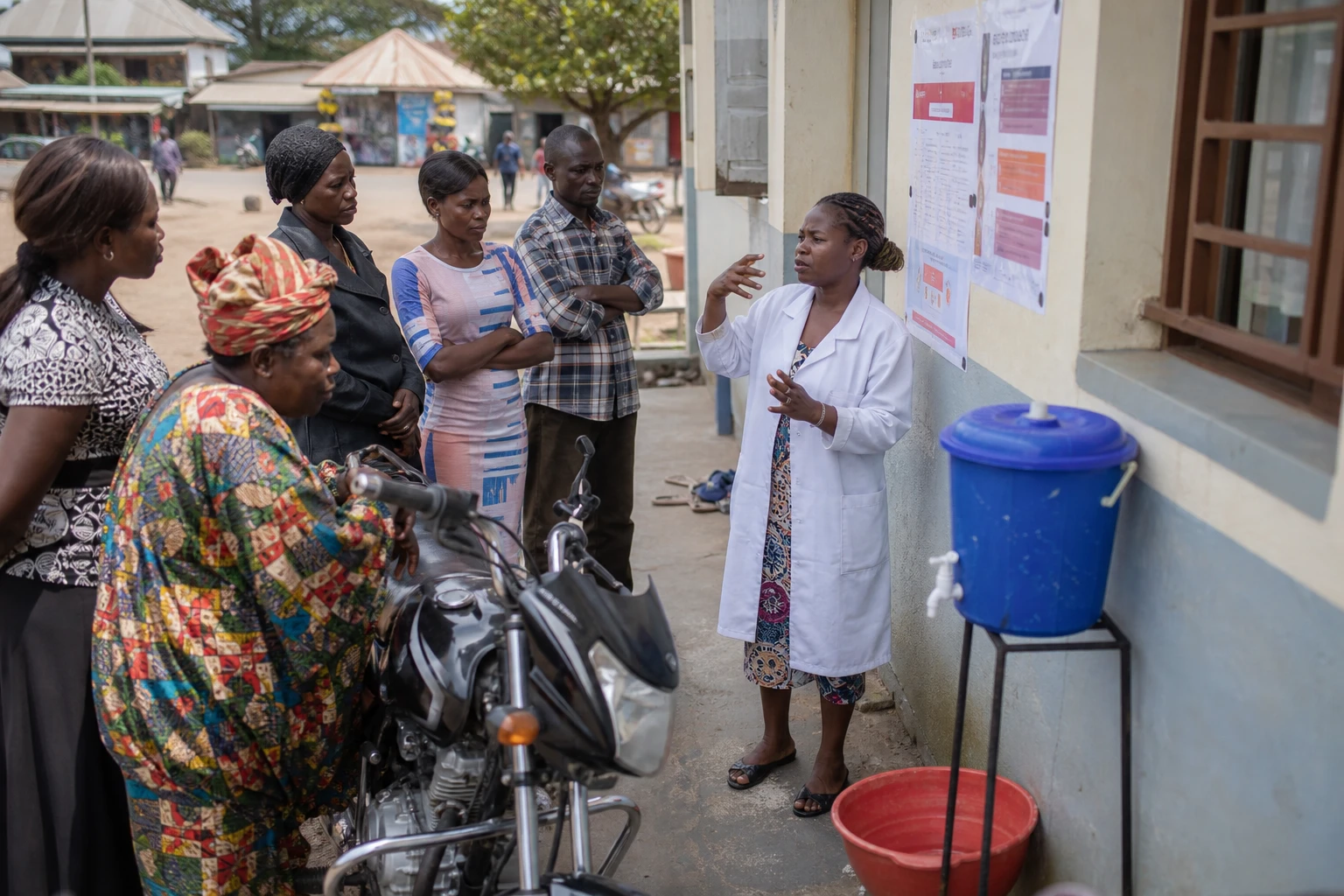
In Biakato, in the east of the Democratic Republic of the Congo, the Ebola outbreak revealed a major challenge: saving lives depended as much on residents’ trust as on the availability of care. In just a few days, local alerts highlighted logistical and community-related shortcomings in the response in Ituri.
An outbreak in the heart of Ituri
On 28 and 29 September 2019, 18 deaths linked to Ebola virus disease were reported in Biakato, in Mambasa territory. The toll came from local civil society actors drawing on health information. It therefore had to be treated with caution, in the absence of a detailed publication distinguishing confirmed from probable cases.
The alert came in an area already identified as one of the new transmission hotspots. In its 3 October 2019 bulletin, the World Health Organization said that the Mambasa and Mandima health zones accounted for more than half of the new cases recorded during the previous week. Ituri had thus become a central focus of the outbreak, after several months during which activity had been observed mainly in North Kivu.
Ebola virus disease causes fever and digestive problems, among other symptoms, and haemorrhaging in severe cases. But its spread also depends on how quickly cases are diagnosed and patients isolated, contacts traced and teams kept safe. In the east of the DRC, these operations took place in an environment marked by insecurity and persistent mistrust of response workers.
Time lost between the village and the laboratory
In Biakato, the health response faced very practical constraints. The area had no mobile laboratory. Samples taken from people suspected of being infected had to be transported to Komanda, more than 100 kilometres away.
This distance made it harder to confirm cases quickly. It also slowed patient referrals and the introduction of measures to protect their relatives. In an outbreak where every contact must be traced and monitored for several days, a difficult journey can turn an administrative delay into a new chain of transmission.
Field logistics were also hampered by fuel shortages. In the Mandima health zone, the only available ambulance was reportedly limited in its movements. This information, reported locally, was not independently documented in the public bulletins consulted. It nevertheless describes a recurring problem in the response: infrastructure alone is not enough if teams cannot travel.
The difficulties were not limited to equipment. The WHO had already reported tensions between communities and response teams, as well as interruptions to activities in some areas of Mandima. These disruptions could lead to contacts being lost, delay investigations into deaths and contribute to an underestimate of the actual number of cases.
Deaths far from treatment centres
One of the most worrying indicators concerned where deaths occurred. An analysis by Save the Children, based on data from the Congolese health ministry, estimated that 81.5% of deaths recorded in the three weeks before 27 September 2019 had occurred in communities, rather than in treatment centres.
This figure did not mean that treatment centres were ineffective. It showed above all that many patients arrived too late, or never reached them at all. Families might hesitate to report a case. Some feared isolation, stigma or safe burial practices. Others lived far from medical facilities, along difficult roads and in areas where the presence of armed groups made travel more complicated.
Awareness-raising therefore had to go beyond general hygiene messages. It needed to draw on local networks, community leaders, women, young people and front-line health workers. In this context, trust was not a secondary element of the response: it determined access to patients and whether deaths were reported.
Children bear a heavy toll
The situation was particularly serious for children. According to the analysis published by Save the Children using Congolese health data, at least 2,071 children had contracted Ebola since the start of the outbreak. Of these, 961 had died, including 623 children under the age of five.
The case fatality rate was 61% among children aged zero to four, compared with about 48% for all cases studied. These differences could be explained by the physiological vulnerability of younger children, but also by delays in care and the difficulty of quickly recognising the first symptoms in a child.
Save the Children also estimated that at least 180 children had lost both parents or their main caregivers. Behind the statistics, the crisis was therefore affecting child protection, schooling and families’ day-to-day lives. Survivors could be left without an adult able to provide food and care or help them return to school.
A response under pressure, with regional implications
In response to the rise in cases in the Mambasa and Mandima health zones, the WHO announced the deployment of a rapid response team. Its aim was to reinforce local teams, improve case detection and support contact tracing.
The DRC government and its partners nevertheless had to contend with a dual imperative. They needed to contain the virus while ensuring that health operations were not seen as being imposed from outside. The involvement of Congolese communities was therefore crucial, particularly for safe burials, local surveillance and support for families.
At the regional level, the outbreak also affected neighbouring countries in the Great Lakes region. The WHO was maintaining a very high regional risk level at the time, while advising against general restrictions on travel and trade with the DRC. This position underlined that protecting populations depended first and foremost on surveillance, vaccination of targeted groups and cross-border health co-operation.
In Biakato, then, the emergency was not simply about the number of deaths recorded in two days. It raised a broader question: how can patients be reached quickly in a rural area, travel made safe and trust built when public services are already under severe pressure? The answer would determine the DRC’s ability to curb transmission in Ituri over the long term.



