Algeria
 Egypt
 Libya
 Morocco
 Sudan
 Tunisia
 Benin
 Burkina Faso
 Cabo Verde
 Côte d'Ivoire
 Ghana
 Guinea
 Guinea-Bissau
 Liberia
 Mali
 Mauritania
 Niger
 Nigeria
 Sierra Leone
 The Gambia
 Togo
 Cameroon
 Central African Republic
 Chad
 DR Congo
 Equatorial Guinea
 Gabon
 Republic of the Congo
 São Tomé and Príncipe
 Burundi
 Comoros
 Djibouti
 Eritrea
 Ethiopia
 Kenya
 Madagascar
 Malawi
 Mauritius
 Mozambique
 Rwanda
 Seychelles
 Somalia
 South Sudan
 Tanzania
 Uganda
 Angola
 Botswana
 Eswatini
 Lesotho
 Namibia
 South Africa
 Zambia
 Zimbabwe
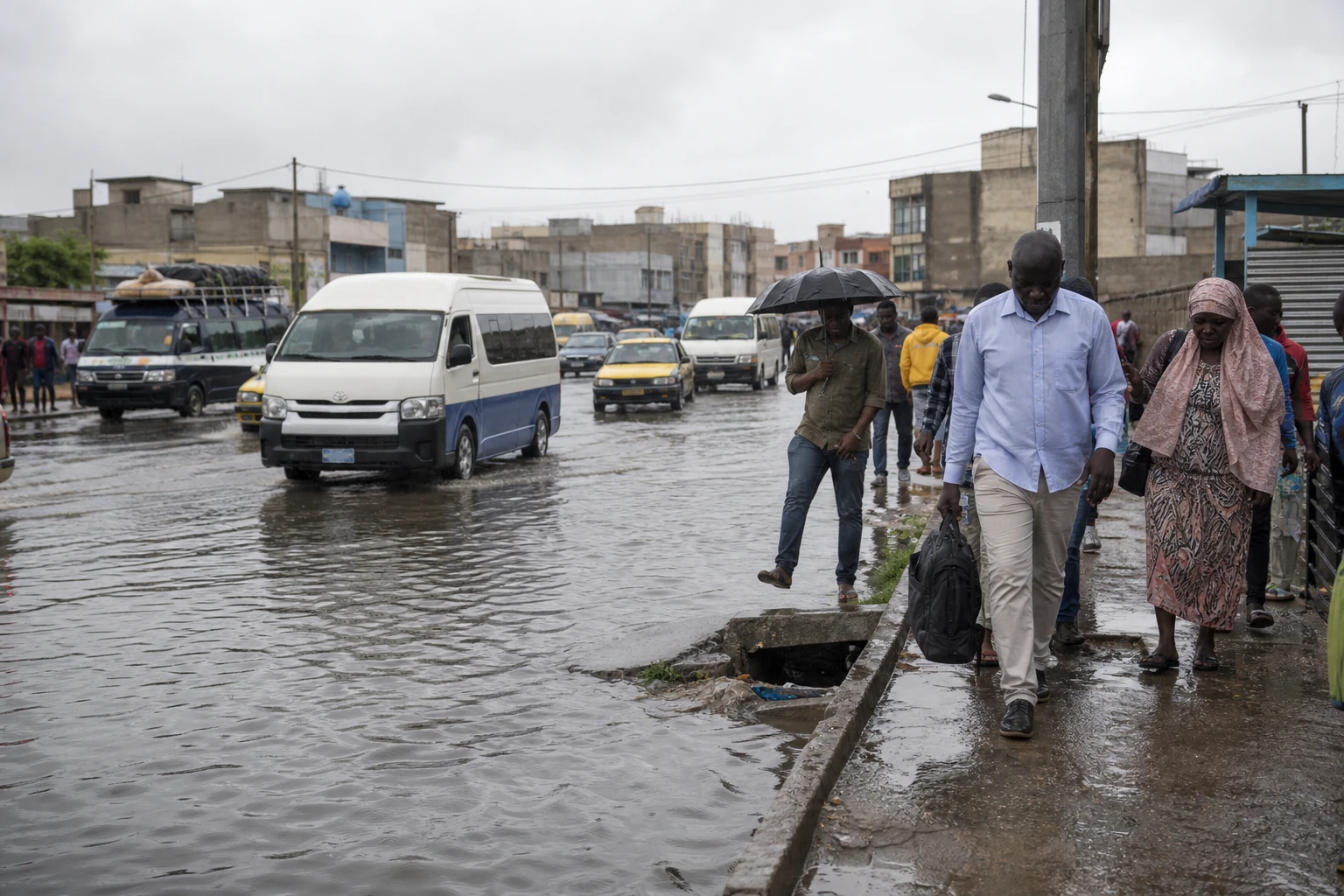
In Dakar, the rain did more than slow traffic. It once again exposed the vulnerability of several neighbourhoods to rapid runoff, as the ground remains saturated and further showers are forecast. During the night of Sunday 4 to Monday 5 October 2026, families were affected, major roads were cut off and several deaths were reported.
A difficult night in Dakar and its suburbs
The rainfall severely disrupted travel in the Senegalese capital. The motorway linking the suburbs to central Dakar was cut off near Mariama Niasse school, forcing motorists to take alternative routes. The Voie de dégagement nord quickly became congested, while some workers were unable to reach their workplaces.
In several areas of Pikine, Diamaguène and Mbao, water flooded streets and made it difficult for residents to get around. Local people used carts to cross the worst-affected areas. In Mbao, rising water levels in the marigot caused concern for nearby homes.
Neighbourhoods in Guédiawaye were also affected. In Keur Massar, overflowing basins caused material damage. In Parcelles Assainies, homes were flooded, particularly in the Unité 7 area.
In this neighbourhood, a 25-year-old woman and her four-year-old son died in their home. The Ministry of the Interior linked the tragedy to rising waters and the collapse of a wall at the family compound. The information was reported by the authorities and corroborated by several Senegalese media outlets.
The situation is not confined to Dakar. In Gourel Serigne, in the Matam region, the collapse of a hangar killed one person and injured two, according to information confirmed with the family of one victim. In Kaolack, the circumstances surrounding the collapse of a building were still being assessed on Monday 5 October.
Exceptional rainfall totals recorded by ANACIM
Data from the National Agency for Civil Aviation and Meteorology show the scale of the rainfall episode. The highest provisional totals reached 142 millimetres in 24 hours in Rufisque and Ranérou. The Dakar-Yoff station recorded 138 millimetres, while Blaise Diagne International Airport recorded 76 millimetres.
Other localities also received significant amounts. ANACIM measured 63 millimetres in Podor, 47 in Kaolack, 39 in Linguère and 33 in Saint-Louis. These figures may still be adjusted after readings from all weather stations have been consolidated.
The agency forecasts further rain and thunderstorms during the day on Monday 5 October. The regions of Dakar, Thiès, Diourbel, Louga, Saint-Louis, Ziguinchor, Sédhiou, Kolda, Tambacounda and Kédougou remain at risk of showers. Areas already flooded are the most vulnerable, as drains and retention basins have less capacity to absorb further rainfall.
The official forecasts from ANACIM therefore call for caution in areas where water is standing, near weakened structures and on roads that are difficult to use.
Death toll still provisional
In an initial situation report published overnight from Sunday to Monday, the Ministry of the Interior reported fatalities, injuries, flooding and material damage in several regions. The government has not, however, released a definitive national toll.
This caution is necessary. In the first hours of a disaster, information comes in unevenly from neighbourhoods, municipalities and emergency services. Deaths reported in other parts of Dakar, including Grand-Yoff, were still awaiting official confirmation on Monday morning.
Firefighters and local authorities were mobilised for rescue work, damage assessments and assistance to those affected. Governors, prefects and sub-prefects are to co-ordinate operations in the affected areas. The authorities are asking residents not to enter flooded roads and to avoid buildings showing cracks or signs of instability.
The recurring question of urban planning
In Dakar, flooding is not explained by the intensity of the rain alone. It is also the result of rapid urbanisation, construction in low-lying areas, soil sealing and the persistent limitations of drainage networks.
The suburbs bear much of the burden. Densely populated neighbourhoods sometimes have narrow roads, incomplete networks and poorly maintained basins. The consequences vary between households. Families living in precarious homes face a direct threat to their safety, while informal-sector workers may lose a full day’s income when transport is disrupted.
Formal economic activity is also affected. Traffic jams slow deliveries, business travel and access to services. In peripheral municipalities, schools, markets and health centres can become difficult to reach, even when their buildings are not directly damaged.
The Senegalese government convened an emergency meeting at the Prime Minister’s Office to review the situation. President Bassirou Diomaye Faye expressed his sadness and offered his condolences to the victims’ families. The immediate response will nevertheless need to be followed by longer-term work on drainage, infrastructure maintenance and control of development in exposed areas.
An issue extending beyond the capital
The early October rains are a reminder that hydrological risk affects several regions of Senegal. Matam, Kaolack, Saint-Louis, Thiès and the southern territories can experience different impacts depending on their topography, networks and proximity to waterways.
At the level of ECOWAS, the Economic Community of West African States, the issue is linked to shared challenges around urbanisation, warning systems and the circulation of meteorological data. Episodes of intense rainfall can simultaneously affect transport, agriculture, markets and essential services in several neighbouring countries.
In the immediate term, Senegal must monitor the showers forecast through Tuesday 6 October 2026 while updating the toll of deaths and material damage. The priority remains protecting people already at risk. But the episode also raises a fundamental question: how can Dakar and other Senegalese cities adapt their urban planning to rains that may be brief, yet intense enough to disrupt an entire territory ?