Algeria
 Egypt
 Libya
 Morocco
 Sudan
 Tunisia
 Benin
 Burkina Faso
 Cabo Verde
 Côte d'Ivoire
 Guinea
 Guinea-Bissau
 Liberia
 Mali
 Mauritania
 Niger
 Nigeria
 Senegal
 Sierra Leone
 The Gambia
 Togo
 Cameroon
 Central African Republic
 Chad
 DR Congo
 Equatorial Guinea
 Gabon
 Republic of the Congo
 São Tomé and Príncipe
 Burundi
 Comoros
 Djibouti
 Eritrea
 Ethiopia
 Kenya
 Madagascar
 Malawi
 Mauritius
 Mozambique
 Rwanda
 Seychelles
 Somalia
 South Sudan
 Tanzania
 Uganda
 Angola
 Botswana
 Eswatini
 Lesotho
 Namibia
 South Africa
 Zambia
 Zimbabwe
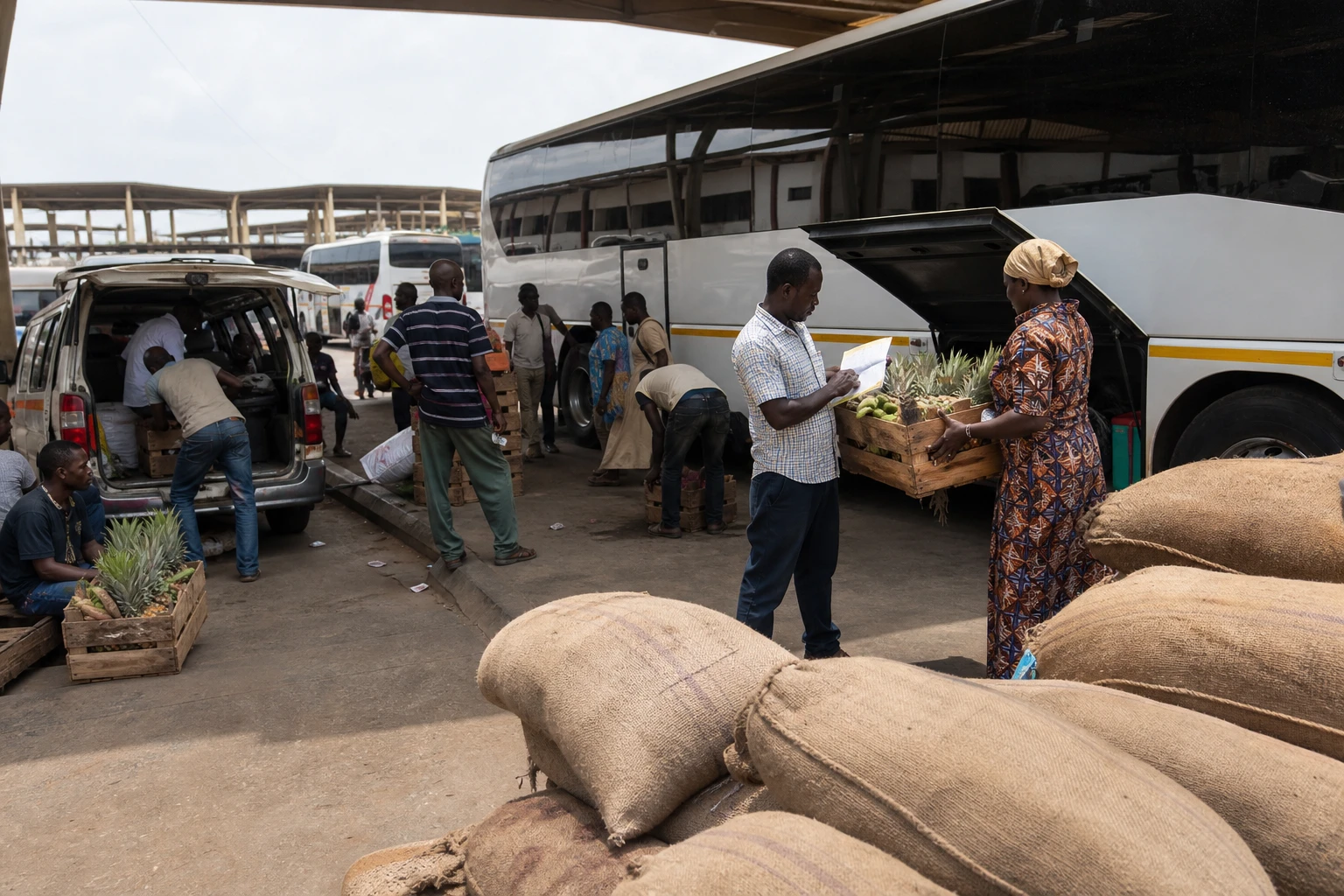
Ghana sells more agro-food products to the European Union than it buys. But this favourable balance still rests largely on cocoa. For Accra, the challenge is therefore no longer simply to export. It is also to process more products locally and remain competitive as European rules become increasingly specific.
A trade surplus driven by cocoa
Ghanaian exports of agricultural and food products to the European Union are estimated to have reached €2.91 billion in 2025, up from €1.73 billion in 2024. This represents an increase of 68.7%, according to European Commission data cited in the available trade data.
Cocoa accounts for the bulk of this performance, however. Beans, butter, paste and cocoa-based preparations are estimated to have accounted for about €2.63 billion in 2025. This means that more than nine euros in every ten exported to the European Union came from this sector.
Tree nuts, nuts, oils and vegetable fats account for a smaller share. This structure shows Ghana’s strength in the cocoa market. It also highlights the vulnerability of a trade relationship that depends too heavily on a single value chain.
The country nevertheless has other strengths. Its agricultural sector includes pineapples, mangoes, bananas, palm oil, rubber and several processed products. The challenge is to connect these products to European markets without undermining domestic supply or producers’ incomes.
Accra seeks to move from trade to partnerships
This shift will be at the heart of the EU-Ghana Agribusiness Exhibition & Forum, scheduled for 28 and 29 October 2026 in Accra. The event is expected to bring Ghanaian and European businesses together to discuss trade, investment and agro-food partnerships. The Ghana Netherlands Business & Culture Council, which is supporting its organisation with EuroCham Ghana and other partners, has announced the theme “Where Europe Meets Ghana”.
The choice of Accra is no accident. The capital is home to government departments, financial services, exporting businesses and some of the country’s logistics infrastructure. However, the success of an agro-food strategy will also be determined in producing regions, far from offices and trade fairs.
For co-operatives and small businesses, access to finance remains crucial. Storage, the cold chain, certification and consistent volumes also need to improve. Without these capabilities, producers may sell a quality raw material without capturing a sufficient share of its value.
The Ghanaian government has sought for several years to strengthen local processing. This approach responds to a structural problem: export revenues can rise without industrial processing, skilled employment and rural incomes increasing at the same pace.
Trade is imbalanced, but in both directions
European agro-food imports into Ghana are estimated to have reached €775 million in 2025, up from €684 million in 2024. They therefore remain below Ghanaian exports to the European Union.
The relationship is not limited to cocoa purchases, however. Animal products were the largest category of EU exports to Ghana, at €337 million, or 43.5% of the total. Poultry and eggs are estimated to have accounted for €185 million. Dairy products reached €80 million, ahead of beef and veal, at €45 million.
Plant products and arable crops totalled €182 million. Beverages, wines and food preparations accounted for €163 million. This mix puts pressure on local businesses already operating in an environment shaped by transport costs, fluctuations in the cedi and difficulties accessing inputs.
The impact on Ghanaian consumers varies by product and location. Imports can support supply in cities, particularly Accra and Kumasi. They can also intensify competition for local producers when international prices fall or imported products benefit from economies of scale.
European standards become a trade issue
The next challenge is compliance. The EU regulation on deforestation-linked products, known as the EUDR, covers cocoa, coffee, rubber, palm oil, soya, wood and cattle, among other products. It requires businesses to demonstrate that products do not come from land deforested after 31 December 2020.
The regulation is due to start applying to large and medium-sized companies on 30 December 2026. Most micro and small businesses will have an additional period, until 30 June 2027. Operators will need, among other things, to strengthen plot-level traceability, data collection and due diligence statements.
For the cocoa sector, this requirement could speed up the formalisation of supply chains. It could also create significant costs for small producers and co-operatives. The outcome will therefore depend on the support provided by Ghanaian authorities, buyers and technical partners.
Other rules will also come into play. The EU regulation on packaging and packaging waste, which will be phased in from 12 August 2026, strengthens requirements on recyclability, packaging reduction and reuse. From 14 December 2027, the EU Forced Labour Regulation will prohibit the marketing of products made using forced labour.
The next test will be value addition
For Ghana, its relationship with the European Union provides a solid foundation. It does not, however, guarantee an automatic move up the value chain. The country will need to invest in cocoa processing, food safety, agricultural data and infrastructure linking production areas to ports.
The issue also concerns the Economic Community of West African States, ECOWAS. A Ghanaian business better integrated into European supply chains could become a regional supplier. Conversely, complex standards and high costs could exclude small businesses and limit the benefits to a handful of exporters.
Across the continent, the issue illustrates a central challenge for the African Continental Free Trade Area: selling more processed products rather than shipping mainly raw materials. The discussions in Accra in October 2026 will show whether the announced partnerships genuinely serve this ambition.