
 Algeria
 Egypt
 Libya
 Morocco
 Sudan
 Tunisia
 Benin
 Burkina Faso
 Cabo Verde
 Côte d'Ivoire
 Ghana
 Guinea
 Guinea-Bissau
 Liberia
 Mali
 Mauritania
 Niger
 Nigeria
 Senegal
 Sierra Leone
 The Gambia
 Togo
 Cameroon
 Central African Republic
 Chad
 Equatorial Guinea
 Gabon
 Republic of the Congo
 São Tomé and Príncipe
 Burundi
 Comoros
 Djibouti
 Eritrea
 Ethiopia
 Kenya
 Madagascar
 Malawi
 Mauritius
 Mozambique
 Rwanda
 Seychelles
 Somalia
 South Sudan
 Tanzania
 Uganda
 Angola
 Botswana
 Eswatini
 Lesotho
 Namibia
 South Africa
 Zambia
 Zimbabwe
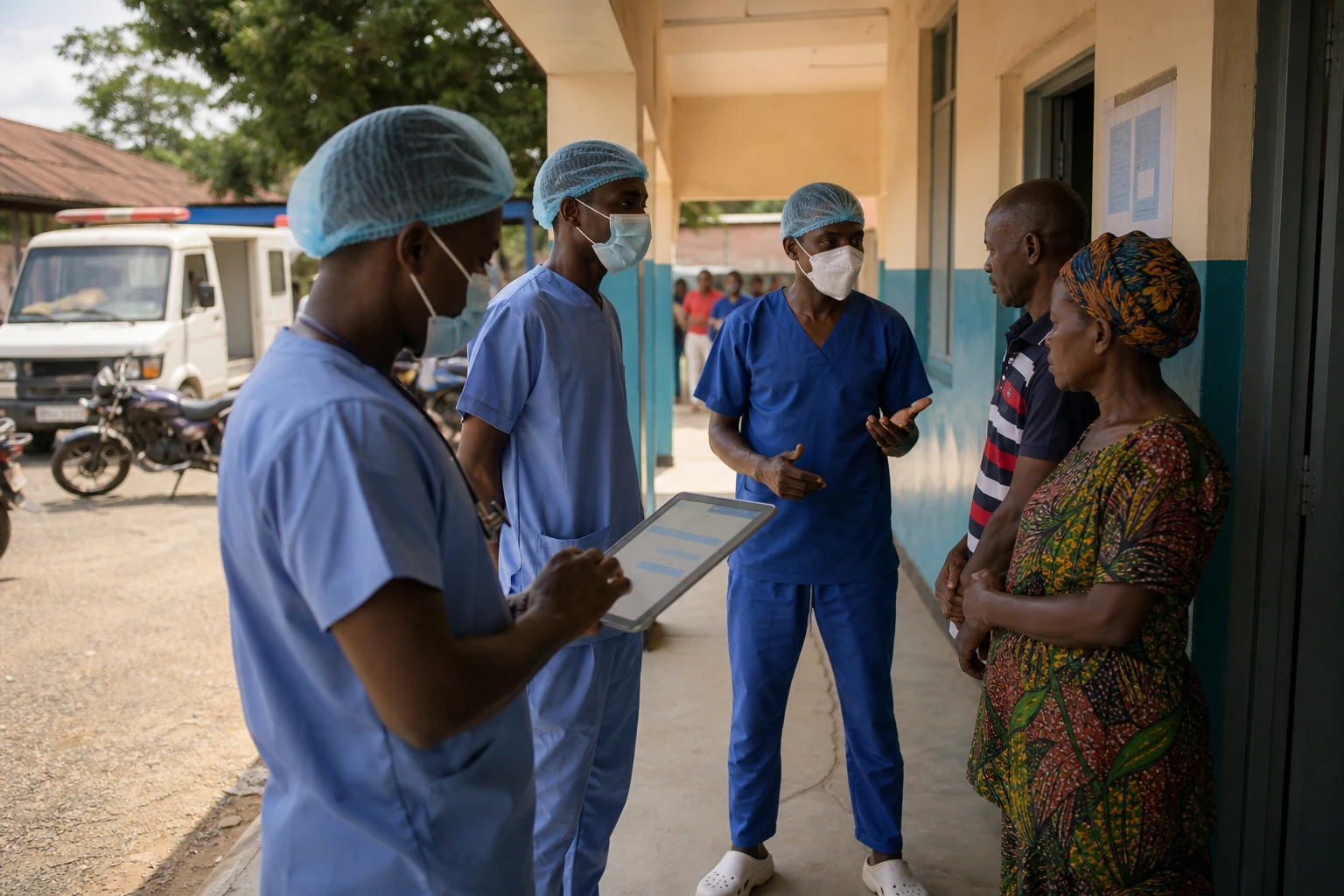
In the Democratic Republic of the Congo, the death toll passing 4,000 confirms the exceptional scale of the Ebola outbreak declared in May 2026. The response is making progress in some areas, but transmission remains active in several provinces. The challenge is no longer limited to treating patients. It also involves maintaining surveillance, restoring trust and ensuring that funding can be traced.
A heavy toll as the outbreak continues to spread
According to figures released on 2 October by the National Institute of Public Health, the outbreak has recorded 8,300 confirmed cases and 4,018 deaths. The case fatality rate stands at 48.4%, or nearly one death for every two confirmed cases. The institute also reports 2,162 people who have recovered and 842 patients who remain in isolation or hospital.
These figures remain provisional. Health authorities say they may change once data from the provinces have been consolidated and harmonised. This caveat is important in a crisis where laboratory results, community deaths and patient records are sometimes logged late.
The national toll nevertheless confirms a trend already observed by the World Health Organisation. In its situation update published on 25 September, the WHO reported 7,890 confirmed cases and 3,799 deaths as of 23 September. It had then recorded cases in 63 health zones across seven provinces: Ituri, North Kivu, South Kivu, Bas-Uélé, Haut-Uélé, Tshopo and South Ubangi.
The difference between the two sets of figures is mainly explained by the outbreak’s spread and the regular updating of data. On its own, it does not indicate a sudden acceleration in transmission. It does, however, confirm that the 8,000-case threshold was passed within a few days.
Uneven outbreaks across the provinces
Ituri remains the national epicentre. As of 23 September, the province had recorded 6,032 confirmed cases since the outbreak began. North Kivu followed with 1,480 cases. These two provinces account for most of the virus’s spread and face difficulties with access, frequent population movements and significant pressure on health facilities.
The situation nevertheless varies sharply from one area to another. The WHO reported that 48 health zones had recorded at least one case in the 21 days before its report. South Kivu, by contrast, had reported no new cases since 29 May. This difference shows why a national average can mask widely divergent local realities.
In North Kivu, the case fatality rate stood at 59.7% as of 23 September, according to the WHO. The organisation is continuing its investigations to understand this particularly high level. Delays in detection, late arrival at care centres and deaths within communities can all worsen the toll.
Community deaths are a critical indicator. When someone dies at home without having been identified or treated, relatives may be exposed to the virus while caring for them or during funeral rites. Contact tracing then becomes more difficult. As of 2 October, the overall contact-tracing rate reported by the National Institute of Public Health stood at 80.6%, below the level sought to break chains of transmission quickly.
Trust and security at the heart of the response
The health response is taking place in an environment marked by insecurity, population displacement and limited access to some essential services. In several territories, these constraints hamper the work of teams tasked with finding cases, tracing contacts and organising safe burials.
The WHO also says that attacks on health facilities and response teams disrupt surveillance. They can deter families from seeking care and delay the isolation of patients. Tackling Ebola therefore depends as much on medical capacity as on the ability to reach neighbourhoods, villages and transport routes.
This reality requires a response built with communities. Local authorities, religious leaders, associations and community health workers play an essential role in explaining symptoms, directing patients to care and encouraging acceptance of preventive measures. Trust cannot be decreed from Kinshasa. It is built through direct engagement with the communities concerned.
The Minister of Public Health, Hygiene and Social Welfare, Roger Samuel Kamba, nevertheless said some indicators gave reason to hope for an improvement. Speaking at a press conference in Kinshasa on 2 October, he argued that the response was better prepared, while acknowledging the need to continue efforts in areas where the outbreak remains active.
Funding debate takes on a political dimension
Management of resources has become another front in the crisis. Roger Samuel Kamba says the first response plan, set to run for three months, mobilised about $227m. According to him, nearly $99m remains unused or insufficiently documented by partners working on the ground.
The minister said that, at that point, about 25% of the 97 partners identified had accounted for the resources mobilised for the DRC. The government now wants to make access to the field conditional on accreditation and the disclosure of information about the origin and use of funds.
This demand addresses a genuine transparency issue. It also raises an operational question. Humanitarian organisations play an important role in care, logistics, surveillance and staff protection. Any administrative measure that slows their work could weaken the response, especially in hard-to-reach provinces.
The debate is therefore less a clash between the state and its partners than a question of coordination. The Congolese authorities want greater visibility over resources mobilised in the DRC’s name. Organisations working on the ground, for their part, must be able to document their spending without interrupting services for patients and communities.
A regional risk that extends beyond Congo’s borders
The outbreak directly affects the countries neighbouring the Democratic Republic of the Congo. Haut-Uélé shares a border with South Sudan. Other affected areas lie close to Uganda, Rwanda and the Central African Republic. The movement of traders, families, aid workers and patients makes coordinated border surveillance essential.
The WHO considers the risk very high in the DRC and high in countries sharing a land border with it. It nevertheless recommends against general restrictions on travel or trade. The priority is screening, information-sharing and the prompt treatment of suspected cases.
The response therefore involves a framework that extends beyond the Congolese administration alone. The World Health Organisation, health authorities in neighbouring countries, humanitarian actors and African institutions must maintain their coordination mechanisms. The next challenge will be to turn the decline observed in some outbreak areas into a sustained national fall, without neglecting newly affected areas.
As of 2 October 2026, the Democratic Republic of the Congo is not facing a controlled outbreak, but a crisis with an uneven trajectory. Recoveries and improved surveillance offer signs of hope. However, the persistence of community deaths, insecurity and funding tensions are reminders that ending transmission will depend as much on trust and coordination as on medical resources.



