
 Algeria
 Egypt
 Libya
 Morocco
 Sudan
 Tunisia
 Benin
 Burkina Faso
 Cabo Verde
 Côte d'Ivoire
 Ghana
 Guinea
 Guinea-Bissau
 Liberia
 Mali
 Mauritania
 Niger
 Nigeria
 Senegal
 Sierra Leone
 The Gambia
 Togo
 Cameroon
 Central African Republic
 Chad
 Equatorial Guinea
 Gabon
 Republic of the Congo
 São Tomé and Príncipe
 Burundi
 Comoros
 Djibouti
 Eritrea
 Ethiopia
 Kenya
 Madagascar
 Malawi
 Mauritius
 Mozambique
 Rwanda
 Seychelles
 Somalia
 South Sudan
 Tanzania
 Uganda
 Angola
 Botswana
 Eswatini
 Lesotho
 Namibia
 South Africa
 Zambia
 Zimbabwe
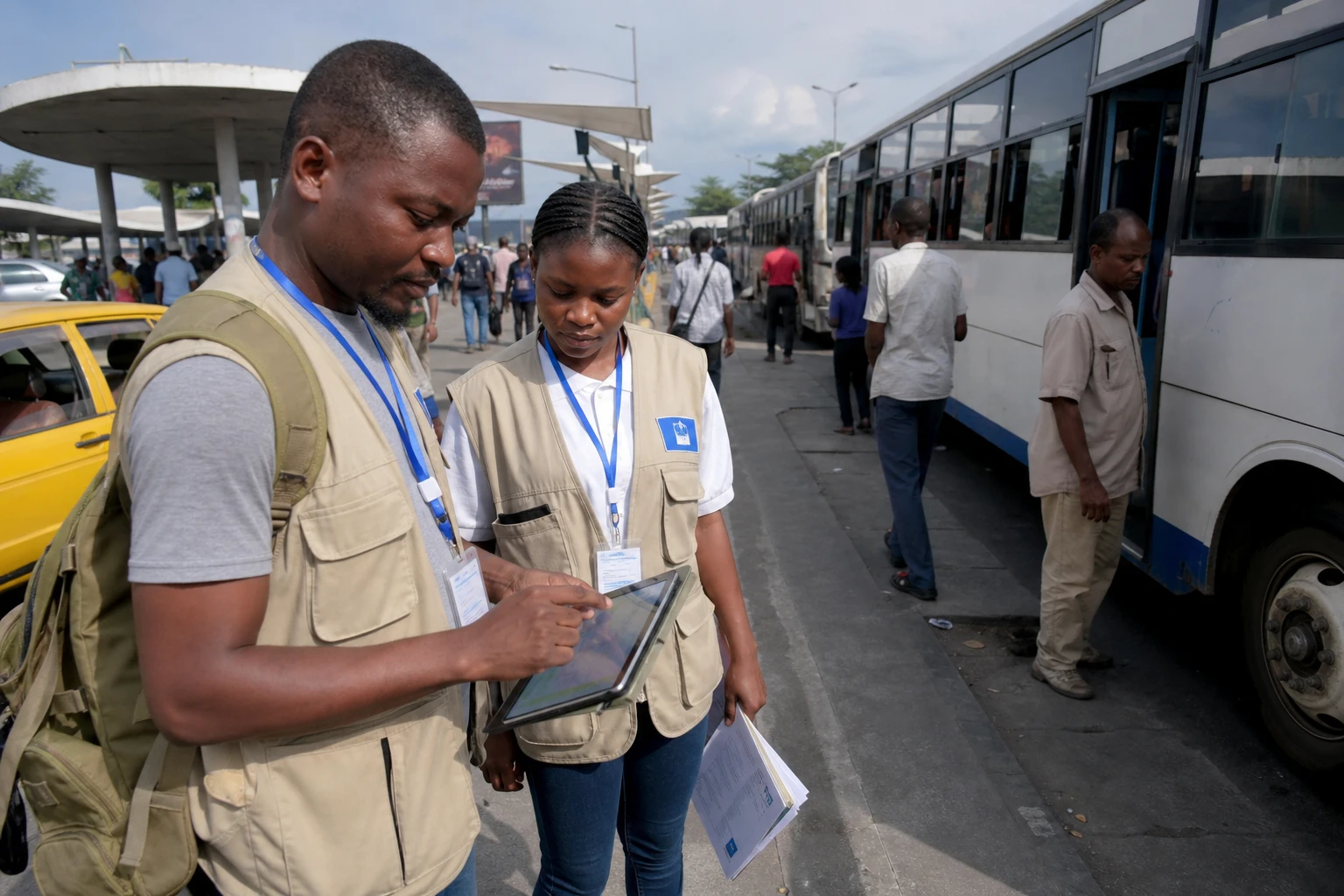
In Kinshasa and in the country’s most remote territories, the Democratic Republic of the Congo is finally beginning to update its human map. The operation is intended to answer a simple but decisive question: how many people actually live in each province, city and rural area of the country?
A preparatory operation before the population count
The Ministry of Planning launched census mapping for the second General Population and Housing Census, known as RGPH2, in Kinshasa on Monday 28 September 2026. This stage comes before the actual enumeration, which will involve counting residents and housing.
Census mapping is used to divide the territory into working areas. Agents must identify neighbourhoods, villages, households and infrastructure. They will thus prepare the routes and boundaries that will guide teams during the final data collection.
The Central Census Bureau plans to use digital tools, including tablets and geographical data-collection applications. The old zones established during the 1984 census can no longer be used directly in digital format. They must therefore be updated and adapted to the current administrative divisions.
Mapping operators are being trained at several sites. Recruitment includes team leaders and agents responsible for fieldwork. The system is intended to cover the entire national territory, with the exception of Kinshasa for certain recruitment operations announced by the census technical bodies.
Forty-two years without a general census
The last scientific census of the Congolese population dates back to 1 July 1984, when the country was still called Zaire. It remains the only nationwide operation of its kind carried out since independence.
Since then, the population has grown considerably. The United Nations Population Fund estimates that it now exceeds 112 million. In 1984, the country had about 30 million people. These current figures remain estimates, however, and are not the result of a recent comprehensive count.
This long interruption makes public planning more difficult. The authorities must plan schools, health centres, roads, water networks and administrative services using data that do not always provide a precise picture of where people live.
The problem varies in intensity from one territory to another. Kinshasa is experiencing rapid urban growth. In rural provinces, populations are often scattered across vast areas. In the east of the country, displacement linked to conflicts and humanitarian crises also makes demographic monitoring more difficult.
A budget of nearly $200 million
The operation’s projected budget is estimated at $192 million, or nearly $200 million. In March 2026, UNFPA said that 83 % of the necessary funding had been secured, including $30 million provided by the Congolese state.
This funding is intended to cover technical preparation, mapping, training, agents’ pay, data collection and processing. The size of the country inevitably increases costs. DR Congo is Africa’s second-largest country, and its road network remains uneven across the provinces.
The financial issue is therefore not limited to the announced amount. It also concerns the regularity of disbursements, logistics in hard-to-reach areas and the ability to keep teams in the field. A delay in a single phase can push back the entire timetable.
The statistical authorities will also need to maintain households’ trust. Agents will have to explain the census’s purpose, guarantee the confidentiality of responses and clearly distinguish the operation from a tax, electoral or migration check.
Data to help the state and local authorities
A census does more than produce a national figure. It provides information on residents’ age, sex, place of residence and housing conditions. It also helps measure disparities between provinces, cities and rural areas.
For the government, this information could improve the distribution of public resources. It could also guide the construction of schools in areas where the school-age population is growing, or the opening of maternity units in territories that lack them.
Provinces and decentralised territorial entities also need up-to-date data. Local officials will be better able to estimate needs for markets, transport, sanitation and jobs. Economic stakeholders will also have a firmer basis for assessing demand in different population centres.
The results will nevertheless need to be interpreted with caution. A demographic snapshot does not automatically solve problems of access to services. Rather, it gives public authorities a tool for setting priorities and measuring progress.
A national issue that extends beyond DR Congo’s borders
The success of RGPH2 is also of interest to Central and Southern Africa. DR Congo is a member of the Southern African Development Community, SADC, a regional organisation that coordinates several economic and social policies among its member states.
Reliable data can help with planning trade corridors, energy networks and infrastructure linking DR Congo to its neighbours. It can also improve analysis of population movements in a region shaped by cross-border exchanges and mobility linked to crises.
At African Union level, the census forms part of a broader effort to strengthen national statistics. For Kinshasa, however, the immediate challenge is operational: turning the mapping launched on 28 September 2026 into a complete and credible count that reaches all communities.
The next step will therefore be the gradual deployment of teams in the field. The detailed enumeration timetable will need to specify the provinces involved, the collection periods and the monitoring mechanisms. After four decades of estimates, DR Congo is now seeking to establish a shared demographic baseline for its public policies.



