Egypt
 Libya
 Morocco
 Sudan
 Tunisia
 Benin
 Burkina Faso
 Cabo Verde
 Côte d'Ivoire
 Ghana
 Guinea
 Guinea-Bissau
 Liberia
 Mali
 Mauritania
 Niger
 Nigeria
 Senegal
 Sierra Leone
 The Gambia
 Togo
 Cameroon
 Central African Republic
 Chad
 DR Congo
 Equatorial Guinea
 Gabon
 Republic of the Congo
 São Tomé and Príncipe
 Burundi
 Comoros
 Djibouti
 Eritrea
 Ethiopia
 Kenya
 Madagascar
 Malawi
 Mauritius
 Mozambique
 Rwanda
 Seychelles
 Somalia
 South Sudan
 Tanzania
 Uganda
 Angola
 Botswana
 Eswatini
 Lesotho
 Namibia
 South Africa
 Zambia
 Zimbabwe
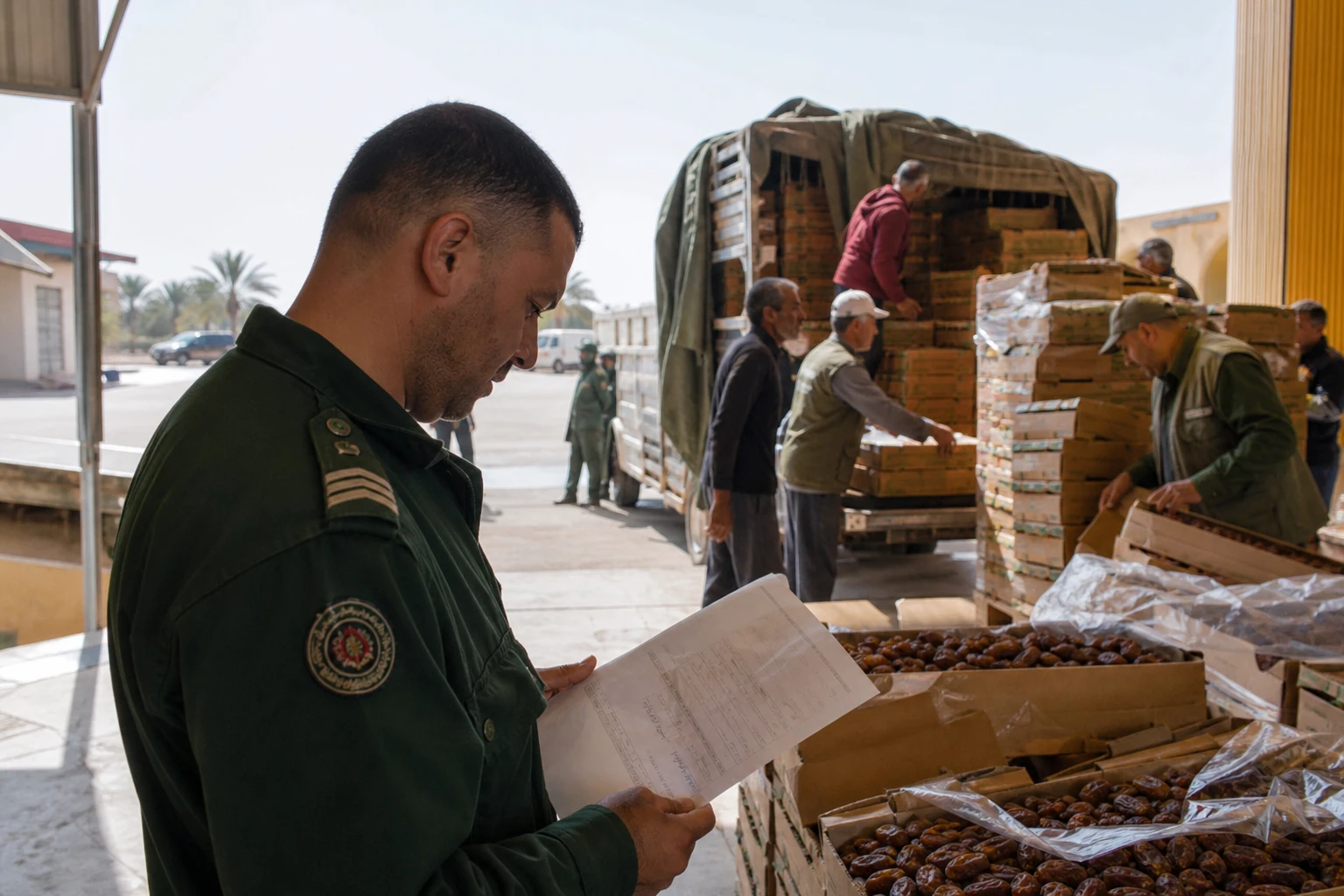
In the oases of southern Algeria, the contest is no longer just about the number of dates sold abroad. It is now about their real value, the traceability of transactions and the return of foreign-currency earnings to Algeria. The new export price controls therefore present a major test for a sector seeking to turn its agricultural weight into lasting revenue.
African leader, but that is not the whole story
According to trade data compiled by the Trade Map platform, Algeria is estimated to have shipped about 185,000 tonnes of dates in 2025. These sales are estimated to have generated nearly $184 million. By volume, the country ranks ahead of Tunisia, at about 147,000 tonnes, followed by Egypt, Libya and South Africa.
This ranking, however, measures reported trade flows. It is not enough to compare the profitability of the two main Maghreb date industries. The calculation puts the average value of Algerian dates at about $993 per tonne, compared with more than $2,300 for Tunisian dates. This difference may reflect quality, the varieties sold, the degree of processing and the markets targeted.
The product mix matters greatly. Algeria exports several categories of dates, including varieties intended for direct consumption and others used in lower-value markets. Tunisia relies more heavily on the commercial reputation of Deglet Nour, particularly dates produced in the regions of Kébili and Tozeur.
The Algerian sector nevertheless retains considerable potential. The wilayas of Biskra, El Oued and Ouargla account for a significant share of the palm groves and packing activity. National production is estimated to have reached about 1.34 million tonnes in 2024, according to figures reported from the Food and Agriculture Organization of the United Nations’ statistics. The issue, then, is not a lack of volume, but the ability to extract more value from it.
Price controls become a tool for traceability
The debate grew in scale after an intervention by President Abdelmadjid Tebboune in May 2026. The head of state referred to under-invoicing practices in non-hydrocarbon exports. He cited the case of dates sold abroad for one euro per kilogram but declared at only 20 cents. He also said that $350 million in export earnings had not been repatriated over a recent period.
These amounts concern several sectors. They do not make it possible to isolate the share attributable to dates. The figure should therefore be read as an indication of the authorities’ concern, not as a definitive financial assessment of the date industry.
The administrative response took effect on 1 July 2026. Algeria’s Ministry of Foreign Trade and Export Promotion set reference prices according to the variety and quality of dates. The scale is reported to range from $0.80 to $2.50 per kilogram. Details of the system were reported by the Algerian specialist press and presented as part of a broader strengthening of oversight of commercial transactions.
The mechanism brings together banks, customs and agricultural services. An invoice below the threshold for the relevant variety cannot be domiciled through the normal process. Customs services, for their part, must check that the declared value is consistent with the documents accompanying the goods. The phytosanitary certificate must specify the variety shipped.
On paper, the system narrows the scope for undervaluing consignments. It may also improve export statistics and the repatriation of foreign currency. But its effectiveness will depend on checks in the field, the correct identification of varieties and operators’ ability to provide credible price references.
Statistics still need explaining
The 2025 figures should be compared cautiously with those for previous years. Data from UN Comtrade, reported by the World Bank, indicated that Algeria exported about 26,500 tonnes of dates in 2024, worth $87.1 million. The average value then exceeded $3,200 per tonne.
The increase from 26,500 to 185,000 tonnes in a single year represents a major statistical break. Several explanations are possible: differences in the scope of the databases, the timing of cargo registrations, the inclusion of different product categories or revisions to customs statistics. Under-invoicing may also reduce declared values, but available public data do not make it possible to measure its precise contribution to the gap.
This caution is essential. A low average value does not, on its own, prove fraud. It may also reflect a high share of common dates, bulk sales, contracts concluded in less lucrative markets or limited industrial processing. The challenge will therefore be to distinguish the effects of the export mix from those linked to irregular practices.
Volume is no longer enough to compete with Tunisia
The comparison with Tunisia highlights the commercial challenge facing Algeria. During the first ten months of the 2025-2026 season, Tunisian date exports reached 144,100 tonnes, up 13.3% year on year. They generated 908.4 million Tunisian dinars, according to data from the Tunisian National Agricultural Observatory reported by La Presse de Tunisie.
Tunisia benefits from an established commercial network. Its dates are sold in dozens of markets, with a strong presence in Europe. Deglet Nour accounted for 84% of export volumes during the period studied. The country is also developing organic products, packaging and differentiation by origin.
Algeria has an advantage in volume and a vast production basin. It must now strengthen the chain linking the palm grove to the end consumer. This means sorting, grading, packaging, certification, processing and building brands that can secure better prices for Algerian origin.
The next test will be the 2026-2027 season
The harvest beginning in autumn 2026 will be the first season fully monitored under the reference-price regime. Operators, banks and customs will have to apply the scale to actual volumes and under varying commercial conditions.
Several indicators will bear watching: the average declared value per tonne, the amount of earnings actually repatriated, the breakdown by variety and the trend in sales to the European Union. Customs statistics from importing countries will also make it possible to compare the amounts declared when goods leave Algeria with those recorded on arrival.
For Algiers, the goal therefore goes beyond the African ranking. It is to make dates an example of moving non-hydrocarbon exports upmarket. For producers in the south, the reform’s success will be measured less by announcements than by better returns for quality and more consistent access to markets. Across the Maghreb, competition will increasingly pit Algerian volumes against Tunisia’s ability to add value.