Algeria
 Egypt
 Libya
 Morocco
 Sudan
 Tunisia
 Benin
 Burkina Faso
 Cabo Verde
 Côte d'Ivoire
 Ghana
 Guinea
 Guinea-Bissau
 Liberia
 Mali
 Mauritania
 Niger
 Nigeria
 Senegal
 Sierra Leone
 The Gambia
 Togo
 Cameroon
 Central African Republic
 Chad
 Equatorial Guinea
 Gabon
 Republic of the Congo
 São Tomé and Príncipe
 Burundi
 Comoros
 Djibouti
 Eritrea
 Ethiopia
 Kenya
 Madagascar
 Malawi
 Mauritius
 Mozambique
 Rwanda
 Seychelles
 Somalia
 South Sudan
 Tanzania
 Uganda
 Angola
 Botswana
 Eswatini
 Lesotho
 Namibia
 South Africa
 Zambia
 Zimbabwe
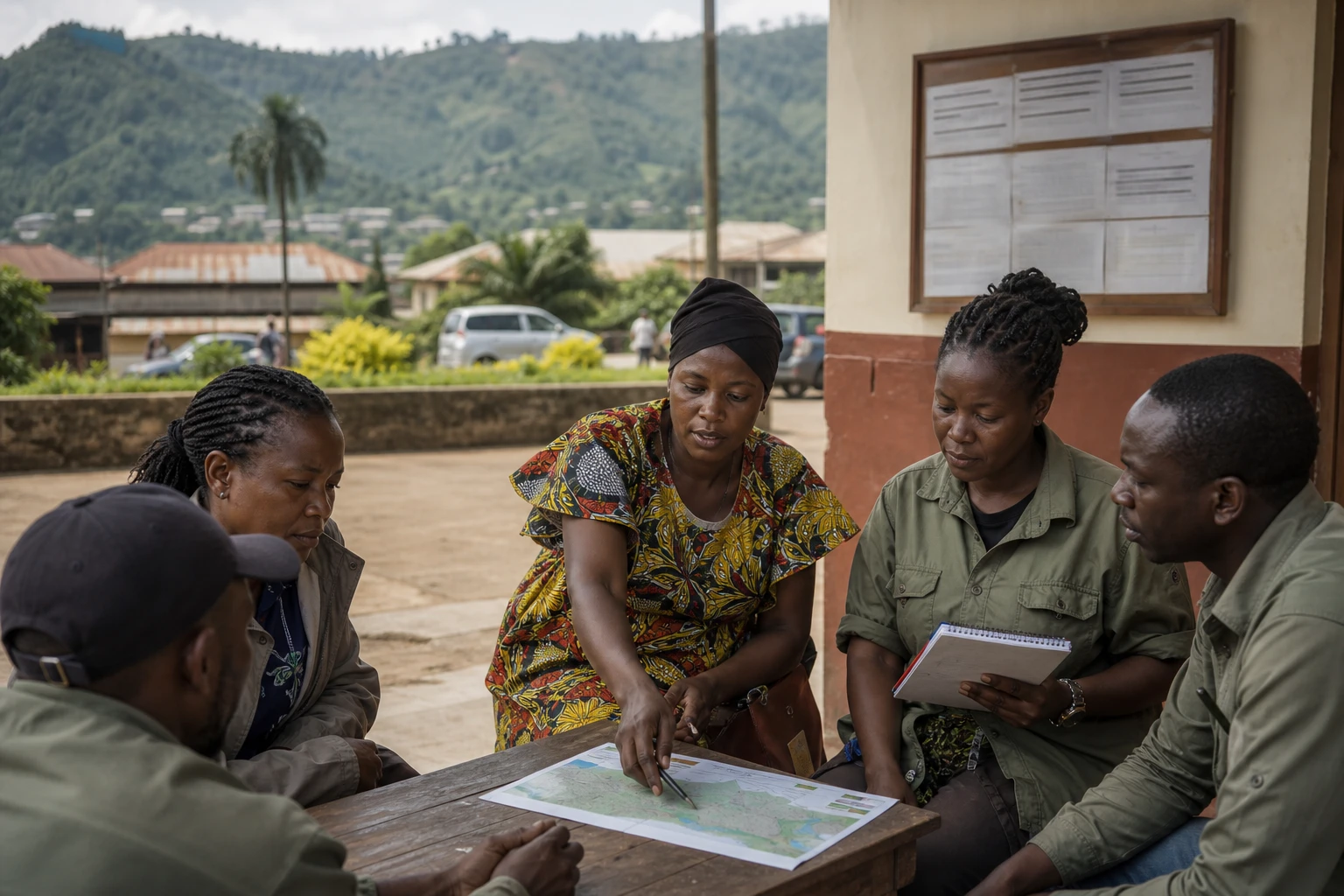
In Bukavu, the return of activities around Kahuzi-Biega National Park does not yet mean a return to normal. In the east of the Democratic Republic of the Congo, conservation now depends on a fragile balance between access to the field, the safety of teams and the participation of neighbouring communities.
The park is home to the Grauer’s gorilla, a species endemic to eastern Congo. It also protects forests between the Albertine Rift and the Congo Basin. Listed as a UNESCO World Heritage Site since 1980, Kahuzi-Biega remains one of Central Africa’s major reservoirs of biodiversity.
A park caught up in South Kivu’s instability
Kahuzi-Biega National Park is in South Kivu province, near Bukavu. Its location places it at the heart of a region marked by armed clashes, population displacement and the movement of armed groups.
The worsening security situation in eastern DR Congo has sharply reduced the presence of eco-guards in several parts of the park. On 26 January 2025, the M23 fighters’ and allied forces’ capture of Goma further complicated the protection of the region’s natural sites, according to UNESCO’s World Heritage Committee.
South Kivu is part of the Southern African Development Community, or SADC. This regional organisation is involved in security and co-operation issues, but the park’s conservation depends first and foremost on the ability of Congolese authorities and local actors to maintain an effective presence on the ground.
In this context, access to some areas of the park has become irregular. Patrols, scientific monitoring and visitor supervision cannot be maintained as consistently as before the crisis.
Gorilla monitoring halted in several areas
Arthur Kalonji, the park’s director, told reporters in Bukavu that conservation teams could no longer access some parts of the site as normal. This is preventing them, in particular, from monitoring gorilla groups and assessing changes in their numbers.
The director compared the park to a house with no doors. The image sums up the problem: when teams withdraw, illegal activities can expand more easily. Deforestation, mining, hunting and the bushmeat trade have long placed pressure on the ecosystem.
The Grauer’s gorilla is classified as critically endangered. An assessment cited by UNESCO reported a very sharp decline in its population across its range. The observed fall was particularly severe in the park’s low-altitude areas.
These figures do not, however, establish how many gorillas currently live across Kahuzi-Biega as a whole. Surveys conducted in 2024 were expected to provide new information, but access restrictions and insecurity are complicating the publication and interpretation of the results.
The figure of 1,500 gorillas sometimes cited for the period before the war should therefore be treated with caution. It is not an up-to-date census. Above all, it points to the scale of the feared losses and the urgency of resuming regular scientific monitoring.
Activities are resuming only gradually
The park has announced a gradual resumption of some conservation operations. This includes mobilising eco-guards, raising awareness and monitoring accessible areas. It does not mean that the entire park is secure.
Kahuzi-Biega’s official website also says that the park remains temporarily closed to visitors. This clarification is important to avoid confusing the administrative or scientific resumption of some activities with the full reopening of tourism.
Before the crisis, gorilla visits were one of the park’s main activities. Kahuzi-Biega is described as the only site where tourists can observe Grauer’s gorillas living in the wild. Tourism, however, is only one part of conservation.
Revenue from visits supports direct and indirect jobs. These include guides, trackers, drivers, accommodation providers, small businesses and various visitor services. When tourists disappear, the effects are felt beyond the park’s boundaries, particularly in Bukavu’s neighbourhoods and nearby rural areas.
For eco-guards, the suspension of patrols increases occupational risks and reduces the ability to document threats. For neighbouring communities, the closure of tourist routes deprives some families of income. At the same time, a lack of alternatives can increase dependence on forest resources.
Conservation cannot rely on surveillance alone
Professor Bertin Murhabale, a specialist in ecology and animal-resource management, is calling for greater involvement from the authorities, UNESCO and local communities. His approach echoes recommendations regularly made for the park: protect habitats, ensure the safety of teams and involve local people in decision-making.
This is essential in a region where thousands of people live around the protected area. Indigenous and local communities have detailed knowledge of the forest. They must be able to take part in conservation programmes and benefit from economic activities compatible with protecting the park.
Combating illegal mining is also a central challenge. For several years, UNESCO has identified mining and associated hunting as major threats to Grauer’s gorillas and eastern chimpanzees. Without controls on supply chains and a sustained state presence, occasional operations risk producing limited results.
The park has therefore launched awareness-raising activities with the media, scientists, tourism professionals and civil society organisations. The aim is to keep the issue in the public debate, despite the priority given in the news to clashes and humanitarian emergencies.
An issue for DR Congo and the Congo Basin
The fate of Kahuzi-Biega extends beyond South Kivu. The park forms an ecological link between mountain forests and low-altitude areas. Its degradation would threaten the habitats of a species that the Democratic Republic of the Congo is the only country to host in the wild.
It would also undermine the credibility of DR Congo’s commitments on biodiversity and protection of the Congo Basin. The region plays a major role in regulating the climate, ensuring water availability and conserving unique species.
The next step will be to restore reliable monitoring of gorillas, area by area, while ensuring the safety of teams. The conditions for a managed reopening to tourism will then need to be determined. This can be sustainable only if it is based on scientific data, a minimum level of security and a genuine sharing of benefits with neighbouring communities.