
 Algeria
 Egypt
 Libya
 Morocco
 Sudan
 Tunisia
 Benin
 Burkina Faso
 Cabo Verde
 Côte d'Ivoire
 Ghana
 Guinea
 Guinea-Bissau
 Liberia
 Mali
 Mauritania
 Niger
 Nigeria
 Senegal
 Sierra Leone
 The Gambia
 Togo
 Cameroon
 Central African Republic
 Chad
 Equatorial Guinea
 Gabon
 Republic of the Congo
 São Tomé and Príncipe
 Burundi
 Comoros
 Djibouti
 Eritrea
 Ethiopia
 Kenya
 Madagascar
 Malawi
 Mauritius
 Mozambique
 Rwanda
 Seychelles
 Somalia
 South Sudan
 Tanzania
 Uganda
 Angola
 Botswana
 Eswatini
 Lesotho
 Namibia
 South Africa
 Zambia
 Zimbabwe
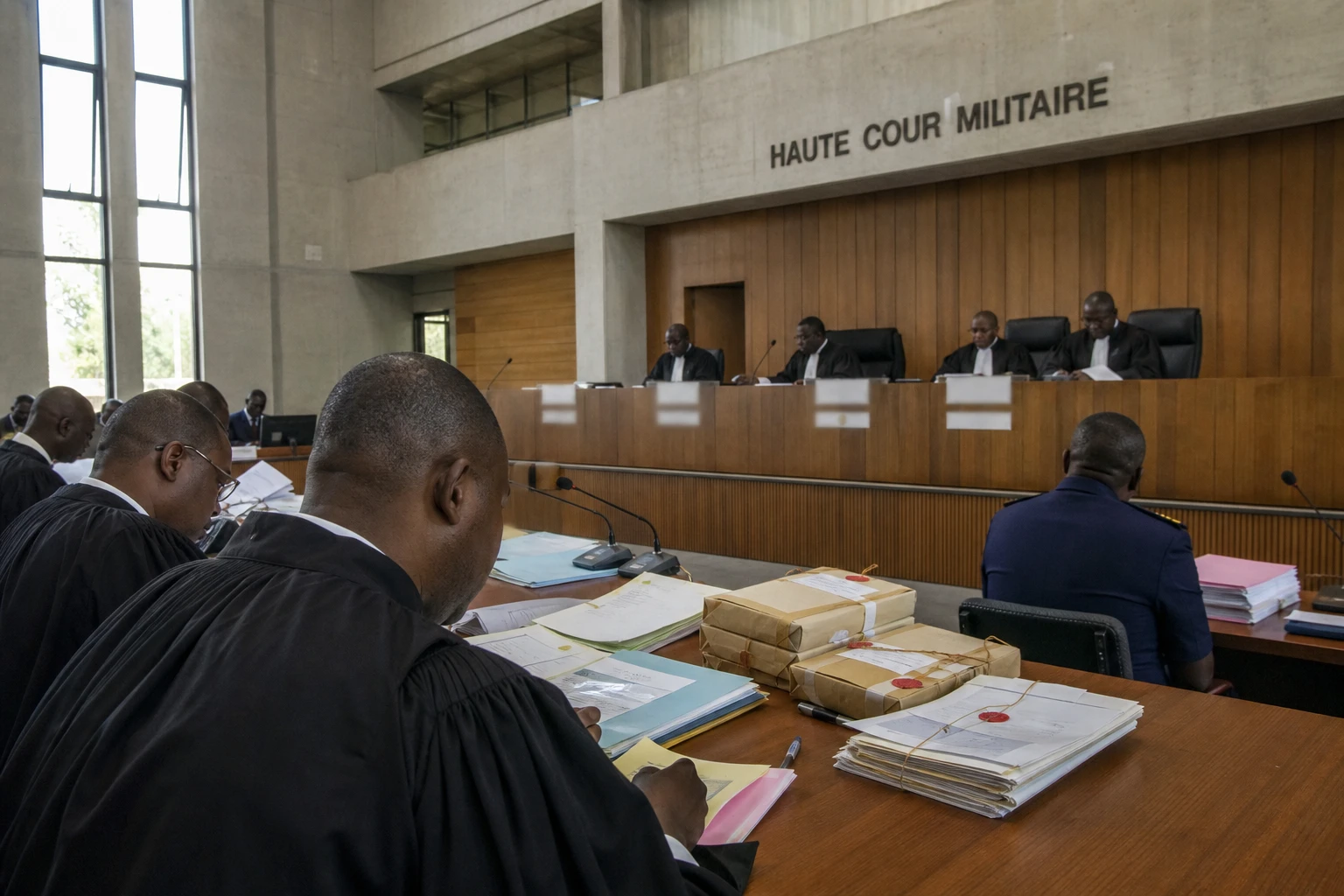
In Kinshasa, the military justice system is opening a case that goes directly to one of the Democratic Republic of the Congo Armed Forces’ (FARDC) heaviest defeats in the east of the country. The fall of Bukavu in February 2025 exposed weaknesses in the Congolese command structure. Two senior officers are now appearing before the High Military Court.
An offensive that shifted the front towards South Kivu
The trial, announced on Friday 25 September 2026, concerns Major Generals Robert Anvul Yav and André Ehonza Uketi. The former was then in charge of military operations in South Kivu. The latter commanded the Sukola 2 North operational sector, responsible for part of the operations in the area.
The events under examination date back to the first weeks of 2025. After the capture of Goma, the capital of North Kivu, the Alliance of the Congo River (AFC), a politico-military coalition whose armed wing is the March 23 Movement (M23), continued its advance south. Bukavu, the capital of South Kivu, came under rebel control on 16 February 2025, after several strategic positions, including the airport, had been taken.
The advance had fundamentally altered the military balance around Lake Kivu. It had also prompted soldiers, wazalendo auxiliaries and civilians to move towards the territories of South Kivu. The term wazalendo refers to local armed groups mobilised by the Congolese authorities as auxiliary forces, though their oversight and discipline vary widely.
The advance towards Bukavu was documented by several sources, including international media and observers of the regional security situation. The course of the capture of Bukavu notably revealed a rapid withdrawal by government forces and their allies.
What the prosecution alleges against the two officers
According to information reported in the case file, Robert Anvul Yav allegedly left Bukavu before the rebels entered the city. He then set up his headquarters in Nyangezi, and later in Nyantende, to reorganise units in retreat. The military prosecutor nevertheless accuses him of failing to prepare a counter-offensive aimed at retaking the city.
The prosecution also argues that the general abandoned his command post in circumstances that could be deemed cowardice in the face of the enemy. The judges will have to examine this charge. At this stage, it does not amount to a conviction.
André Ehonza Uketi is being prosecuted in a related case. The public prosecutor is said to accuse him of contributing to the disorganisation of the troops by portraying the opposing forces as superior in numbers and equipment. At earlier hearings, the two officers reportedly said that the balance of forces made a counter-attack difficult.
The case also includes an allegation relating to the distribution of weapons. Robert Anvul Yav allegedly handed 82mm mortars and PKM machine guns to wazalendo fighters in Lumbishi, in Kalehe territory. Some of the weapons were reportedly defective and some of the ammunition out of date. These details will have to be verified at the hearing, including through expert assessments and testimony from the soldiers concerned.
The High Military Court will therefore have to draw an essential distinction between a contested operational decision, a command error and a criminal offence. In a conflict marked by successive retreats, an officer’s individual responsibility cannot be inferred solely from the loss of a position.
A trial at the heart of a command crisis
The fall of Bukavu was not an isolated episode. It came after several months of setbacks in North Kivu, notably around Masisi, Minova and the route linking Goma to South Kivu. The M23 had already captured Goma in late January 2025 before extending its influence into neighbouring territories.
For the Congolese authorities, prosecuting military officials offers a way to establish the precise causes of these defeats. The trial could also serve to reaffirm the authority of the chain of command. But the approach carries a risk: placing responsibility on a handful of officers for a military structure weakened by institutional rivalries, the dispersal of forces and reliance on auxiliary armed groups.
The issue also concerns soldiers deployed in the field. A withdrawal may result from an order, a shortage of ammunition, a breakdown in communications or the collapse of a neighbouring position. The justice system will have to determine which matters were the generals’ responsibility and which depended on decisions taken at higher levels.
The defence is expected to challenge the prosecution’s account. The officers could argue that their units had already been disorganised by earlier fighting and that the enemy’s superiority made a counter-attack unrealistic. Only adversarial proceedings can test these accounts against written orders, field reports and testimony.
Proceedings watched beyond the individual cases
The trial comes as the Congolese military justice system pursues a growing number of cases against security officials. Other recent hearings before the High Military Court have involved senior officers charged with offences linked to operations in the east of the country, as shown by coverage of the case of General Philémon Yav.
This turn to the courts comes at a time when Kinshasa is seeking to regain the initiative militarily, diplomatically and judicially. The African Union, the Southern African Development Community (SADC) and the East African Community (EAC) are all following the crisis, which now extends beyond a single province.
SADC had deployed a regional force in eastern DR Congo before its gradual withdrawal. The EAC, for its part, had already tried to facilitate a political and security settlement. These initiatives have shown the limits of a response based solely on military deployments. The questions of border control, external support for armed groups and the representation of local communities remain unresolved.
For the people of Bukavu and the surrounding territories, the immediate concerns remain security, movement and access to essential services. For the army, the trial will test internal accountability. For the political leadership, it will be a chance to demonstrate that command reform is not limited to arrests after each setback.
The next stages of the proceedings will above all test the strength of the evidence. The judges will have to examine the orders issued, the resources actually available and the decisions taken before, during and after the withdrawal from Bukavu. Only then can the trial shed light on the 2025 defeat without turning a complex military crisis into a simple case of individual blame.



