
 Algeria
 Egypt
 Libya
 Morocco
 Sudan
 Tunisia
 Benin
 Burkina Faso
 Cabo Verde
 Côte d'Ivoire
 Ghana
 Guinea
 Guinea-Bissau
 Liberia
 Mali
 Mauritania
 Niger
 Nigeria
 Senegal
 Sierra Leone
 The Gambia
 Togo
 Cameroon
 Central African Republic
 Chad
 Equatorial Guinea
 Gabon
 Republic of the Congo
 São Tomé and Príncipe
 Burundi
 Comoros
 Djibouti
 Eritrea
 Ethiopia
 Kenya
 Madagascar
 Malawi
 Mauritius
 Mozambique
 Rwanda
 Seychelles
 Somalia
 South Sudan
 Tanzania
 Uganda
 Angola
 Botswana
 Eswatini
 Lesotho
 Namibia
 South Africa
 Zambia
 Zimbabwe
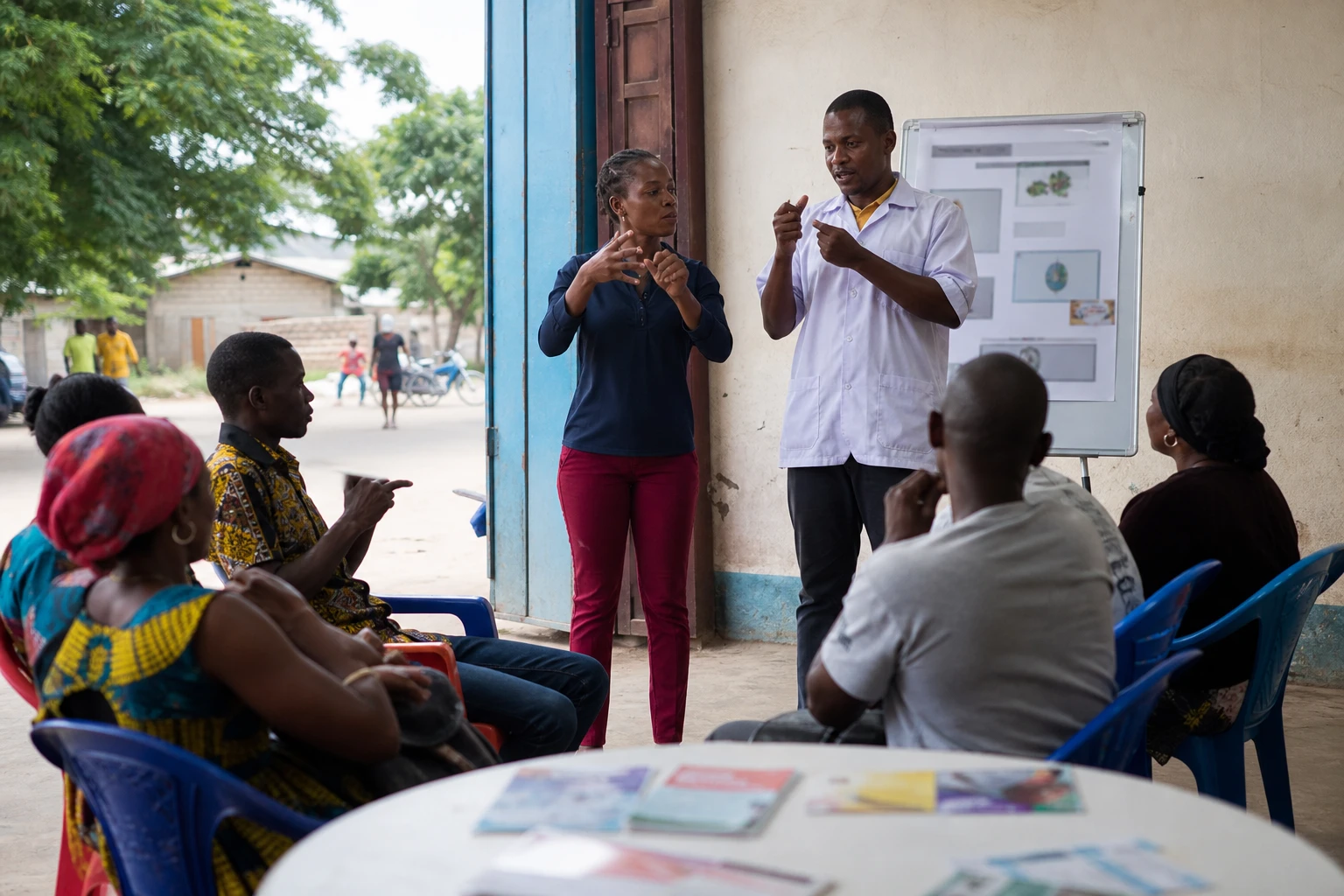
In Kisangani, access to reliable health information depends not only on the presence of medical teams. It also depends on their ability to communicate with all residents. In this city in Tshopo province, a session for deaf people served as a reminder that an effective response to Ebola must take account of the realities facing every audience.
Tailored awareness-raising in Kisangani
Teams involved in the response to Ebola virus disease organised a meeting for deaf people. The aim was to present the main signs of the disease, the risks of transmission and the steps to take in the event of symptoms or contact with someone who is ill.
The session took place with the support of a sign-language interpreter. This adaptation made it possible to convey prevention messages without relying solely on audio materials or spoken exchanges. It also addressed a practical difficulty encountered in health facilities.
Gloris Esaa, a doctor on the response team, explained that some deaf people may find it difficult to describe their symptoms to a health worker. Misunderstandings can then delay referral to a specialist centre or lead to the seriousness of the situation being underestimated.
In the context of Ebola, this risk is particularly significant. Fever, extreme fatigue, vomiting, diarrhoea or bleeding must be reported promptly. An incomplete exchange between a patient and medical staff can make the initial assessment more difficult.
Inclusion, a public health issue
Taking deaf people into account is therefore not simply a social consideration. It directly affects case surveillance and the speed of treatment. Someone who does not receive the same message as the rest of the population may also be less able to pass information on to family and friends.
This issue also concerns relatives. In many families, they act as intermediaries with public services. However, this mediation should not replace deaf people’s direct access to clear, understandable and confidential information.
Congolese Sign Language is already recognised as an essential tool for informing deaf people and involving them in public life. Using it in health campaigns helps reduce a recurring barrier: the gap between a message that is officially broadcast and citizens’ actual ability to receive it.
For medical teams, this approach requires available interpreters, suitable visual materials and training in communication with people with disabilities. It also means not limiting inclusion to large cities. Outlying areas and rural communities must be able to access messages in languages and formats they understand locally.
An epidemic in a difficult environment
The awareness-raising session in Kisangani took place as the Democratic Republic of the Congo was facing its longest and one of its most severe Ebola epidemics. Declared in August 2018, it mainly affected the provinces of North Kivu and Ituri in the east of the country.
The response was unfolding amid insecurity, population displacement and distrust of some interventions. These factors complicated contact tracing, vaccination, the isolation of patients and the organisation of safe burials.
Data published at the time of the session recorded 7,541 confirmed cases, 3,639 deaths and 1,823 people who had recovered, according to figures from the Congolese government as of the Saturday before the event. These figures must be viewed in the context of the epidemiological situation at the time, as totals were changing rapidly and could be revised as investigations progressed.
Retrospective data from the US Centers for Disease Control and Prevention confirm the exceptional scale of the outbreak and highlight the significant proportion of deaths that occurred in communities before cases were identified. This made it harder to break chains of transmission.
The World Health Organization had also documented the spread of the epidemic in North Kivu and Ituri. Its situation reports show that outbreaks shifted according to contacts, population movements and access to health services, rather than along administrative boundaries alone.
Different effects across regions and groups
In Kinshasa, national decisions and institutional coordination were the main focus. In Kisangani, the challenge was more operational: delivering understandable information to diverse communities in a city far from the main outbreak areas in the east, but connected to the country’s transport and trade networks.
In urban neighbourhoods, messages could circulate through health centres, associations and local media. In more isolated areas, distance, transport costs and a shortage of specialist staff could delay access to information as well as care.
Deaf people were not the only group needing tailored communication. People with visual impairments, those who do not speak French, children and residents with limited access to media also needed specific formats. Prevention could therefore benefit from combining sign language, images, community outreach and explanations in national languages.
An issue extending beyond the DRC
The Kisangani initiative is a reminder of a rule that applies to health responses across Central Africa: a campaign cannot be complete if part of the population is left outside the information network. Accessibility strengthens trust, early detection and the quality of medical follow-up.
It also highlights the role of local actors. Associations of deaf people, interpreters, community outreach workers and health workers understand barriers that systems designed in capital cities sometimes identify late. They should be involved from the outset in preparing messages, not only when those messages are distributed.
For the Democratic Republic of the Congo, the priority at the time remained reducing transmission in North Kivu and Ituri while maintaining vigilance in the other provinces. For regional partners, the Congolese experience underscored the importance of health preparedness that takes account of mobility, borders and the needs of people often left out of general campaigns.



