
 Algeria
 Egypt
 Libya
 Morocco
 Sudan
 Tunisia
 Benin
 Burkina Faso
 Cabo Verde
 Côte d'Ivoire
 Ghana
 Guinea
 Guinea-Bissau
 Liberia
 Mali
 Mauritania
 Niger
 Nigeria
 Senegal
 Sierra Leone
 The Gambia
 Togo
 Cameroon
 Central African Republic
 Chad
 Equatorial Guinea
 Gabon
 Republic of the Congo
 São Tomé and Príncipe
 Burundi
 Comoros
 Djibouti
 Eritrea
 Ethiopia
 Kenya
 Madagascar
 Malawi
 Mauritius
 Mozambique
 Rwanda
 Seychelles
 Somalia
 South Sudan
 Tanzania
 Uganda
 Angola
 Botswana
 Eswatini
 Lesotho
 Namibia
 South Africa
 Zambia
 Zimbabwe
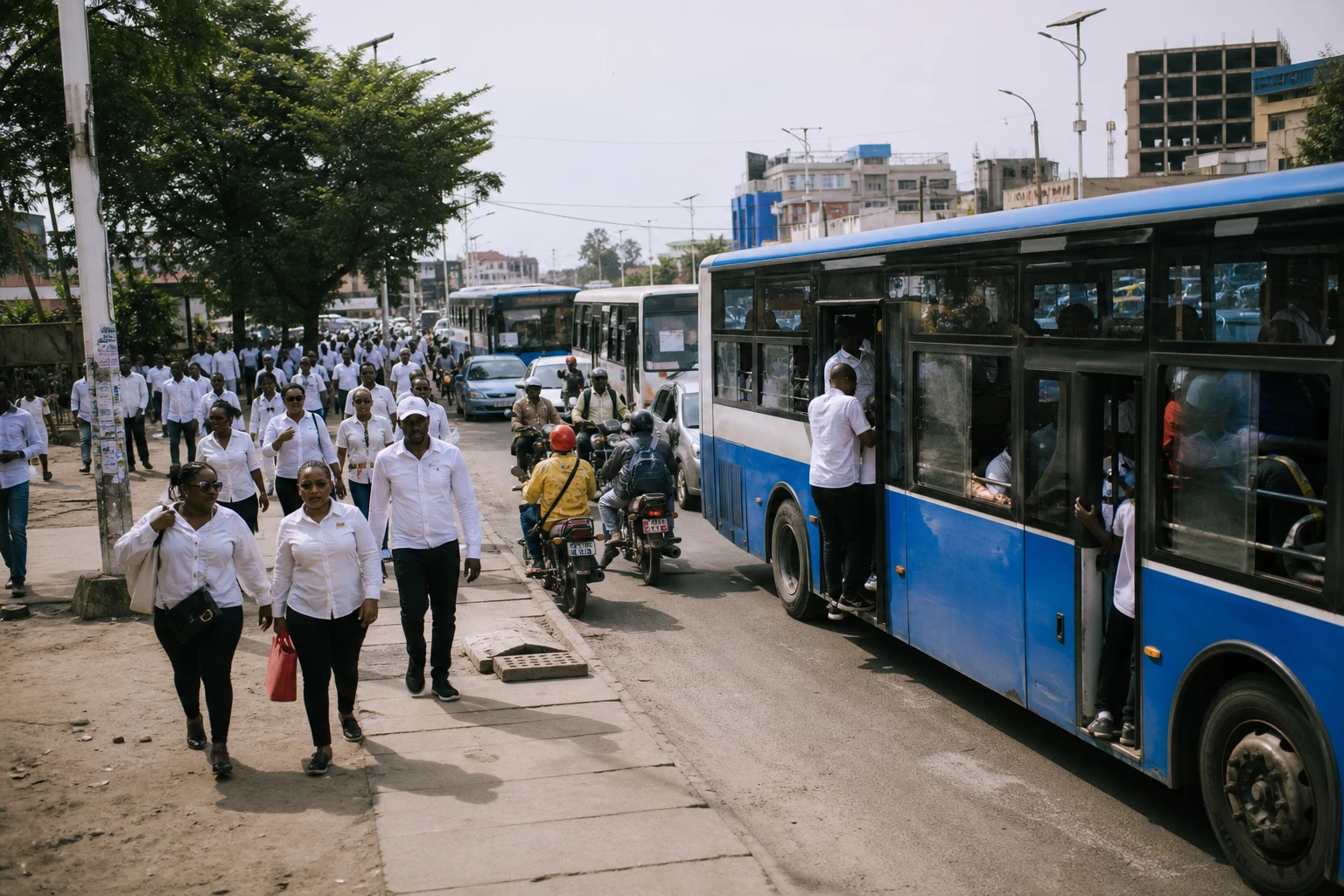
In Kinshasa, the battle over the Constitution has taken a new turn. After the opposition mobilised against any revision of the fundamental law, the Union for Democracy and Social Progress (UDPS), President Félix Tshisekedi’s party, sought to show that the government could also fill the streets.
On Tuesday 22 September 2026, thousands of supporters and sympathisers took part in a march in the capital of the Democratic Republic of the Congo. The procession defended the institutions, political dialogue and the principle of a constitutional referendum.
A carefully managed mobilisation in Kinshasa
Participants gathered in the morning around the UDPS headquarters in the Limete commune. Many wore white clothing, which organisers presented as a sign of peace and unity.
The march was due to start at 11th Street, on Lumumba Boulevard. It was then to pass Cohydro station, Sendwe and Kasa-Vubu, before reaching the annex field at the Martyrs Stadium. The route had been agreed with the provincial authorities in Kinshasa.
The previous day, the governor of the capital had asked organisers to respect the agreed route and preserve the peaceful nature of the gathering. The appeal also aimed to limit disruption in a city where large demonstrations quickly paralyse traffic and commercial activity.
UDPS/Tshisekedi supporters marched alongside several allied parties, including Samy Badibanga’s Progressives and Gentiny Ngobila’s Alliance of Progressive Congolese. The presence of these parties was intended to give the mobilisation a broader profile than that of the president’s party alone.
In an account published by the Congolese Press Agency, Kinshasa authorities said security measures had been put in place to accompany the procession. The first available accounts reported no major incidents.
Referendum at the heart of the political message
The march was not solely about supporting the head of state. Above all, it served to demonstrate the presidential camp’s backing for the constitutional reform project and the law governing recourse to a referendum.
At the end of the march, Augustin Kabuya, the UDPS secretary-general and acting president, called on Félix Tshisekedi to support the initiative. “The time has come for you to help us change this Constitution,” he told demonstrators, according to Actualite.cd.
The UDPS official invoked Article 5 of the Constitution. It states that national sovereignty belongs to the people and may be exercised directly, including through a referendum. This is one of the government’s central arguments in favour of a public consultation.
The presidential camp presents the reform as a response to the country’s evolution and the limitations of the current text. Its opponents see it instead as a risk that the rules of the game could be changed to benefit the incumbent president. The debate therefore goes beyond legal technicalities. It directly concerns the institutional balance and presidential succession.
The Congolese Constitution limits presidents to two terms. The opposition fears that any change could indirectly open the way to another candidacy by Félix Tshisekedi. The government, for its part, argues that no definitive decision on a possible candidacy can be inferred from a mere discussion of constitutional reform.
A direct response to the opposition’s mobilisation
The 22 September march came a few days after an opposition rally held in Kinshasa on 15 September. That first mobilisation denounced a change to the Constitution and the prospect of a third presidential term.
The UDPS demonstration therefore also took the form of a show of strength. The president’s party wanted to show that opposition to the reform did not represent Congolese society as a whole. The opposition, by contrast, is seeking to prevent the majority’s mobilisation from being presented as an unquestionable popular mandate.
This confrontation is particularly pronounced in major urban centres. In Kinshasa, parties have longstanding activist networks, logistical resources and high visibility. In the provinces, genuine support for the reform is harder to gauge. A crowd gathered in a capital city is not enough to establish a national consensus.
The question also has a social dimension. Party members, local officials and informal economy actors do not always take part in demonstrations for the same reasons. Some come to defend a political position. Others hope to preserve their influence, access to institutions or protection networks.
The government’s message was also framed by the security situation in the east of the Democratic Republic of the Congo. Several participants linked their support for Félix Tshisekedi to the fight against what Kinshasa calls Rwandan aggression and armed groups active in the eastern provinces.
This link between institutional reform and the defence of national sovereignty allows the government to bring together different concerns. However, it can also blur the debate. Seeking a solution to the security crisis does not automatically answer the questions raised by a change to the Constitution.
A debate extending beyond Congo’s borders
The Congolese political developments will be closely watched by the DRC’s regional partners, including the Southern African Development Community, SADC. The regional organisation is working with Kinshasa on security issues in the east of the country and officially upholds the principle of constitutional stability.
At African Union level, constitutional changes linked to term limits remain a sensitive issue. The continent has experienced several crises after leaders attempted to extend their time in power. Each national process is different, but regional precedents make transparency in the procedure essential.
The next steps will therefore be crucial. The precise content of the proposal, the procedure chosen by the institutions, the timetable for any referendum and the guarantees offered to competing political forces will all need to be established. Popular participation will also have to be assessed beyond images of crowds in the streets of Kinshasa.
For both the government and the opposition, the streets have become an indicator of the balance of power. They cannot, however, replace parliamentary debate, judicial review or a national consultation. In the Democratic Republic of the Congo, the central question will be whether the proposed reform can be pursued without deepening political polarisation.



