Algeria
 Egypt
 Libya
 Morocco
 Sudan
 Tunisia
 Benin
 Burkina Faso
 Cabo Verde
 Côte d'Ivoire
 Ghana
 Guinea
 Guinea-Bissau
 Liberia
 Mali
 Mauritania
 Niger
 Nigeria
 Senegal
 Sierra Leone
 The Gambia
 Togo
 Cameroon
 Central African Republic
 DR Congo
 Equatorial Guinea
 Gabon
 Republic of the Congo
 São Tomé and Príncipe
 Burundi
 Comoros
 Djibouti
 Eritrea
 Ethiopia
 Kenya
 Madagascar
 Malawi
 Mauritius
 Mozambique
 Rwanda
 Seychelles
 Somalia
 South Sudan
 Tanzania
 Uganda
 Angola
 Botswana
 Eswatini
 Lesotho
 Namibia
 South Africa
 Zambia
 Zimbabwe

As the lake retreats, the entire local economy falters
In Chad’s Lac Province, the problem goes beyond fishing. As the water recedes, meals, incomes, travel and even the social balance of lakeside villages are thrown into disarray. Around Lake Chad, entire families still depend on fishing, recession agriculture and small-scale trade linked to the markets along the shore. When all three activities falter, the cost of living rises quickly and room for survival shrinks.
Lake Chad is not some distant backdrop. It is a shared space for Cameroon, Chad, Niger and Nigeria, managed cooperatively by the Lake Chad Basin Commission, headquartered in N’Djamena. This regional institution has existed since 1964, with a mandate covering sustainable water management, cooperation between states and stability in the basin. In this kind of transboundary basin, a fall in catches, an unexpected flood or a security problem has repercussions across the border.
An ecosystem under pressure from climate, water use and insecurity
The core of the issue has long been known. The United Nations Environment Programme has noted that the lake has lost about 90% of its surface area since the 1960s, owing to the combined effects of drought, over-exploitation of water and climate change. Its surface area fell from about 26,000 square kilometres in 1963 to less than 1,500 square kilometres today, although the lake remains seasonal and changes over time.
This contraction is more than an ecological story. It is disrupting the entire economic chain. In its work on the basin, the FAO documented how closely inland fishing, farming and livestock rearing are tied to water cycles. When rainfall becomes irregular, fish breeding grounds become scarce, recession crops yield less and households have to buy more food instead of producing it. The impact on local prices is immediate, especially in remote areas.
Added to this environmental fragility is a long-standing security threat. The Lake Chad Basin continues to be affected by violence linked to Boko Haram and the Islamic State in West Africa. In 2026, the United Nations High Commissioner for Refugees again reported an increase in incidents and deaths in the basin, with displacement placing pressure on host communities. In very practical terms, this means fishing areas that are harder to reach, disrupted markets and more costly journeys for small-scale producers.
Life for people in Chad’s Lac Province: fewer fish, higher costs
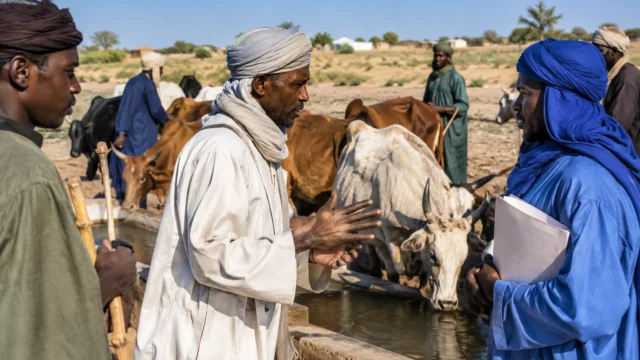
On the ground, falling catches are profoundly changing daily life. Fishers have to travel further, spend longer on the water or use less selective nets to make up the shortfall. Some turn to gear that catches smaller or fewer fish, perpetuating a cycle of scarcity. Others give up fishing in part to pursue survival activities that often pay less. Women, who play a major role in processing and selling fish, are also affected, because the scarcity of the product reduces incomes throughout the downstream part of the value chain.
In Lac Province, food security is therefore also a matter of purchasing power. When fish is scarce, households turn to other foods imported or transported from further away. But logistics costs rise quickly in an area where roads can be difficult, crossings are controlled and markets are exposed to security risks. The result is familiar but harsh: higher spending for lower incomes, putting greater pressure on the poorest households.
Chad already faces severe climate shocks elsewhere in the country. UNICEF says the country is among the world’s most vulnerable to climate hazards for children, with recurrent floods and droughts. This national vulnerability adds to the fragility of Lac Province: when the same family has to contend with erratic harvests, unstable fishing income and security risks, its ability to adapt falls sharply.
A regional response that remains incomplete but is under way
The response cannot be strictly local. The Lake Chad Basin Commission has adopted a 2023–2037 strategic programme and an action plan focused on ecosystem restoration, climate adaptation, water management and support for livelihoods. In March 2026, in N’Djamena, its ministers again stressed climate resilience and the sustainable management of water resources, showing that the issue remains a regional priority.
The African perspective on the issue matters. In the Lake Chad Basin, the task is not simply to “save a lake”, but to protect an area of production, mobility and peace. Cooperation between the riparian states matters as much as external funding. Water management, fish farming, wetland restoration and the protection of trade routes can help cushion the shock, provided they are designed with communities, not for them.
At the continental level, Lake Chad is also a test. The basin brings together pressures already evident elsewhere in Africa: population growth, climate variability, competition for water, insecurity and fragile rural economies. What is at stake therefore goes beyond Lac Province. The next challenge will be to see whether the regional commitments already put on the table in N’Djamena translate into available water, accessible fish and stable incomes for people in Chad’s part of the basin.