Algeria
 Libya
 Morocco
 Sudan
 Tunisia
 Benin
 Burkina Faso
 Cabo Verde
 Côte d'Ivoire
 Ghana
 Guinea
 Guinea-Bissau
 Liberia
 Mali
 Mauritania
 Niger
 Nigeria
 Senegal
 Sierra Leone
 The Gambia
 Togo
 Cameroon
 Central African Republic
 Chad
 DR Congo
 Equatorial Guinea
 Gabon
 Republic of the Congo
 São Tomé and Príncipe
 Burundi
 Comoros
 Djibouti
 Eritrea
 Ethiopia
 Kenya
 Madagascar
 Malawi
 Mauritius
 Mozambique
 Rwanda
 Seychelles
 Somalia
 South Sudan
 Tanzania
 Uganda
 Angola
 Botswana
 Eswatini
 Lesotho
 Namibia
 South Africa
 Zambia
 Zimbabwe
An old case, but a memory that remains vivid
In Cairo, some cases never really fade. They span the years, governments and promises of reform. The payment of compensation to Shaimaa al-Sabbagh’s family, more than ten years after her death, is a reminder that in Egypt the issue of police violence is as much legal as it is political.
For many Egyptians, this case goes beyond financial compensation alone. It evokes a period when public space closed in, the streets became a place under close surveillance, and every case of police brutality took on a symbolic significance far greater than its immediate circumstances. Shaimaa al-Sabbagh, a poet and left-wing activist, has remained one of the best-known faces of this collective memory.
The scene belongs to the country’s contemporary history. On 24 January 2015, the activist, then aged 34, was taking part in a gathering in central Cairo on the eve of the fourth anniversary of the 25 January 2011 revolution. She had just laid a wreath in tribute to protesters killed during the uprising when she was hit in the back by police gunfire. Images of her body being carried by other protesters spread rapidly and made her a figure of Egyptian dissent.
Late compensation amid a tense political climate
According to the family’s lawyer, the Egyptian state has finally paid 300,000 Egyptian pounds, or about $6,000. A court had ordered the compensation in 2023, but payment came much later. For her relatives, the issue was not merely material. Above all, it was about securing recognition of the Interior Ministry’s responsibility for the tragedy.
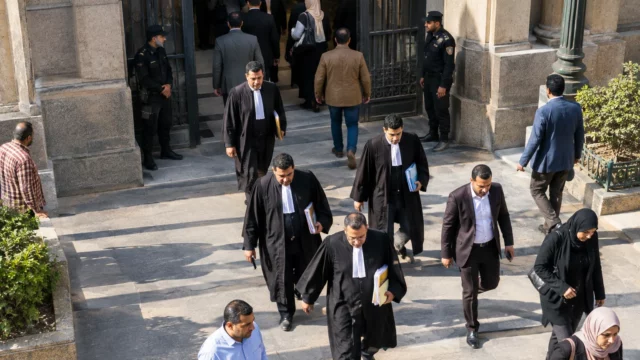
The case went through several judicial stages. The police officer found guilty of the fatal shooting was sentenced to seven years in prison in 2020, following appeals and successive rulings. Earlier in the proceedings, an initial judgment had already resulted in a prison sentence before the case was reconsidered. This judicial back-and-forth shows how sensitive cases involving security forces remain in Egypt.
The case must also be viewed in the broader context of Egypt’s political system. Since Abdel Fattah al-Sisi came to power in 2014, following the ousting of Mohamed Morsi, the authorities have tightened restrictions on the opposition. Unauthorised gatherings are heavily restricted. The right to protest, already limited by the 2013 protest law, is now exercised in an environment of surveillance and deterrence. Cairo, the political and administrative capital, is where these tensions are concentrated.
In this context, the payment of compensation should not be seen as a major turning point. It looks more like belated redress, secured after lengthy proceedings in a public sphere where protests have become rare. That is precisely what gives it significance. When cases of this kind reach a conclusion, even slowly, they are a reminder that the question of accountability has not entirely disappeared from Egypt’s public debate.
What this case says about Egypt today
The Shaimaa al-Sabbagh case resonates beyond a single ruling. It sheds light on how the Egyptian state deals with dissent, security forces and the memory of the 2011 uprisings. It also serves as a reminder that, in major cities and the provinces alike, the line between maintaining public order and the excessive use of force remains a sensitive issue for families, activists and lawyers.
The social significance is clear. For victims’ relatives, compensation can have greater moral than financial value. It can mean that the administration acknowledges, even belatedly, that a wrong was committed. But for many observers, the absence of a broader public review leaves a sense that the matter is unfinished. The gesture settles a case. It does not necessarily repair the relationship between power, the police and citizens.
Egypt is not alone in facing this kind of debate. In several African countries, periods of political transition, social mobilisation and security tensions raise the same central question: how can public order be maintained without emptying the right to protest of meaning? Across the continent, the answer is often decided in the courts, but also depends on institutions’ willingness to accept scrutiny, transparency and accountability.
For North Africa, this case is also a reminder that an apparently individual event can become a lasting political marker. At a time when Cairo is seeking to project the image of a stable country, the compensation brings another reality back into focus: that of a society in which the memory of streets, squares and uprisings continues to shape public life. The question, then, is not simply whether a family has received compensation. It is what the state is, or is not, willing to acknowledge about its own use of force.
In a country where cases of this kind are increasingly rare, the decision serves as a signal. It shows that a legal dispute can still run its course through the courts. Above all, it shows that the memory of 25 January 2011, even as it is suppressed in the political sphere, remains present in Egypt’s courts, families and civic conscience.