Algeria
 Egypt
 Libya
 Morocco
 Sudan
 Tunisia
 Benin
 Burkina Faso
 Cabo Verde
 Côte d'Ivoire
 Ghana
 Guinea
 Guinea-Bissau
 Liberia
 Mali
 Mauritania
 Niger
 Nigeria
 Senegal
 Sierra Leone
 The Gambia
 Togo
 Cameroon
 Central African Republic
 Chad
 DR Congo
 Equatorial Guinea
 Gabon
 Republic of the Congo
 São Tomé and Príncipe
 Burundi
 Comoros
 Djibouti
 Eritrea
 Ethiopia
 Kenya
 Madagascar
 Malawi
 Mauritius
 Mozambique
 Rwanda
 Seychelles
 Somalia
 South Sudan
 Tanzania
 Angola
 Botswana
 Eswatini
 Lesotho
 Namibia
 South Africa
 Zambia
 Zimbabwe
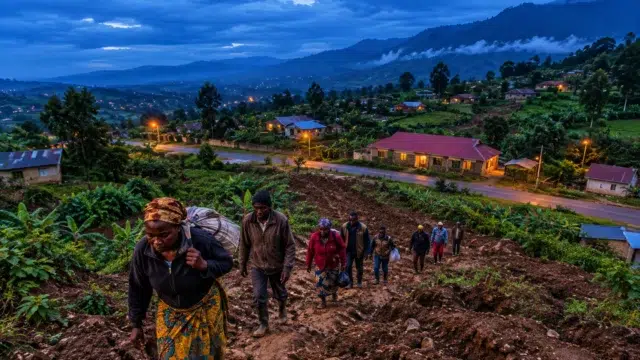
In south-eastern Central African Republic, insecurity is no longer seen only through the lens of armed frontlines
In Bangassou, in Mbomou, fear often returns along tracks, rivers and fishing grounds. For families, danger does not lie only in visible weapons. It also lies in disrupted journeys, fields left fallow and children who do not come home at night. In this part of the Central African Republic, every attack is a reminder that security is not simply a matter of controlling a town, but of being able to live and travel without fear.
The country’s south-east remains a strategic area. It borders Haut-Mbomou, Mbomou and the frontier areas with South Sudan and the Democratic Republic of the Congo. This location makes it a corridor for trade, pastoral movement and civilian flight. It also provides a retreat for armed groups that exploit long distances, isolation and an intermittent state presence. MINUSCA regularly points out that the Haut-Oubangui region still faces significant challenges involving protection, the return of displaced people and the restoration of public authority.
What happened near Bangassou
On Saturday 12 September 2026, several villages around Bangassou were attacked, according to local sources cited by AFP and reported by other media. Residents fled to Bangassou to alert the authorities. According to these accounts, the assailants targeted fishermen and hunters. The human toll should be treated with caution, but sources agree that there was a mass abduction. The same reports attribute the attack to members of the LRA, the Lord’s Resistance Army, an armed group founded in Uganda and now best known for abductions and the forced recruitment of children.
In more detail, Bangassou MP Serge Singha Bengba and Frédéric Kinza, alternate MP for Bangassou 2, cited 44 people abducted, including 13 children, with 31 released. Another report on the incident refers to “at least thirty” people kidnapped, showing that early figures are still circulating with discrepancies. On such a sensitive issue, the precise figure should therefore remain attributed until confirmed by an independent institutional source.
The authorities responded immediately with a military deployment in Mbomou, according to the initial reporting and available cross-checks. The response follows a familiar approach in Bangassou: protect routes, deter incursions and prevent rural areas from slipping beyond all control. But in practice, residents chiefly see the gap between the state’s presence in the town and its fragility beyond it.
The LRA, weakened but not gone
The LRA has lost the capacity to cause the harm it once did, but it has not disappeared entirely from the Central African Republic’s security landscape. The UN has documented periods of withdrawal, the voluntary repatriation of former combatants to Uganda and demobilisation in Haut-Mbomou. MINUSCA said it had supported the repatriation in 2023 of the last former combatants and their families remaining in the Central African Republic. Yet this decline has never guaranteed that the danger would disappear completely. In the most isolated areas, small groups can survive by changing their movements, targets and alliances.
Joseph Kony, the LRA’s founder, remains wanted by the International Criminal Court. In 2024, the ICC confirmed that proceedings against him were still advancing despite his absence. The UN Security Council also notes that he is on its sanctions list for acts linked to serious violations committed in the Central African Republic, including abductions, attacks on civilians and the use of children in the conflict. In other words, Kony’s name continues to weigh on the region’s security memory, even though the group no longer has the same structure as before.
For the people of Bangassou, the central issue is not only the group’s identity. It is the recurrence of its methods. When a village depends on fishing, hunting, small-scale trade or subsistence farming, the abduction of one adult or child is enough to disrupt the entire local economy. The cost is therefore social, economic and psychological. It affects families, but also Bangassou’s markets, riverside villages and supply routes to the administrative centres.
A warning for the Central African Republic and the wider sub-region
This incident says something broader about the Central African Republic. In Mbomou and Haut-Mbomou, the state is trying to re-establish its presence, but its reach remains uneven. Security therefore depends on national forces, MINUSCA, local peace agreements and sustained work on roads, bridges, schools, justice and the gendarmerie. When one of these links fails, armed groups find space to operate. When they settle there, civilians are the first to pay the price.
The issue also has regional significance. The Central African Republic’s south-east is connected to South Sudan and the DRC by family, commercial and military movements that extend beyond administrative borders. The LRA itself moved between these areas for a long time, making it a cross-border problem rather than simply a national one. For Bangui, the question is therefore not just that of one more attack. It concerns the country’s ability to secure its peripheries, protect border corridors and prevent a group portrayed as marginal from regaining a lasting foothold in an area already exposed to other violence, notably that linked to the AAKG militia in Haut-Mbomou.
Across Central Africa, the message is clear. The most enduring threats are not always those that dominate the news. Sometimes they take root in the gaps: a porous border, a blocked road, a remote village, an absent administration. This is where the credibility of peace is decided in practical terms. It is also where the Central African Republic’s ability to turn a security presence into real protection for its people is measured.