
 Algeria
 Egypt
 Libya
 Morocco
 Sudan
 Tunisia
 Benin
 Burkina Faso
 Cabo Verde
 Côte d'Ivoire
 Ghana
 Guinea
 Guinea-Bissau
 Liberia
 Mali
 Mauritania
 Niger
 Nigeria
 Senegal
 Sierra Leone
 The Gambia
 Togo
 Cameroon
 Central African Republic
 Chad
 Equatorial Guinea
 Gabon
 Republic of the Congo
 São Tomé and Príncipe
 Burundi
 Comoros
 Djibouti
 Eritrea
 Ethiopia
 Kenya
 Madagascar
 Malawi
 Mauritius
 Mozambique
 Rwanda
 Seychelles
 Somalia
 South Sudan
 Tanzania
 Uganda
 Angola
 Botswana
 Eswatini
 Lesotho
 Namibia
 South Africa
 Zambia
 Zimbabwe
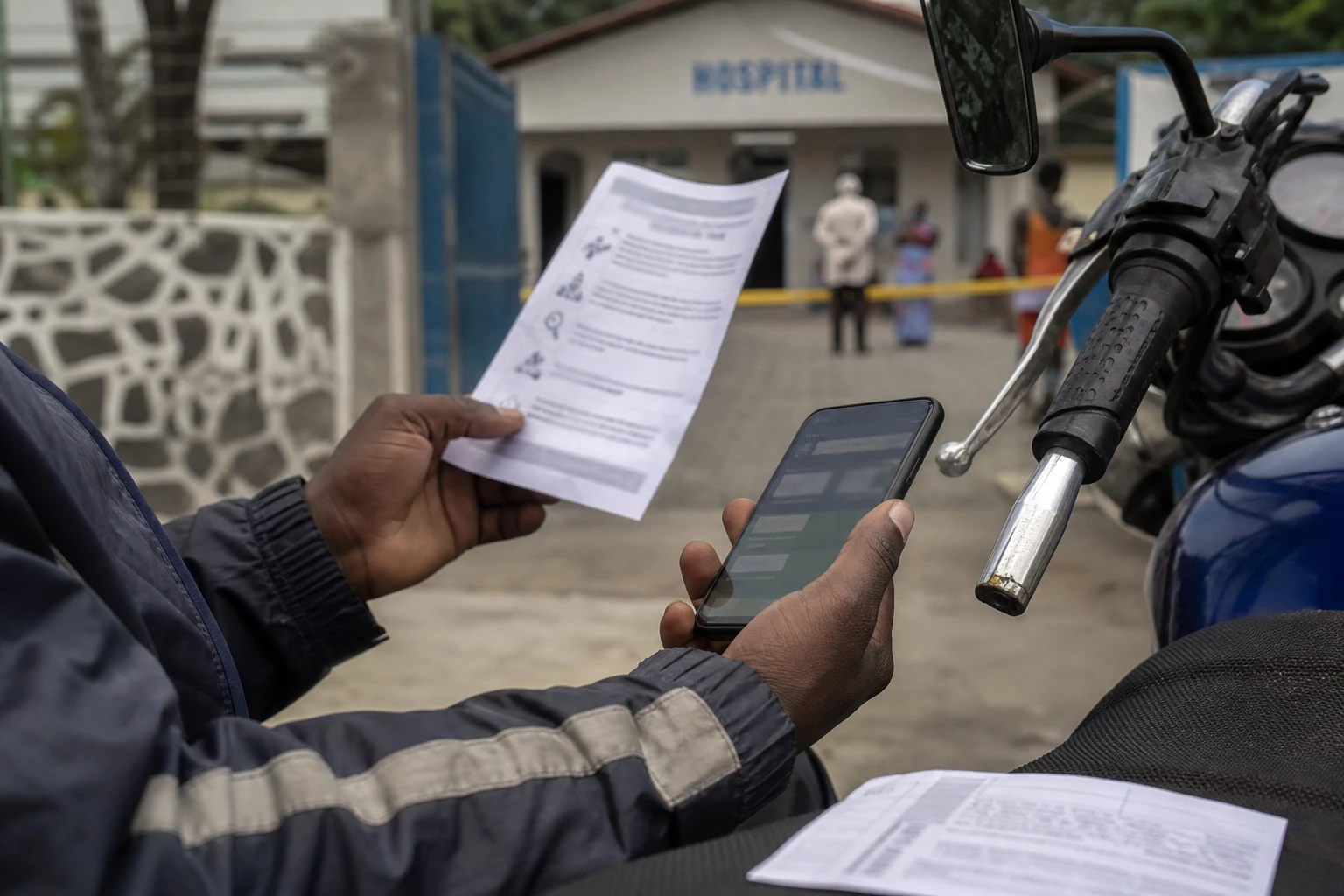
In Beni, public health is also shaped on the streets
In Beni, North Kivu, the response to Ebola is not confined to laboratories and treatment centres. It also involves those who criss-cross the city all day, see people’s faces, hear the rumours and know the shortcuts: motorcycle taxi drivers. In a city where motorcycle transport remains an essential part of daily life, their role goes far beyond simply giving people a ride. It has become a public health tool.
This approach is no mere detail. It addresses a reality well known in the Democratic Republic of the Congo: when it comes to Ebola, trust matters as much as protocols. When fear spreads faster than information, local community networks become crucial. Beni, a strategic city in eastern DR Congo, has for years stood at the crossroads of commercial movements, security tensions and health alerts.
A recent outbreak in a long-standing context
On 15 May 2026, Congolese authorities declared a new Ebola outbreak caused by the Bundibugyo virus in the north-east of the country. The World Health Organization subsequently confirmed that this was the 17th Ebola outbreak recorded in DR Congo since 1976. On 17 May, the WHO also assessed the event as a public health emergency of international concern.
Over the following weeks, the situation moved beyond a local alert. In early August and again in mid-August, the WHO said the outbreak had spread rapidly and had become the largest Ebola outbreak ever documented in the country in terms of confirmed cases. The organisation also stressed that Bundibugyo ebolavirus does not affect just one district: it raises questions about movement, surveillance and regional coordination, particularly along the border with Uganda.
In this context, health authorities are stepping up community outreach. In Beni, health professionals have already urged the public to strictly observe preventive measures, while other operations have targeted travellers, contact households and crossing points. The idea is simple: break the chain of transmission as close as possible to the routes people actually travel.
Why motorcycle taxi drivers have become key players
The session held at Beni’s Ebola treatment centre is part of this approach. Motorcycle taxi drivers were able to see how the facility operates, from a patient’s admission through to medical follow-up. This was more than an educational visit. It was also a way to dispel misconceptions that still surround care facilities, which are sometimes viewed with suspicion by families already under strain.
The choice of audience was strategic. In Beni, motorcycle taxis offer a fast and flexible form of local transport. They connect neighbourhoods, markets, hospitals and outlying communities. A driver may therefore be the first to hear that a passenger is feeling unwell, the first to see someone arriving with a fever, or the first to recommend a consultation. This proximity makes them an informal but powerful health link. It is a practical assessment, not a slogan.
Ebola survivor Josias Tengé-Tengé, who is himself a motorcycle taxi driver, reminded his colleagues that they could protect their passengers as well as themselves. His testimony gives the message particular weight. It speaks to something essential in the cities of eastern DR Congo: the words of a peer can sometimes be more persuasive than a poster or a statement. In a response where public buy-in matters, lived experience becomes a public health argument.
Building trust, protecting neighbourhoods and preventing escalation
The challenge is not simply to provide information. It is also to counter a climate of suspicion that has already left healthcare workers, burial teams and treatment centres exposed to attacks. The WHO regularly stresses that the Ebola response must combine surveillance, care, clear information and safe burials. When one of these elements is missing, people hesitate, go into hiding or delay seeking care.
For health authorities, bringing motorcycle taxi drivers into the response strategy therefore makes it possible to act early. It helps direct patients quickly to appropriate facilities, before a journey to a traditional healer, a remote home or self-medication increases the risk of transmission. It also helps spread simple guidance: seek care early, avoid risky contact and follow the medical teams’ instructions.
This approach also has a broader social impact. In Beni, as in other cities in the east, daily movement does not follow official routes alone. It follows markets, working-class neighbourhoods, taxi ranks, borders and trade routes. An effective health message must therefore travel through the same networks as the potential disease. This is where local actors—motorcycle taxi drivers, young people, community leaders, religious representatives and survivors—come into their own.
A Congolese lesson that reaches beyond Beni
What is happening in Beni matters to all of Central Africa. DR Congo shares intense patterns of human movement with Uganda, Rwanda and Burundi, as well as the wider trade corridors of the Great Lakes region. In such an area, an effective response cannot stop at one city or even one province. It requires consistent messages, coordinated alerts and continuous surveillance at entry points.
The continental significance is clear: the Congolese experience confirms that the fight against Ebola is also won through ordinary movement—the movement of motorcycles, markets, buses and people across borders. It also shows that public health is not solely the preserve of experts. It depends on the often unseen occupations of everyday life. In DR Congo, a country already facing multiple health and humanitarian emergencies, this local knowledge remains one of the strongest defences against repeated outbreaks.



