
 Algeria
 Egypt
 Libya
 Morocco
 Sudan
 Tunisia
 Benin
 Burkina Faso
 Cabo Verde
 Côte d'Ivoire
 Ghana
 Guinea
 Guinea-Bissau
 Liberia
 Mali
 Mauritania
 Niger
 Nigeria
 Senegal
 Sierra Leone
 The Gambia
 Togo
 Cameroon
 Central African Republic
 Chad
 Equatorial Guinea
 Gabon
 Republic of the Congo
 São Tomé and Príncipe
 Burundi
 Comoros
 Djibouti
 Eritrea
 Ethiopia
 Kenya
 Madagascar
 Malawi
 Mauritius
 Mozambique
 Rwanda
 Seychelles
 Somalia
 South Sudan
 Tanzania
 Uganda
 Angola
 Botswana
 Eswatini
 Lesotho
 Namibia
 South Africa
 Zambia
 Zimbabwe
A reassuring decline, without erasing the danger
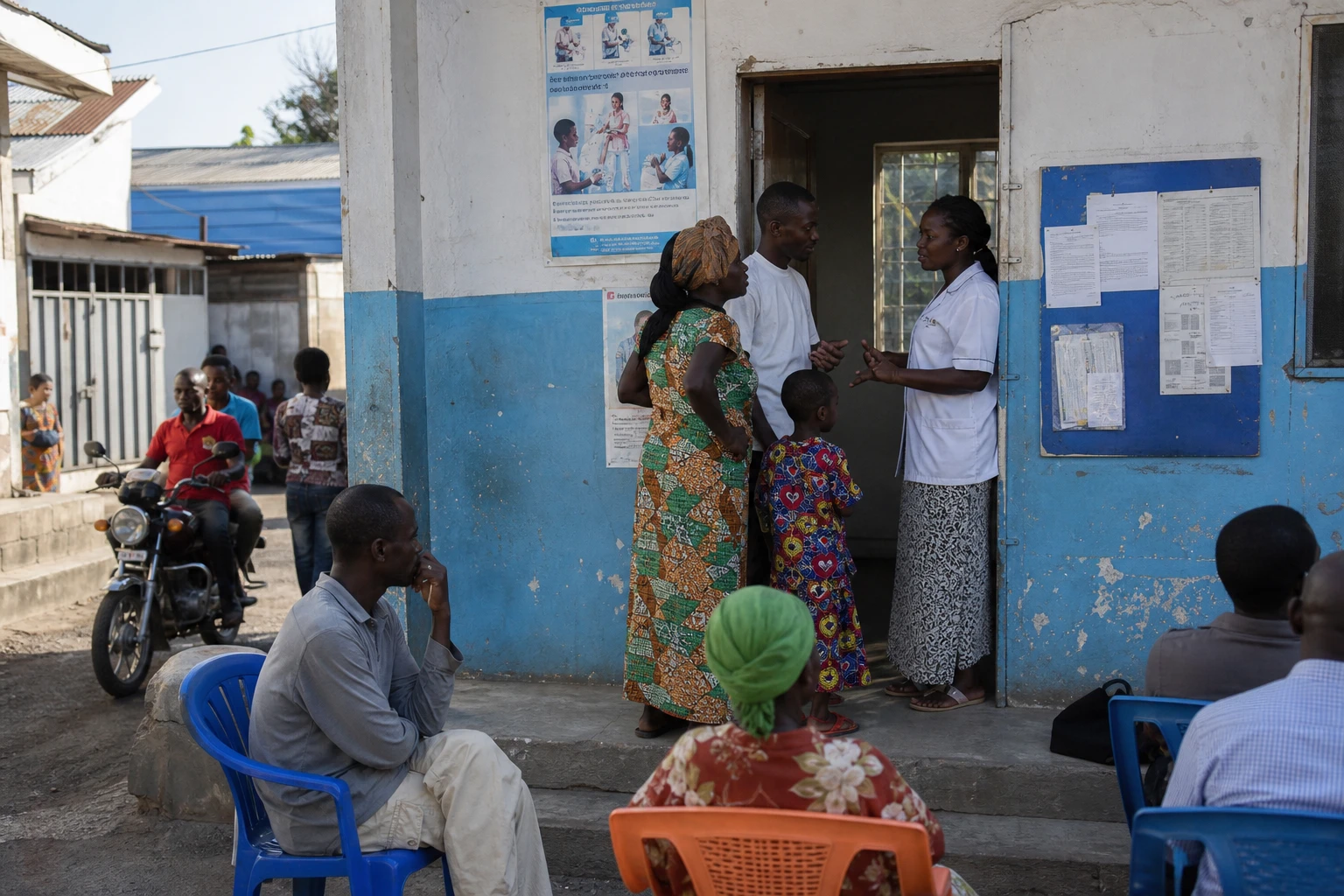
In eastern Democratic Republic of the Congo, the curve is beginning to flatten, but the Ebola epidemic has not yet relented. Four months after it was officially declared, on 15 May 2026, Congolese authorities say they are seeing a marked slowdown in transmission. The latest available figures show 7,258 confirmed cases, 3,510 deaths and 1,726 people recovered. The toll remains high. It also confirms a familiar reality of the health response in the DRC: an overall improvement can coexist with active hotspots, sometimes far apart.
The outbreak first affected Ituri, a province bordering Uganda and South Sudan, in an area where roads, population movements and insecurity complicate surveillance. The epidemic began there, in Mongbwalu, before spreading to other provinces. The World Health Organization says the international alert was raised in mid-May and strengthened a few days later, as the risk of regional spread was considered serious.
Ituri sees respite in places, while North Kivu remains tense
There are positive signs. As of 12 September, several health zones in Ituri, including Adja, Kambala and Mahagi, had reported no new cases for 41 days, according to health surveillance shared by response partners. At provincial level, however, Ituri remains the worst-affected area. Monitoring published by European public health authorities showed that the province had recorded 5,659 confirmed cases and 2,583 deaths, accounting for most of the national burden.
But the decline is uneven. In North Kivu, the spread remains worrying. WHO teams note that national trends do not capture local realities, and that some areas continue to record active transmission. This disparity is central to understanding the response: a health zone can go days without a case, only for the disease to re-emerge elsewhere because of population movements, untraced contacts or delayed access to care.
The epidemic has also shifted geographically. Sud-Ubangi was reported as a newly affected province, bringing the number of provinces affected in this outbreak to seven. This is significant. A spread to the country’s north-west expands the response area, increases logistical needs and complicates cross-border surveillance with the Republic of the Congo and the Central African Republic. Health authorities are therefore stressing the risk of transmission driven by the movement of residents and traders.
What the figures reveal about the Congolese response
The total of 7,258 confirmed cases and 3,510 deaths shows that the epidemic continues to take a heavy toll, even as it slows. According to monitoring published on 14 September, Ituri remains the national epicentre, ahead of North Kivu, with 1,281 cases, and the other affected provinces, including Haut-Uélé, Tshopo, Bas-Uélé, South Kivu and Sud-Ubangi. The same update also says that 1,726 patients have recovered. The case fatality rate therefore remains high, at around 48.4% when deaths are measured against the cumulative number of confirmed cases.
For district hospitals, treatment centres and community health teams, a fall in daily cases does not mean the pressure is over. Staff still have to trace contacts, isolate patients quickly, support bereaved families and limit unsafe burials. WHO says that during an apparent decline, surveillance becomes critical, as a resurgence can emerge in a single health zone and restart the chain of transmission. Previous outbreaks in the DRC have shown that a poorly controlled hotspot can quickly affect several provinces.
The issue is not only medical. It is also social and economic. In the east of the country, markets, transport, exchanges between villages and provincial capitals, and travel to neighbouring countries are affected when fear of the virus takes hold. Households lose income, health facilities become overwhelmed and trust between communities and public services becomes as important a factor as medicines. That is why the Congolese response involves the Ministry of Health, the National Institute for Biomedical Research in Kinshasa, WHO, Africa CDC and local authorities.
An alert for the DRC, the region and the continent
This outbreak extends beyond the national context. It affects the Great Lakes region of Africa, where administrative borders do not stop markets or family travel. This is also why regional coordination was emphasised early on, through exchanges between the DRC, Uganda and South Sudan, with support from WHO and Africa CDC. The declaration of a public health emergency of international concern confirmed that controlling Ebola is not just a matter for Kinshasa, but for the entire border region of central and eastern Africa.
One essential scientific point should also be recalled. The current outbreak is caused by the Bundibugyo virus, an Ebola strain for which there is currently no specifically approved vaccine or treatment. This changes the nature of the response. Teams must therefore rely on rapid isolation, contact tracing, protection for healthcare workers and community engagement, rather than on mass vaccination that is already available. Clinical research continues, but it cannot replace field surveillance.
For the Congolese authorities, the challenge in the coming weeks will be simple to state, but harder to meet: turn a national decline into a lasting retreat, without allowing any province to see cases rise again on its own. If the trend holds, this episode could mark a turning point for the response in the DRC. If it breaks, the country could once again see what the virus does best: move faster than certainty.



