Algeria
 Egypt
 Libya
 Morocco
 Sudan
 Tunisia
 Benin
 Burkina Faso
 Cabo Verde
 Côte d'Ivoire
 Ghana
 Guinea
 Guinea-Bissau
 Liberia
 Mali
 Mauritania
 Niger
 Nigeria
 Sierra Leone
 The Gambia
 Togo
 Cameroon
 Central African Republic
 Chad
 DR Congo
 Equatorial Guinea
 Gabon
 Republic of the Congo
 São Tomé and Príncipe
 Burundi
 Comoros
 Djibouti
 Eritrea
 Ethiopia
 Kenya
 Madagascar
 Malawi
 Mauritius
 Mozambique
 Rwanda
 Seychelles
 Somalia
 South Sudan
 Tanzania
 Uganda
 Angola
 Botswana
 Eswatini
 Lesotho
 Namibia
 South Africa
 Zambia
 Zimbabwe
In Dakar, the flame means more than a simple relay
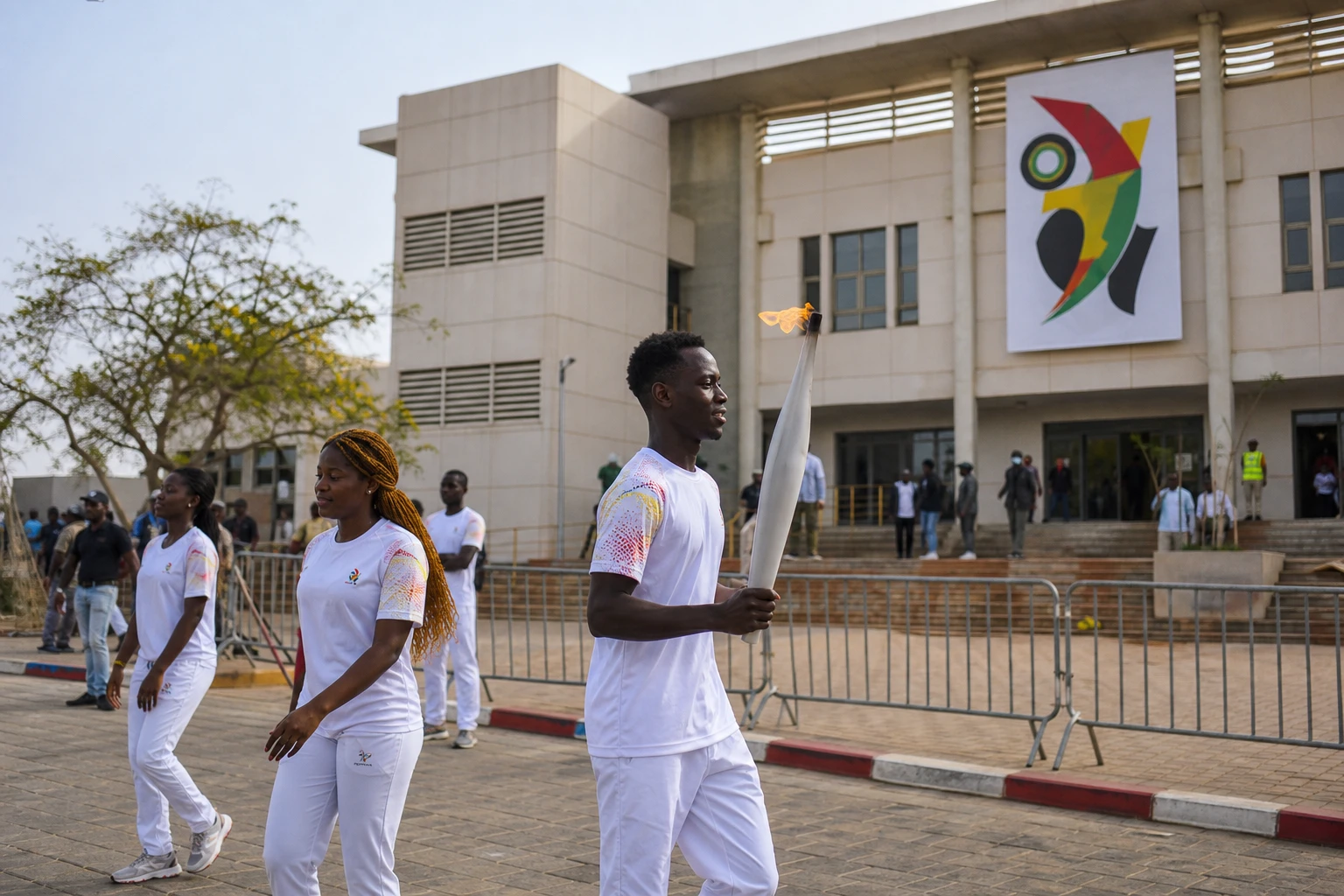
In Senegal’s capital, a sporting flame can say a great deal about a country. It tells a story of national pride, of course. But it also says something broader: how Senegal wants to showcase its young people, its regions and its organisational capacity ahead of an unprecedented event for the African continent. The Dakar 2026 Youth Olympic Games flame relay began in Dakar on 12 September 2026, after being lit in Athens, and is due to travel across the country until the end of October, before the Games open on 31 October.
The launch comes at a particular moment. Dakar 2026 is not taking place only in the stadiums of Dakar, Diamniadio and Saly. It also involves the regions, municipalities, schools, clubs and families. The organising committee describes the tour as a way to spread Olympic values beyond urban centres, with a clear promise: to bring the event to all 14 regions of Senegal.
A tour designed to link the capital with the rest of the country
The flame’s journey began in downtown Dakar. It passed through highly symbolic locations, including Independence Square, the presidential palace, Sandaga and then the city hall. This staging is no coincidence. It places the event among the political and urban landmarks of Senegal’s capital. It also serves as a reminder that Dakar remains the country’s most visible centre, even as the stated ambition is national.
According to the organising committee’s presentation documents, the national tour is to run from 14 September to 16 October 2026 under the slogan “From History to the Future” / “Pass the Energy”, passing through the whole of Senegal. Other material published by the organisers refers to more than 30 stages and a two-part route: first Dakar and its outskirts, then the other regions. Leading African media have confirmed that the tour will cover all 14 regions, with stops announced in areas such as Rufisque, Guédiawaye, Pikine, Saint-Louis, Matam, Kolda and Ziguinchor.
The length of the relay, the distance covered and the scale of the logistics give an idea of the operation. The raw material puts the distance at 3,600 kilometres. The sources consulted chiefly confirm the national scope of the route and its schedule. For Senegal, the main point lies elsewhere: the aim is to take Dakar 2026 beyond the confines of sport and make it an event rooted across the country.
The facts: torchbearers, symbols and a distinctly Senegalese selection
In Dakar, the flame was passed from hand to hand to the sound of drums played by the 12th Gaïndé, a supporters’ collective well known in Senegalese sport. The torchbearers include young athletes, former Olympians and figures from other fields, including content creators. This diversity is more than a communications detail. It reflects an effort to bring together sport, popular culture and new media habits.
The organisers’ narrative is also rooted in the regions. President Bassirou Diomaye Faye has already stressed that the flame’s tour of Senegal’s 14 regions is a marker of inclusion and national mobilisation. The presidency describes the Games as a challenge for the country and a continental responsibility, given that they are the first Olympic event to be held on African soil.
The official schedule confirms the dates. The Dakar 2026 Youth Olympic Games are set to take place from 31 October to 13 November 2026, with the opening ceremony at Abdoulaye Wade Stadium in Diamniadio. Competition venues are spread across Dakar, Diamniadio and Saly, requiring careful organisation of transport, security, accommodation and urban services.
What the event changes in practice
For Senegal, the stakes go beyond the ceremony. The Youth Olympics are a full-scale test of infrastructure, local administrations and coordination between the state, local authorities and the organising committee. They also encourage a more even distribution of attention between the capital, its suburbs and developing hubs such as Diamniadio and Saly. This matters in a country where Dakar still attracts much of the attention, economic activity and movement of people.
The decision to hold a nationwide tour also addresses a simple question: how can young people who do not all live in the places that benefit from major events take part? In practice, the activities announced alongside the relay — sports demonstrations, workshops, introductory sessions, and cultural and educational events — are intended to turn an Olympic symbol into a local experience. This may build support, but it could also raise expectations of a tangible legacy: neighbourhood facilities, sporting opportunities, temporary jobs and a fairer distribution of the benefits.
The cultural dimension matters just as much. Senegal’s official messaging emphasises “Teranga”, or Senegalese hospitality, presenting it not as folkloric decoration but as an intangible contribution to the Olympic model. This framing responds to a frequent criticism of major international events: infrastructure alone is not enough; there must also be a way of welcoming people, passing on traditions and bringing the event to life.
A regional significance that extends well beyond Senegal
Dakar 2026 resonates beyond Senegal. West Africa, a region of intense movement between ECOWAS countries, views the event as a test of the collective ability to host a global gathering without overlooking local realities. The symbolism is powerful: Africa is no longer merely a spectator to the Olympic movement; it is becoming its host.
Attention will now turn to the end of the tour, scheduled for 30 October, and then to the opening of the Games the following day. Between those two dates, Senegal will be staging far more than a ceremony. It will seek to show that a major event can begin in an urban centre, travel through the regions and leave behind more than an image: new uses, facilities and a shared memory. That is where the true success of Dakar 2026 will be decided.