Egypt
 Libya
 Morocco
 Sudan
 Tunisia
 Benin
 Burkina Faso
 Cabo Verde
 Côte d'Ivoire
 Ghana
 Guinea
 Guinea-Bissau
 Liberia
 Mali
 Mauritania
 Niger
 Nigeria
 Senegal
 Sierra Leone
 The Gambia
 Togo
 Cameroon
 Central African Republic
 Chad
 DR Congo
 Equatorial Guinea
 Gabon
 Republic of the Congo
 São Tomé and Príncipe
 Burundi
 Comoros
 Djibouti
 Eritrea
 Ethiopia
 Kenya
 Madagascar
 Malawi
 Mauritius
 Mozambique
 Rwanda
 Seychelles
 Somalia
 South Sudan
 Tanzania
 Uganda
 Angola
 Botswana
 Eswatini
 Lesotho
 Namibia
 South Africa
 Zambia
 Zimbabwe
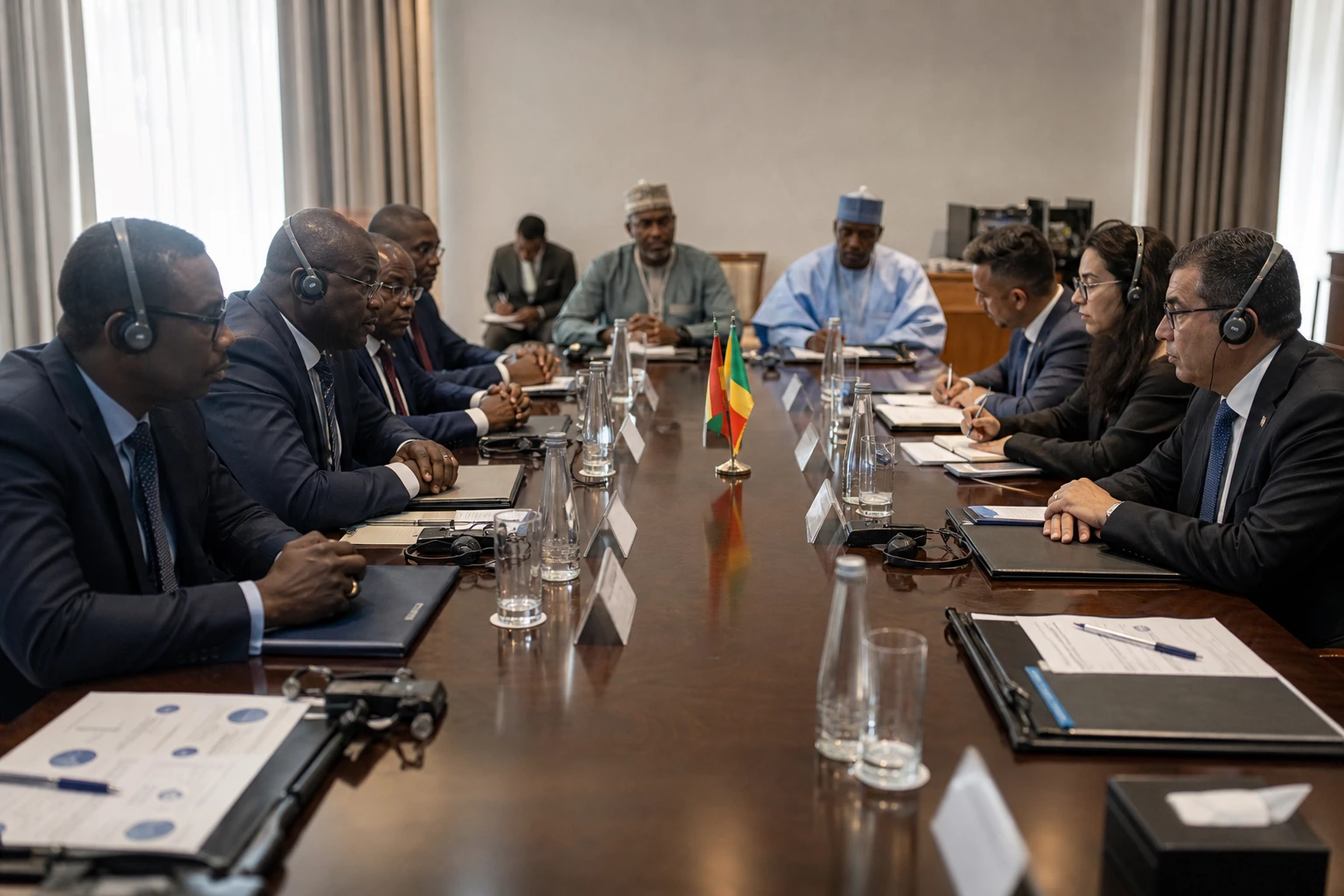
As Bamako and Algiers seek to close a border crisis that became diplomatic
Between northern Mali and Algeria, the border separates more than two states. It also connects trade routes, families, security networks and political expectations. For several months, Bamako and Algiers have sought to turn a damaged relationship into a channel for dialogue. Algerian Prime Minister Sifi Ghrieb’s visit to Bamako on Monday 14 September 2026 is part of this cautious thaw.
For Mali, a Sahelian country whose stability remains fragile, this rapprochement matters far beyond diplomatic ceremony. For Algeria, which shares more than 1,300 kilometres of border with Mali, the challenge is also to retain a role as an interlocutor in a Sahelian region reshaped by crises, military transitions and regional realignments.
A diplomatic process revived after the 2025 rupture
The crisis between the neighbours took a sharp turn after a Malian drone was destroyed by Algerian air defences on the night of 31 March to 1 April 2025, near Tinzaouatène on the border. Bamako disputed Algeria’s account that its airspace had been violated. Tensions then led to the reciprocal recall of ambassadors and the closure of airspace, before a gradual easing began in summer 2026.
On 10 July 2026, Mali announced the return of its ambassador to Algiers and the reopening of its airspace to civilian and military aircraft travelling to or from Algeria. Algiers lifted the same restrictions that day. At the end of July, the Algerian ambassador in Bamako was received by Mali’s foreign minister, signalling a resumption of the political channel.
Sifi Ghrieb’s visit to Bamako therefore follows a phase of de-escalation achieved through small steps. It comes after Malian Prime Minister Abdoulaye Maïga’s visit to Algiers on 24 August 2026, where he was received by his Algerian counterpart and then by President Abdelmadjid Tebboune. The Malian authorities described the trip as a platform for revitalising bilateral cooperation.
Discussions extending beyond security
In Bamako, Sifi Ghrieb is due to meet the president of the transition, General Assimi Goïta, and hold talks with Mali’s head of government, Major General Abdoulaye Maïga. According to information published by the Malian authorities and the African Press Agency, the discussions are intended to prepare a roadmap and revive institutional cooperation mechanisms, including the Algerian-Malian Joint Commission.
The agenda is not limited to military matters. The two capitals are also seeking to reopen economic and administrative initiatives that have been on hold. These include cross-border trade, transport, coordination between administrations and, more broadly, the movement of people and goods in a Saharan region where informal markets play a major role. In this part of Mali, diplomatic normalisation has a direct impact on traders, transport operators and communities living on both sides of the border.
Security nevertheless remains central. Algiers has long championed a doctrine based on state sovereignty and opposition to interference, while affirming its support for Mali’s unity. Bamako, for its part, wants to retain control over its security and diplomatic decisions. The renewed dialogue is therefore intended both to limit risks along the border and to restore a minimum level of trust between two state administrations that watch each other as much as they talk.
What rapprochement means for Mali and the Sahel
In the Malian context, this détente has broader political significance. The country remains engaged in a military transition and in a new Sahelian framework with Burkina Faso and Niger, within the Confederation of Sahel States. But Bamako continues to work with its neighbours and with regional and continental organisations, including the African Union, which recently called for lasting de-escalation amid rising armed violence in the Sahel.
For the Malian authorities, a smooth channel with Algiers offers several advantages. First, it reduces the risk of military incidents along a long and difficult-to-monitor border. Second, it could facilitate information-sharing on armed groups active in the north and across the Sahel-Sahara region. Finally, it gives Bamako more room to diversify its partnerships without relying on a single diplomatic axis.
For Algeria, resuming dialogue with Bamako allows it to reassert a regional role unsettled by the Sahel’s realignments. Several APA analyses note that Algiers’ influence in the region has diminished amid recent political ruptures, but that Algerian diplomacy continues to rely on mediation, proximity to the border and political approaches to crises. The Bamako visit is therefore also a test of the credibility of this approach.
A bilateral matter with continental consequences
Beyond the face-to-face talks between Bamako and Algiers, the episode says something about the current moment in Africa. In several parts of the continent, states are seeking to reorganise their alliances, take control of security issues and reduce their dependence on external mediation. The Mali-Algeria case is a reminder that a Saharan border can affect the balance across West Africa, the Maghreb and the Sahel.
What happens next will depend less on statements than on practical mechanisms. Attention will turn to the planned technical meetings, preparations for a visit to Algeria by Mali’s president of the transition and, above all, the two capitals’ ability to stabilise a dialogue that has already broken down several times. In a region where crises spread quickly, genuine easing of tensions between Bamako and Algiers would matter far beyond their shared border.