
 Algeria
 Egypt
 Libya
 Morocco
 Sudan
 Tunisia
 Benin
 Burkina Faso
 Cabo Verde
 Côte d'Ivoire
 Ghana
 Guinea
 Guinea-Bissau
 Liberia
 Mali
 Mauritania
 Niger
 Nigeria
 Senegal
 Sierra Leone
 The Gambia
 Togo
 Cameroon
 Central African Republic
 Chad
 Equatorial Guinea
 Gabon
 Republic of the Congo
 São Tomé and Príncipe
 Burundi
 Comoros
 Djibouti
 Eritrea
 Ethiopia
 Kenya
 Madagascar
 Malawi
 Mauritius
 Mozambique
 Rwanda
 Seychelles
 Somalia
 South Sudan
 Tanzania
 Uganda
 Angola
 Botswana
 Eswatini
 Lesotho
 Namibia
 South Africa
 Zambia
 Zimbabwe
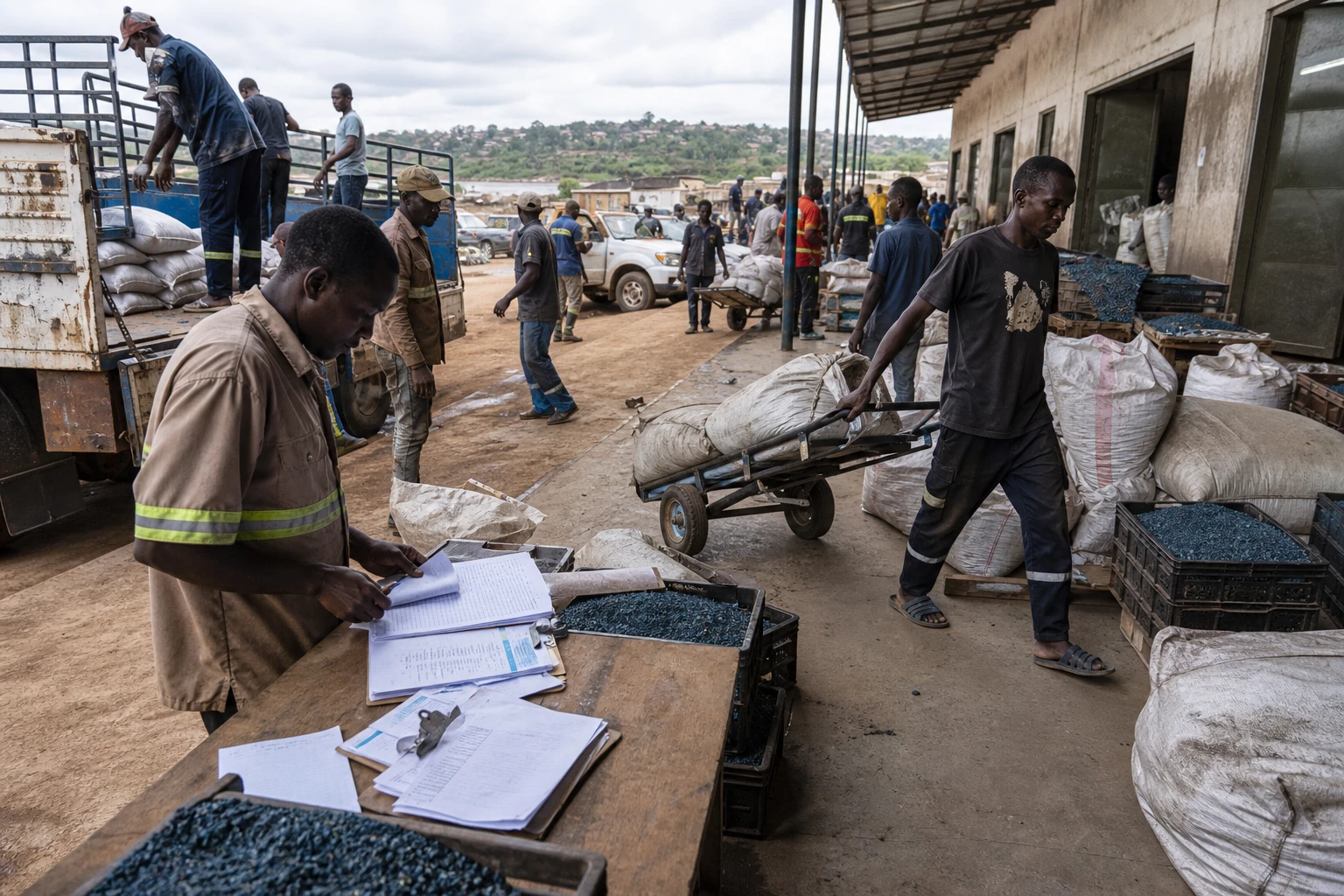
When Congolese cobalt is no longer invisible
In Kolwezi, Likasi and along the mining routes of Lualaba, the issue is no longer simply getting ore out of the ground. It is now a question of who buys it, who traces it and who captures its value. In the Democratic Republic of the Congo, artisanal cobalt is no longer just a by-product of the mining sector: it is becoming a strategic asset in a global supply chain linking Kinshasa, Geneva, Houston, Dubai and Singapore.
This shift is significant. Cobalt remains a key metal for some batteries, as well as for industrial and aerospace uses. The DRC, meanwhile, retains a central position in the sector. According to the Cobalt Institute, the country accounted for 73% of global cobalt production in 2025. The same body notes that artisanal mining, which was long significant, fell to less than 2% of Congolese production in 2024 after several years of decline.
Artisanal formalisation seeks a foothold
The heart of the issue lies in the artisanal segment, often referred to as ASM, for artisanal and small-scale mining. This is where the Entreprise Générale du Cobalt, or EGC, comes in: a Congolese state-owned company tasked with buying, processing and exporting artisanal cobalt through official channels. Established in 2019, it long struggled to translate that mandate into tangible volumes. But 2025 and 2026 marked a turning point.
In November 2025, EGC announced its first traceable production of 1,000 tonnes of artisanal cobalt in Kolwezi, in Lualaba. Then, on 9 February 2026, Mercuria confirmed its first purchase of copper and cobalt from EGC. On 13 May 2026, EGC, Trafigura and EVelution Energy also announced a memorandum of understanding to build a direct supply chain between the DRC and the United States. These developments show one simple thing: Congolese artisanal supply is becoming bankable again when it enters more transparent channels.
The regulatory framework has also changed. Following the suspension of cobalt exports decided in February 2025 by the Congolese authority regulating strategic mineral substances, the country adopted a quota system in September 2025, effective from 16 October 2025. The mechanism sets an annual ceiling and reserves a strategic share for the state. It is intended to reduce oversupply, stabilise prices and regain control of a resource that has long left the country without sufficient oversight.
Why traders are interested now
The renewed interest in Congolese artisanal cobalt is first and foremost explained by the market. After a prolonged period of surplus, prices have rebounded. The IEA now estimates that cobalt could face a more pronounced supply deficit as Congolese quotas limit export volumes. The Cobalt Institute, for its part, notes that global demand continued to grow in 2025, driven by batteries, electronics and some industrial, defence and aerospace uses.
In this context, traders are seeking traceable volumes that are easier to defend against compliance requirements. This is where the DRC can gain more than simply a commercial outlet. If artisanal cobalt is better organised, the country can retain a larger share of the value while reducing the opacity that has long surrounded the segment. But this requires reliable purchasing channels, effective checks and a genuine state presence at mining sites.
The interests of major trading houses are aligned with this approach. Mercuria has already formalised a transaction with EGC. Trafigura followed with a partnership focused on a direct DRC–US supply chain. BGN, whose official locations include Houston, Geneva, Singapore and Dubai, operates in the same global trading sphere, where swift access to critical metals matters as much as their provenance. Their presence in these trading centres shows how Congolese cobalt now moves through decision-making networks far broader than the Katanga mining basin alone.
What this means for the Congolese
For artisanal miners, the stakes are tangible. A more structured market can offer more secure outlets, clearer prices and, in time, better working conditions. But the equation remains fragile. Artisanal mining in the DRC continues to be associated with familiar risks: accidents, unequal bargaining, informality, pressure on incomes and inadequate oversight of purchasing chains. Formalisation only makes sense if it genuinely improves workers’ daily lives.
For the Congolese state, the issue extends beyond the mining sector. It concerns public revenues, regulatory credibility and Kinshasa’s ability to arbitrate between large industrial producers, artisanal operators and foreign buyers. Decisions taken since 2025 show that the authorities want to regain a strategic lever. The DRC is no longer content simply to export raw ore; it is trying to redefine the terms of access to its production.
For Central Africa, the signal is broader. Congolese cobalt has become a test of economic sovereignty in a region where raw materials are now attracting entire industrial supply chains, not just buyers of unprocessed commodities. What is at stake in Kolwezi reverberates as far as the markets of Dubai and Geneva, as well as in African debates on local processing, traceability and the role of states in critical supply chains. The next step will be measured by EGC’s ability to increase its volumes without losing control, and by Kinshasa’s ability to turn renewed global interest into lasting income for the Congolese.



