Algeria
 Egypt
 Libya
 Morocco
 Sudan
 Tunisia
 Benin
 Burkina Faso
 Cabo Verde
 Côte d'Ivoire
 Ghana
 Guinea
 Guinea-Bissau
 Liberia
 Mali
 Mauritania
 Niger
 Nigeria
 Senegal
 Sierra Leone
 The Gambia
 Togo
 Cameroon
 Central African Republic
 Chad
 DR Congo
 Equatorial Guinea
 Gabon
 Republic of the Congo
 São Tomé and Príncipe
 Burundi
 Comoros
 Djibouti
 Eritrea
 Ethiopia
 Kenya
 Madagascar
 Malawi
 Mauritius
 Mozambique
 Rwanda
 Seychelles
 Somalia
 South Sudan
 Tanzania
 Uganda
 Angola
 Botswana
 Eswatini
 Lesotho
 Namibia
 South Africa
 Zambia
 Zimbabwe
A real decline, but not yet a victory
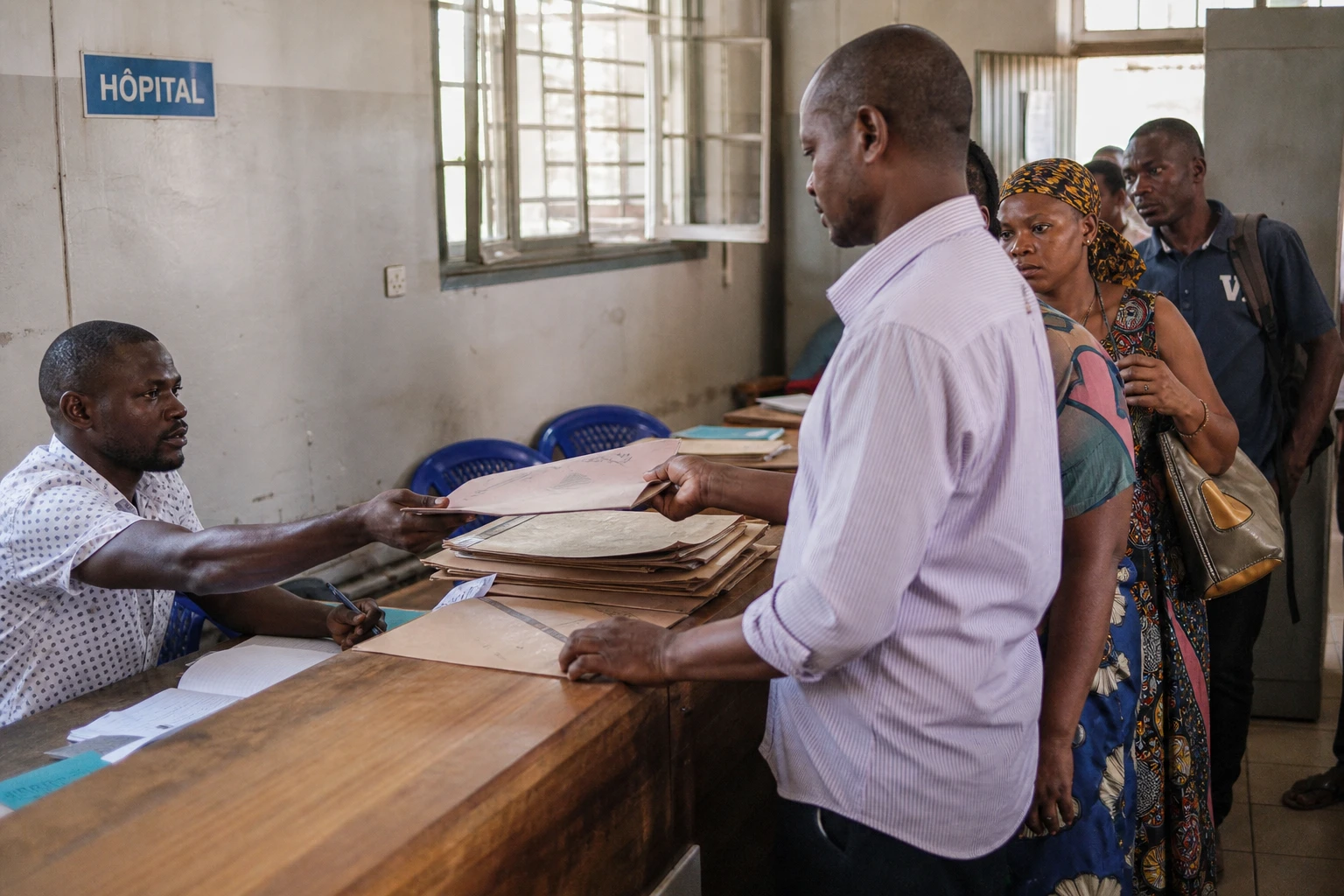
In Kinshasa, health authorities are describing a turning point in the response to Ebola in the Democratic Republic of the Congo. The curve is falling, but the virus continues to spread through outbreaks, province by province. In a vast country where distances complicate contact tracing, each statistical decline may conceal operational weaknesses on the ground.
This phase matters for the DRC, but also for all of Central Africa and the Great Lakes region. The country shares borders with several states where cross-border movement is part of daily life. That is why the response is playing out not only in treatment centres, but also in health posts, markets, along roads and in forested areas.
What the latest figures show
The latest available data indicate that the epidemic has passed a symbolic threshold. As of 7 September 2026, the DRC had recorded 6,757 confirmed cases, or 6,778 cases for the DRC, Uganda and France combined in the World Health Organization’s global tally. On 10 September, a new tally reported by the authorities and carried by several media outlets put the number at 7,022 confirmed cases and 3,398 deaths, with a case fatality rate of 48.4%. These differences between datasets are explained by the speed at which results are reported and by surveillance adjustments.
On 10 September alone, 80 new cases and 49 deaths were reported, according to the response report cited by the Congolese press. North Kivu accounted for the majority of new infections, followed by Ituri, Haut-Uélé and Sud-Ubangi. At the same time, ten of the 61 affected health zones had not recorded a new case for at least 21 days, a positive sign but not yet enough to speak of the outbreak ending.
Sud-Ubangi has also been added to the list of affected provinces. According to the acting governor, the first confirmed case was reported in the Gbulu health zone, following analysis by the National Institute for Biomedical Research. This brings the number of provinces affected to seven, according to the Congolese authorities.
An expanded response spanning care, research and logistics
The response is no longer based solely on isolating patients. In Kinshasa, on 4 September, the government and its partners launched a revised 180-day plan to accelerate the response. The goal is clear: strengthen coordination, improve contact tracing, protect health workers and reduce transmission in the areas most at risk. Africa CDC says the epidemic has become the second-largest ever recorded in the DRC and the fastest-spreading observed to date.
The health minister has also highlighted two new measures: so-called compassionate vaccination to protect some people who have been exposed, and clinical research into the Ebola Zaire vaccine to assess whether it could offer cross-protection against this Bundibugyo virus. More than 70,000 doses have already been received, according to the authorities. The challenge now is to get the vaccine, staff and sampling equipment quickly to areas that are sometimes far from major urban centres.
This scientific dimension matters. It shows that the DRC is not limiting itself to an emergency response. It is also trying to learn from each outbreak by combining surveillance, targeted vaccination and operational research. This is a notable development in a country where successive Ebola outbreaks have often exposed the limits of an overly centralised response.
What the decline changes, and what it does not yet change
The decline is first of all a relief for teams on the ground. In the Nia-Nia, Nizy and Mongwalu health zones, the authorities are seeing transmission slow. But the downturn is not benefiting everyone equally. In cities, access to care, testing and prevention messages remains quicker. In rural areas, delays between suspicion, sampling and confirmation can still cost lives.
Community deaths remain a major concern. In its bulletins, the WHO has already highlighted the toll of deaths outside treatment centres and the pressure on facilities in North Kivu. In other words, as long as the disease is spreading within families before people reach the health system, a fall in cases does not guarantee an immediate fall in mortality.
The regional dimension is just as clear. Africa CDC and the WHO have called for urgent community action, and East African health ministers adopted commitments in August to strengthen regional health security in support of the Congolese response. The DRC thus finds itself at the intersection of two imperatives: containing the epidemic at home and preventing its spread to neighbouring countries.
A test for Congolese public health and African cooperation
Ultimately, this period says something broader about public health in Africa. It is a reminder that an epidemic does not end when the curve turns down, but when surveillance is sustained, contacts are followed through to the end and every outbreak is contained without a resurgence. In the DRC, the next stage will therefore be less dramatic than the alert phase, but decisive: stabilising areas already affected, preventing new outbreaks and maintaining communities’ trust.
For Kinshasa, the challenge is also political and logistical. Coordination must be maintained between the state, the INSP, health workers, the WHO, Africa CDC and bilateral partners. Above all, a partial improvement must not be mistaken for the end of the crisis. In an epidemic this mobile, true victory is not measured by a single peak having passed, but by the response’s ability to hold until the last link in transmission is broken.