
 Algeria
 Egypt
 Libya
 Morocco
 Sudan
 Tunisia
 Benin
 Burkina Faso
 Cabo Verde
 Côte d'Ivoire
 Ghana
 Guinea
 Guinea-Bissau
 Liberia
 Mali
 Mauritania
 Niger
 Nigeria
 Senegal
 Sierra Leone
 The Gambia
 Togo
 Cameroon
 Central African Republic
 Chad
 Equatorial Guinea
 Gabon
 Republic of the Congo
 São Tomé and Príncipe
 Burundi
 Comoros
 Djibouti
 Eritrea
 Ethiopia
 Kenya
 Madagascar
 Malawi
 Mauritius
 Mozambique
 Rwanda
 Seychelles
 Somalia
 South Sudan
 Tanzania
 Uganda
 Angola
 Botswana
 Eswatini
 Lesotho
 Namibia
 South Africa
 Zambia
 Zimbabwe
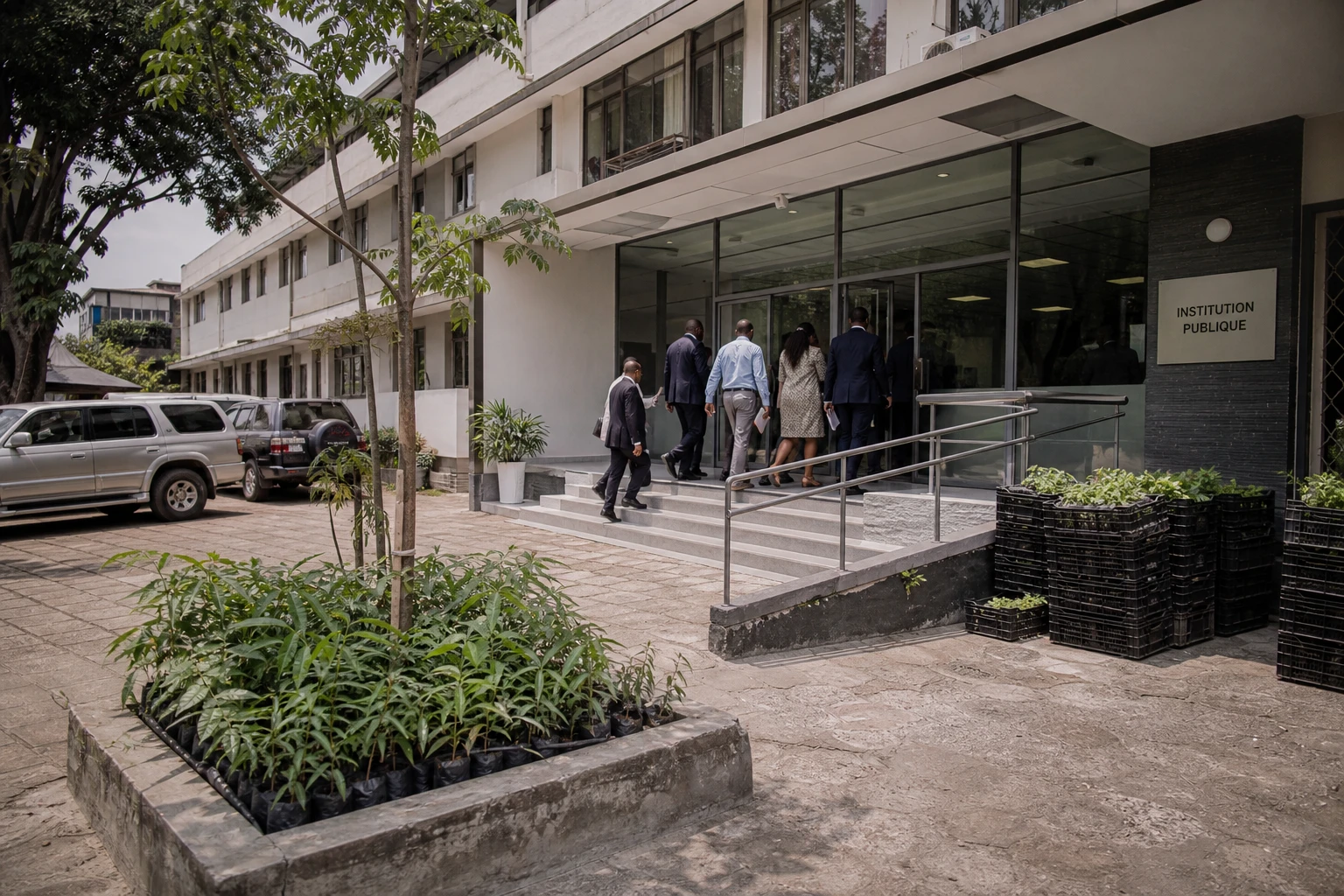
When public reforestation funds fail to reach the trees
In the Democratic Republic of the Congo, reforestation is both a climate emergency and a test of the state’s credibility. In a country whose forest is among the world’s largest carbon reserves, every franc or dollar spent badly weighs on soil restoration, watershed protection and citizens’ trust in green policies. The National Forestry Fund case shows precisely this gap between stated ambition and what can actually be seen on the ground.
The National Forestry Fund, a Congolese public institution, is tasked with financing reforestation, forest management and any operation that helps rebuild forest resources. Its work is governed by the Forest Code and the decree setting out its creation and operations. The Court of Auditors conducted an audit of its management for the 2021-2024 period and published its report in Kinshasa in August 2025.
What the Court of Auditors found
The core of the case is straightforward: funding was indeed granted to projects presented as reforestation operations, but on-site inspections did not confirm the reported work. The Court says it used the projects’ geographical coordinates and visited several sites. It says it found, depending on the case, wasteland, savannah with no visible planting, or untouched areas with no trace of the announced afforestation.
In Haut-Katanga, around Lubumbashi and Kipushi, the Court cites a project run by an NGO that received nearly $230,000. On a site linked to Regideso, 24 hectares were to be used for intensive planting. Auditors say they found only wasteland and natural savannah. In a second case, a foundation that received $90,000 for 50 hectares in the village of Kilambo is said to have left behind only a nursery of about 19,000 young plants, which, according to the report, were abandoned for lack of transplanting and protection.
The Court goes beyond its findings. It recommends drawing up a blacklist of NGOs and organisations involved in these “fictitious projects” and demanding the repayment of funds improperly received. It also believes that some funding was approved outside the normal technical process, without a favourable opinion from the FFN’s specialist departments. In its report, it gives an adverse opinion on the management under review.
A fund that mainly pays for its own machinery
The report’s second key finding concerns the spending structure itself. The Court of Auditors notes that between 2021 and 2025, the FFN incurred cumulative costs of nearly 92 billion Congolese francs. At the official exchange rate published by the Central Bank of Congo on 10 September 2026, that amounts to just over $40.6 million.
Only a limited share of this sum is said to have gone to reforestation projects. The Court of Auditors, as reported by the Congolese press, puts the share allocated to project funding at 12.08% of costs, or 11.06 billion Congolese francs. The remainder, nearly 81.5 billion Congolese francs, was absorbed by overheads: staff, services, goods, materials and equipment. At the same official exchange rate, those 11.06 billion francs amount to about $4.9 million.
The trend is even more worrying. The report highlights a steady decline in the share allocated to reforestation: 27% in 2022, 17% in 2023, just over 8% in 2024 and then 0.11% in 2025. In other words, the body meant to replant trees has drifted towards a model of administrative self-maintenance. This undermines the Fund’s ability to act in degraded areas, particularly where erosion, agricultural pressure and rapid urbanisation require planting to be sustained over time.
Why the case goes beyond the FFN
The issue goes beyond the accounts of a single institution. In DR Congo, the presidential “one billion trees” initiative has made reforestation a visible political marker. The Court also recalls that in 2022 the FFN was heavily called upon as part of the initiative and that 105 projects were selected that year. But without follow-up, robust technical checks and sound supporting documents, the headline announcement does not translate into lasting tree cover. In March 2025, the Congolese environment ministry had already asked NGOs and entities funded by the FFN to submit their activity and financial reports for the period January 2021-December 2024.
For local communities, the stakes are tangible. In Haut-Katanga, on the outskirts of Kinshasa or in other provinces concerned, a reforestation project is not merely a budget indicator. It should stabilise soils, protect fields, limit the effects of heavy rainfall and create local work around nurseries, planting and maintenance. When the money stops at the payment stage, the ecological value disappears, while the promises remain in the reports.
There is also a governance issue. The report highlights management failings, projects that were not properly approved and inadequate traceability. This raises a broader question for DR Congo: how can the green transition be funded without also building mechanisms for on-site audits, disclosure of beneficiaries and checks on results? As a SADC member engaged in African and international climate negotiations, the answer matters beyond the country’s borders. The credibility of Congolese reforestation also affects the place of the Congo Basin in the continent’s climate policies.
What happens next will depend on two fronts. First, the follow-up to the Court of Auditors’ recommendations: repayment, possible sanctions and procedures brought into compliance. Second, the ability of the FFN and its supervising ministry to refocus resources on the ground, where hectares must become trees rather than remain budgetary promises. Only then can DR Congo’s afforestation policy move from announcements to verifiable results.



