
 Algeria
 Egypt
 Libya
 Morocco
 Sudan
 Tunisia
 Benin
 Burkina Faso
 Cabo Verde
 Côte d'Ivoire
 Ghana
 Guinea
 Guinea-Bissau
 Liberia
 Mali
 Mauritania
 Niger
 Nigeria
 Senegal
 Sierra Leone
 The Gambia
 Togo
 Cameroon
 Central African Republic
 Chad
 Equatorial Guinea
 Gabon
 Republic of the Congo
 São Tomé and Príncipe
 Burundi
 Comoros
 Djibouti
 Eritrea
 Ethiopia
 Kenya
 Madagascar
 Malawi
 Mauritius
 Mozambique
 Rwanda
 Seychelles
 Somalia
 South Sudan
 Tanzania
 Uganda
 Angola
 Botswana
 Eswatini
 Lesotho
 Namibia
 South Africa
 Zambia
 Zimbabwe
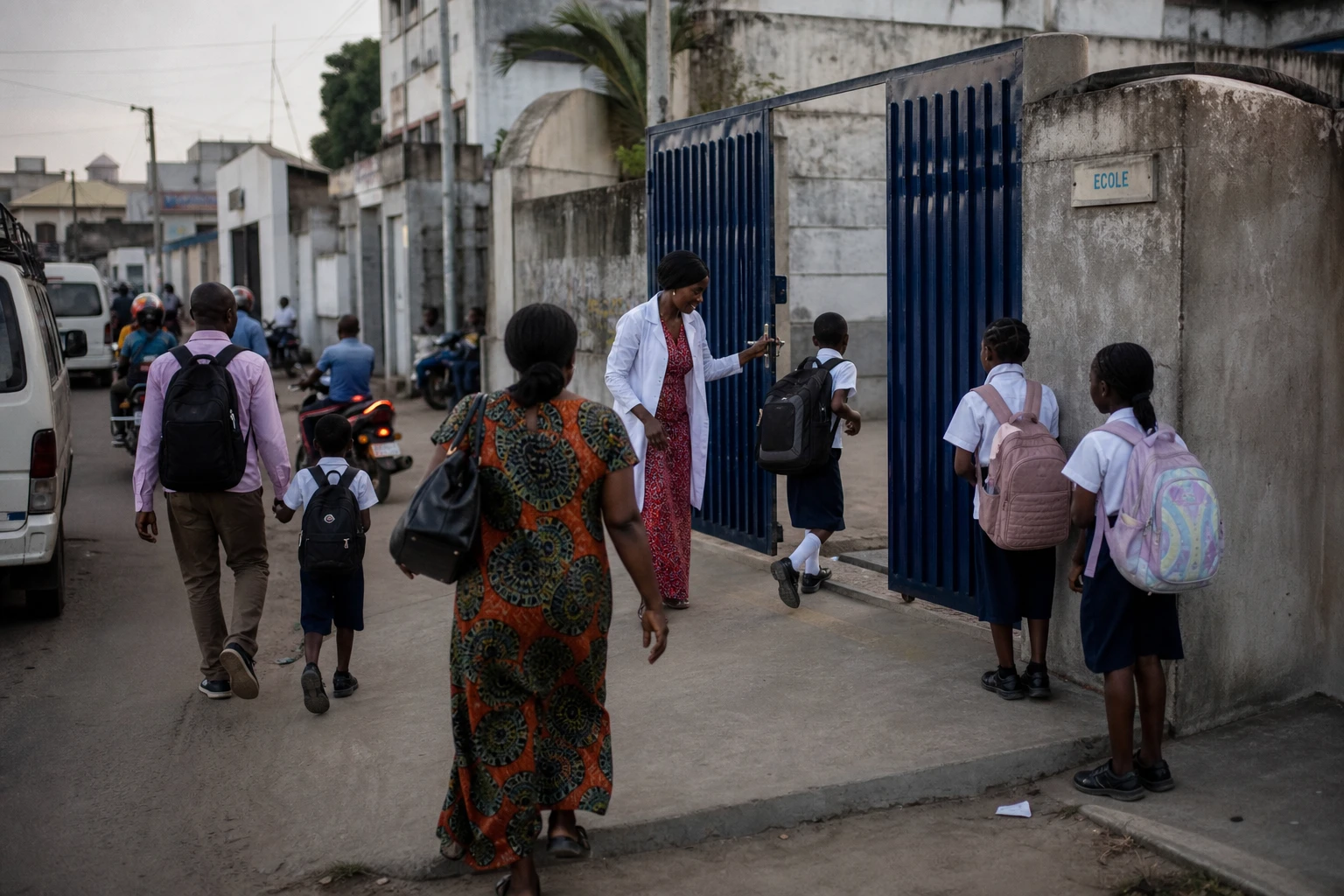
In Kinshasa, a tense start to the school year
In the Democratic Republic of the Congo, the start of the school year is about more than a calendar and new schoolbags. In the east of the country, it still depends on the safety of roads, villages and school buildings. When a school becomes a shelter, a target or a makeshift dormitory, the entire social contract is shaken.
The problem is not new. For several years, the eastern provinces have paid the price of fighting, mass displacement and the growing number of schools occupied, damaged or closed. North Kivu, South Kivu and Ituri remain at the heart of this education crisis, even as the Congolese Ministry of National Education confirmed that classes would resume across the country on 1 September 2026.
491,578 children out of school, according to the Education Cluster
The latest assessment by the Education Cluster in the Democratic Republic of the Congo, the sector’s humanitarian coordination mechanism, counts 1,131 schools still closed a week after classes resumed. It estimates that 491,578 children are out of school. This figure is part of a broader picture: 6,745 schools have been affected by incidents and more than 2.3 million children have been directly affected by these disruptions.
The breakdown shows the scale of the geographical imbalance. South Kivu alone accounts for 462 closed schools and 261,223 children out of school. North Kivu follows, with 241 schools closed and 81,715 children affected. In Ituri, 129 schools are closed, affecting 45,124 pupils. These figures show a simple reality: the education crisis is first and foremost a crisis in eastern Congo, even though its effects are felt across the country.
When classrooms become shelters, learning suffers
The reasons for the closures are well known: insecurity, repeated fighting, the occupation of school buildings, destruction and direct attacks. In some cases, schools are also sheltering displaced people because there is no immediate alternative. This shift is not merely a material one. It deprives children of a space for routine, protection and learning, just when displaced families need stability most.
South Kivu illustrates this cycle of disruption. When hundreds of schools remain closed in a single province, children lose more than class hours. They also lose contact with their teachers and classmates, as well as progress in their studies. In a country where public primary education is officially free, the closure of a public school has an immediate impact on low-income households, which must then choose whether to wait, move a child or take on additional informal costs.
In Masisi, North Kivu, adaptation sometimes means relocating classes to safer centres. Seven schools moved their pupils to Masisi-Centre in early September 2026. This emergency measure makes it possible to continue some teaching, but it also reflects a schooling experience uprooted from home, often more expensive, more precarious and slower to stabilise for displaced families.
A matter of protection as well as education
In the east of the Democratic Republic of the Congo, schools also play a protective role. Humanitarian organisations warn of two major risks: forced recruitment by armed groups and gender-based violence. When classes close, children spend more time outside any safe environment, increasing their exposure to abuse, early labour and permanent disruption to their education.
This reality affects different areas in different ways. In urban areas, some families can move their children to another school or a less exposed neighbourhood. In rural areas, this option is rarely available. Transport costs, the state of the roads and insecurity along routes often prevent any continuity. Ultimately, the poorest households are also those with the least room for manoeuvre.
The institutional response is seeking to limit the damage. The Congolese Ministry of National Education kept the 1 September 2026 start date, while referring to tailored arrangements in areas affected by Ebola and insecurity. On paper, the country remains on track with its school calendar. On the ground, the question is no longer just whether to open the doors, but whether they can stay open.
What this crisis says about DR Congo and the Great Lakes region
The crisis in DR Congo’s schools goes beyond the Ministry of Education. It reflects the security situation in the east, internal displacement, the state’s ability to protect public services and the pressure on the Great Lakes border provinces. As such, it also concerns regional dynamics, particularly in an area where fighting, displacement and the closure of infrastructure reverberate from one province to another.
The continental significance is clear. When nearly half a million children have their schooling interrupted in a single country, the issue is no longer local. It touches on Africa’s promise of accessible, continuous and protective education, including in times of crisis. In DR Congo, schools remain a sensitive indicator of security, administrative capacity and community resilience. As long as fighting moves closer to classrooms, every new school year will feel like a test of survival for the Congolese education system.



