Algeria
 Egypt
 Libya
 Morocco
 Sudan
 Tunisia
 Benin
 Burkina Faso
 Cabo Verde
 Côte d'Ivoire
 Ghana
 Guinea
 Guinea-Bissau
 Liberia
 Mali
 Mauritania
 Niger
 Nigeria
 Senegal
 Sierra Leone
 The Gambia
 Togo
 Cameroon
 Central African Republic
 Chad
 DR Congo
 Equatorial Guinea
 Gabon
 Republic of the Congo
 São Tomé and Príncipe
 Burundi
 Comoros
 Djibouti
 Eritrea
 Ethiopia
 Kenya
 Madagascar
 Malawi
 Mauritius
 Mozambique
 Rwanda
 Seychelles
 Somalia
 South Sudan
 Tanzania
 Angola
 Botswana
 Eswatini
 Lesotho
 Namibia
 South Africa
 Zambia
 Zimbabwe
First crude, then a market to win over
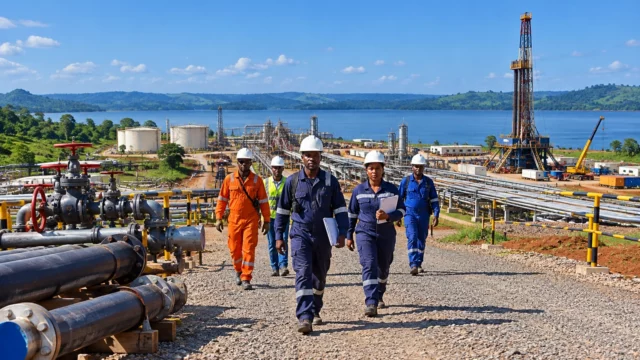
Uganda is finally approaching a moment it has been preparing for nearly 20 years: bringing oil out of the Albertine Basin and onto international markets. But even before the first cargo, the country has chosen the intermediary that will market its crude to refiners. The choice says much about Uganda’s strategy: move quickly, secure sales and rely on a player capable of handling the logistical constraints of a landlocked country.
The issue sits within a specific regional framework. Uganda is a member of the East African Community, an organisation comprising eight partner states, including Tanzania, Kenya and South Sudan. In this region, energy infrastructure no longer serves only to extract oil. It also shapes trade corridors, terminals, depots and decisions between Indian Ocean ports. That is why Kampala is now tying its oil future to Tanga, in Tanzania, rather than to a straightforward national route to the border.
Vitol, from imported fuel to crude for sale
On 5 September 2026, Uganda’s state-owned oil company UNOC announced that it had appointed Vitol to market the share of crude belonging to the state and the public company in the Pearl Sweet project, the now official name of Uganda’s export blend. The announcement came a few days after officials publicly unveiled the name, on 2 September 2026, and confirms that the first exports are now expected in early 2027.
The choice did not come out of nowhere. Vitol already knows the Ugandan market. Since August 2023, its Bahrain subsidiary has held a five-year agreement to import refined petroleum products for Uganda. The arrangement took effect in practice in July 2024, when UNOC began acting as the exclusive importer of petrol, diesel and aviation fuel. Ugandan officials say they see it as a way to better organise supply and reduce the number of intermediaries.
Underground, the project structure remains unchanged. In the Tilenga and Kingfisher fields, UNOC holds a 15% stake, compared with 56.67% for TotalEnergies and 28.33% for CNOOC. Together, the two projects are expected to reach a plateau of about 230,000 barrels per day. Uganda is therefore banking on production that is modest by global standards, but strategically important for its budget, imports and balance of payments.
A useful relationship, but a dependency to watch
The partnership with Vitol is not limited to trading. In December 2025, the group also agreed to establish a $2 billion facility for UNOC, over seven years, at an interest rate of 4.92%. The financing was designed to support oil infrastructure: the refinery, storage terminals in Kampala and Jinja, and transport links for refined products. In other words, the trader is not merely a potential seller. It is also becoming a financier and a link in Uganda’s energy infrastructure.
This close relationship has clear advantages. UNOC has gained visibility, import flows have been better organised, and officials can argue that supplies have been stabilised. Uganda’s finance ministry has also said that import activity helped the state-owned company return to profitability. But this efficiency has a downside: a single company now performs several sensitive functions, from importing fuel to selling crude, as well as providing part of the financing for infrastructure. For a country seeking to strengthen its energy sovereignty, that is no minor issue.
The timeline adds another dimension. For a long time, officials hoped for commercial production in 2025 or 2026. Budget documents for the 2025/2026 financial year now refer to production starting in the second half of 2026, while announcements in September 2026 have shifted expectations for exports to early 2027. This slippage is not merely technical. It shows that the country is entering a phase in which infrastructure construction, financing availability and regional coordination matter as much as geology itself.
An East African issue, not just a Ugandan one
The heart of the system runs through Tanzania. Crude from the Albertine Basin is to be transported by the EACOP pipeline to the port of Tanga on the Indian Ocean. The Tanzanian and Ugandan authorities have also embarked, with Vitol and UNOC, on a project for a regional energy hub in Tanga. In practice, this makes the Uganda–Tanzania corridor an energy backbone for East Africa, with potential benefits for transport, storage, port services and intra-regional trade.
For Kampala, the stakes therefore extend beyond oil alone. The aim is to turn an extractive project into a value chain: production, exports, refining, storage and distribution. For the population, the expected benefits are more tangible than a figure for barrels: they affect pump prices, public revenues, jobs linked to construction and the state’s ability to fund its priorities. For businesses, the signal is different: Uganda is presenting itself as a market that now wants to control its oil logistics rather than be at their mercy.
One central question remains for the coming months: will this expansion give Uganda more room for manoeuvre, or further increase its dependence on international partners already involved at every stage of the oil cycle? The answer will depend on how quickly EACOP is commissioned, progress on the Kabaale refinery, and UNOC’s ability to become an autonomous operator rather than simply a conduit for contracts. In East Africa, where infrastructure is reshaping the balance of power, Uganda has just entered a decisive phase.