
 Algeria
 Egypt
 Libya
 Morocco
 Sudan
 Tunisia
 Benin
 Burkina Faso
 Cabo Verde
 Ghana
 Guinea
 Guinea-Bissau
 Liberia
 Mali
 Mauritania
 Niger
 Nigeria
 Senegal
 Sierra Leone
 The Gambia
 Togo
 Cameroon
 Central African Republic
 Chad
 DR Congo
 Equatorial Guinea
 Gabon
 Republic of the Congo
 São Tomé and Príncipe
 Burundi
 Comoros
 Djibouti
 Eritrea
 Ethiopia
 Kenya
 Madagascar
 Malawi
 Mauritius
 Mozambique
 Rwanda
 Seychelles
 Somalia
 South Sudan
 Tanzania
 Uganda
 Angola
 Botswana
 Eswatini
 Lesotho
 Namibia
 South Africa
 Zambia
 Zimbabwe
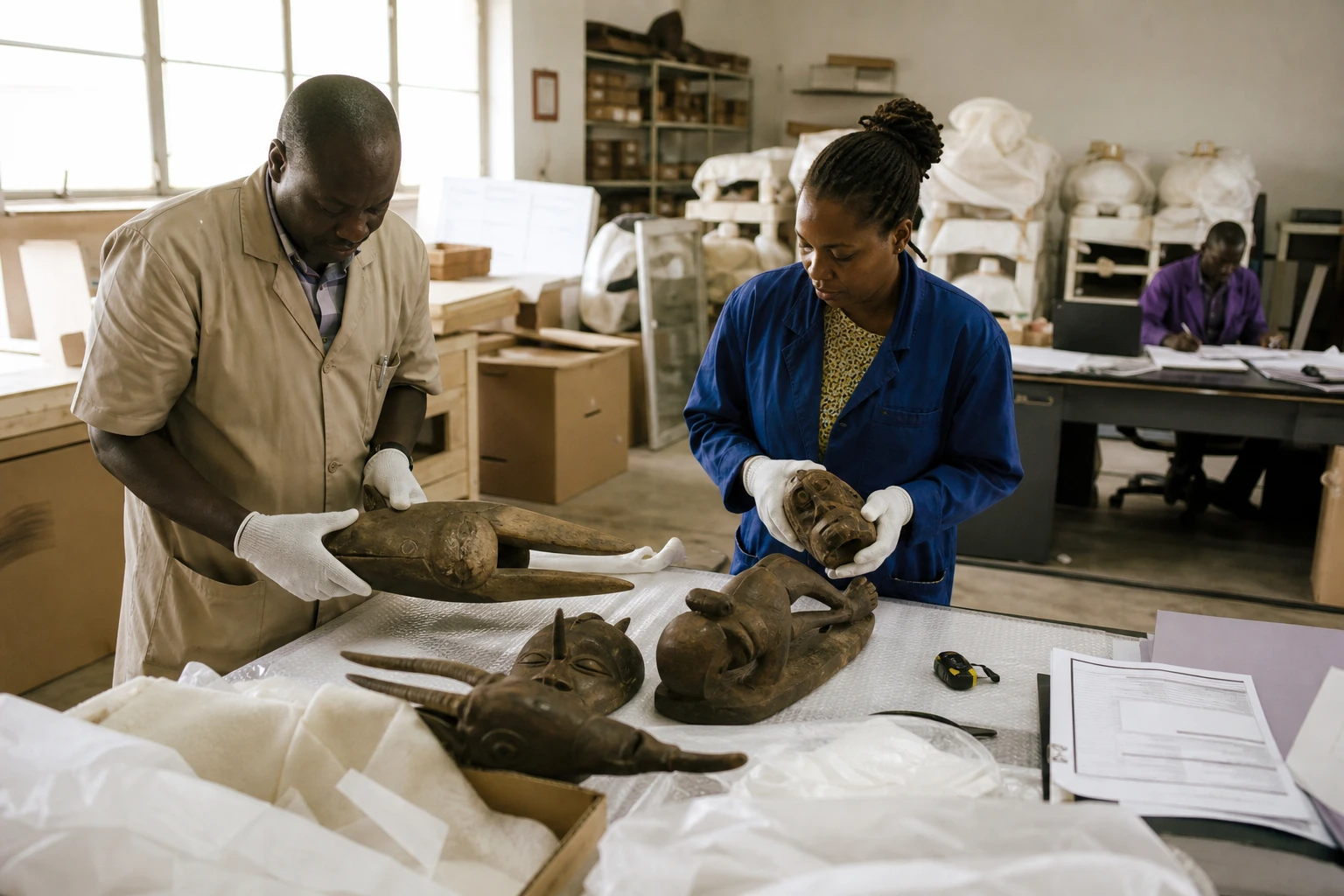
In Paris, an old-art fair reopens a longstanding African question
In the hushed lanes of Saint-Germain-des-Prés, this Paris event does more than sell antique objects. It also puts a broader idea back into circulation: African sculptures were not produced by abstract peoples, but by specific creators, with identifiable gestures, choices and styles. This is an important distinction for museums, collectors and researchers and, beyond them, for the countries from which these works originate.
For Côte d’Ivoire, the stakes are significant. The country, whose capital is Yamoussoukro, has seen debates intensify in recent years over the circulation, attribution and restitution of African artworks. In this context, recognition of a “Master of Bouaflé”, associated with Guro sculptures from Côte d’Ivoire, is no mere scholarly footnote. It is a way of restoring a named place to highly skilled artisans whom art history has long left in the shadows. This reading also comes at a time when the continent’s cultural institutions are seeking to reclaim control of their material and symbolic archives.
An anniversary edition concerned as much with method as with art
The 25th edition of the Parcours des Mondes fair takes place from 8 to 13 September 2026 in Paris’s 6th arrondissement. The town hall of the 6th arrondissement says about 50 French and international galleries are taking part in the event, across a 25,000 sq m route, with more than 10,000 visitors expected or welcomed at each edition. The fair stretches through the streets of Saint-Germain-des-Prés, which over the years has become a hub for the market in ancient art from Africa, Oceania, Asia and the Americas, as well as archaeology.
For this anniversary, two exhibitions frame the presentation: Sculpted Signatures and Continuum. The first makes a simple but decisive argument: when looking at classical African sculpture, it is important to consider not only regions, groups or ritual uses, but also the sculptor’s hand. The second brings ancient works into dialogue with contemporary art inspired by celestial phenomena, showing that African forms do not belong to a frozen past but to a continuing tradition of artistic invention.
This approach is no mere aside. For decades, ancient African art has often been described through collective categories, useful for classification but insufficient to name its makers. The curators instead point out that some works can be linked to the same hand, workshop or formal logic. This is an important methodological correction, because it restores artistic individuality where the colonial gaze, and later the museum gaze, often favoured the anonymity of “tribes” and “styles”.
From the Master of Bouaflé to the Master of Kasadi, working names that change the way we look
In Sculpted Signatures, several groups of works are brought together around anonymous masters identified by art historians. The “Master of Bouaflé” is associated with Guro works from Côte d’Ivoire, including masks and statues made between about 1910 and 1930. Reference works attribute a recognisable style to him, with dynamic profiles and strong formal coherence. For Côte d’Ivoire, this is a reminder that the sculptural arts of the country’s central-western region are not an indistinct whole: they bear aesthetic signatures, even when the sculptor’s personal name has been lost.
The other figure highlighted, the “Master of Kasadi”, is linked to Kongo-Yombe phemba maternity figures from what is now the Democratic Republic of the Congo and neighbouring areas, with dates proposed from the 19th and early 20th centuries. Museum sources note that this working name was coined on the basis of stylistic criteria and a collection location, not a preserved civil record. Here, too, the fair’s value lies less in niche scholarship than in its demonstration that classical African sculpture is a field of individual creation, not production without authors.
This change of focus has practical effects. For museums and researchers, it means revisiting catalogue entries, refining attributions and moving beyond convenient categories. For collectors, it highlights the quality of a group of works beyond the mere exoticism of their provenance. For the African countries concerned, it brings more accurate accounts of their heritage back into view: these works are not simply “African”; they are Ivorian, Congolese or Malian in their contexts, uses and artistic lineages. This is a reasonable inference from the sources consulted, and it connects with wider debates about Africa’s place in world art history.
A continental resonance as Africa rewrites its heritage
The fair’s significance extends beyond the Paris art market. In several African countries, museums, universities and cultural institutions are working to better document collections, the movement of objects and the circumstances of their acquisition. In West Africa, restitution and conservation are now part of heritage policy. In Central Africa, debates about dispersed collections remain vigorous. And in the continent’s cultural capitals, from Dakar to Abidjan, recognition of makers, schools and workshops is becoming an issue of cultural sovereignty as well as research.
The Ivorian case is particularly telling. Guro, Baoulé and Dan sculptures have long featured among the major references in West African art. Yet their international circulation has often been told from Paris, Brussels or New York before being re-examined from Abidjan or Yamoussoukro. The focus on the “Master of Bouaflé” is a reminder that a work created in Côte d’Ivoire can be studied, exhibited and discussed around the world without losing its local roots. It also reminds us that a country cannot be reduced to the extraction of its cultural goods: it produces forms, schools and memories that continue to speak in the present.
The message of this 25th Parcours des Mondes is ultimately clear: classical African sculpture no longer belongs to a history written in a single voice. It is returning as a field of makers, styles and trajectories to be reconstructed. The Paris fair offers a commercial and museum-based version of that story. African states, meanwhile, will have to decide how to turn this kind of recognition into lasting policies for research, conservation and the circulation of works.



