Algeria
 Egypt
 Libya
 Morocco
 Sudan
 Tunisia
 Benin
 Burkina Faso
 Cabo Verde
 Côte d'Ivoire
 Ghana
 Guinea
 Guinea-Bissau
 Liberia
 Mali
 Mauritania
 Niger
 Nigeria
 Sierra Leone
 The Gambia
 Togo
 Cameroon
 Central African Republic
 Chad
 DR Congo
 Equatorial Guinea
 Gabon
 Republic of the Congo
 São Tomé and Príncipe
 Burundi
 Comoros
 Djibouti
 Eritrea
 Ethiopia
 Kenya
 Madagascar
 Malawi
 Mauritius
 Mozambique
 Rwanda
 Seychelles
 Somalia
 South Sudan
 Tanzania
 Uganda
 Angola
 Botswana
 Eswatini
 Lesotho
 Namibia
 South Africa
 Zambia
 Zimbabwe
Anticipated address amid social and budgetary pressure
In Dakar, expectations go well beyond protocol. Prime Minister Ahmadou Al Aminou Lô’s general policy statement must make clear how the Senegalese state intends to respond both to the high cost of living and to debt that has become a heavy burden. In a country where households watch every price rise, the head of government’s speech is also a test of credibility.
The context is all the more sensitive because dozens of people demonstrated in Dakar on 5 September against the high cost of living, while protests continued on social media around the slogan “30 days for a fair price”. This mobilisation gives the political sequence an immediate social dimension.
Between the National Assembly, the budget and political power struggles
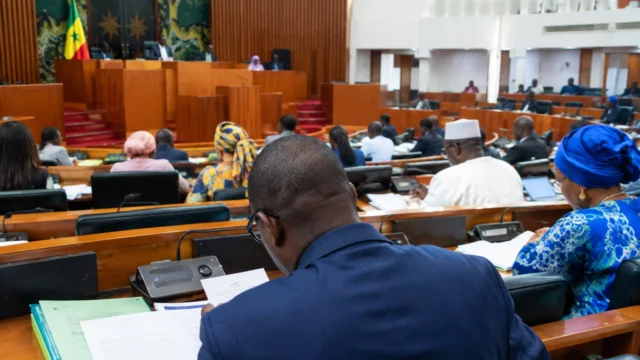
The general policy statement is to be delivered before the National Assembly during an extraordinary session convened for the occasion. The date was initially debated, then set for Tuesday 8 September 2026 at 10am, after several institutional adjustments.
This is not merely a parliamentary event. It comes against a political backdrop in which the head of government must work with a parliamentary majority dominated by Pastef, the party of Ousmane Sonko, who is now president of the National Assembly. The debate on the general policy statement is therefore a moment of political clarification as much as an institutional milestone.
President Bassirou Diomaye Faye, for his part, has asked the prime minister to present the government’s work programme, including forthcoming budget documents and the budget orientation debate. In other words, the general policy statement must provide visibility on the trajectory of public finances.
What the government must say about debt
The heaviest issue remains debt. The IMF estimates Senegal’s total public debt at 132.3% of GDP at the end of 2024, a level that leaves the country under severe constraint. The Fund’s staff also say reforms are needed to restore debt sustainability and reduce fiscal and external vulnerabilities.
On 1 September 2026, the IMF announced a staff-level agreement with Dakar on a 36-month programme worth about $2.2bn. But the agreement remains subject to approval by the Fund’s executive board. It is part of an effort to correct the budget, increase transparency and, above all, address the debt.
According to Reuters, this new financing is linked to a broader discussion on debt restructuring, two years after the revelation of undeclared public debt had already strained relations between Dakar and its lenders. This point is central, as the country seeks to finance its recovery without squeezing its social spending capacity.
The real balancing act: restore order without disrupting daily life
The government will have to spell out what budgetary discipline means in practice. Households want to know whether savings will come from tax rises, cuts to certain spending or a reorganisation of public expenditure. Markets, meanwhile, are looking for signs that the state can meet its commitments without adding to the pressure.
The challenge extends beyond public accounts. The IMF says its programme also aims to increase social spending and support private sector-led growth. For Dakar, the task is therefore to combine financial consolidation with protecting purchasing power, in a country already sensitive to rises in the price of rice, energy and transport.
The equation weighs differently on each group. The executive must restore confidence. Urban households want tangible results on prices. Traders and the informal economy need to avoid a contraction in demand. And public finances must convince people that recovery will not come at the expense of essential services.
Implications beyond Senegal
The Senegalese case resonates across West Africa. The country is part of WAEMU, with a shared currency and common constraints on deficits, debt and access to financing. In this bloc, every adjustment in Dakar is watched as a signal by the other capitals in the region.
There is also a question of approach. Senegal wants to prove it can put its finances in order while maintaining a clear political direction. For West Africa, where several states are also negotiating between budgetary sovereignty, social pressure and programmes with the IMF, the events in Dakar will be a point of reference.
The next moment to watch will therefore be less the parliamentary ritual than the practical translation of the announcements. That is where what happens next will be decided: the make-up of the budgetary effort, the timetable for addressing the debt and the room genuinely available for social protection in the months ahead.