Algeria
 Egypt
 Libya
 Sudan
 Tunisia
 Benin
 Burkina Faso
 Cabo Verde
 Côte d'Ivoire
 Ghana
 Guinea
 Guinea-Bissau
 Liberia
 Mali
 Mauritania
 Niger
 Nigeria
 Senegal
 Sierra Leone
 The Gambia
 Togo
 Cameroon
 Central African Republic
 Chad
 DR Congo
 Equatorial Guinea
 Gabon
 Republic of the Congo
 São Tomé and Príncipe
 Burundi
 Comoros
 Djibouti
 Eritrea
 Ethiopia
 Kenya
 Madagascar
 Malawi
 Mauritius
 Mozambique
 Rwanda
 Seychelles
 Somalia
 South Sudan
 Tanzania
 Uganda
 Angola
 Botswana
 Eswatini
 Lesotho
 Namibia
 South Africa
 Zambia
 Zimbabwe
A quiet reform, but a decisive one for Moroccans around the world
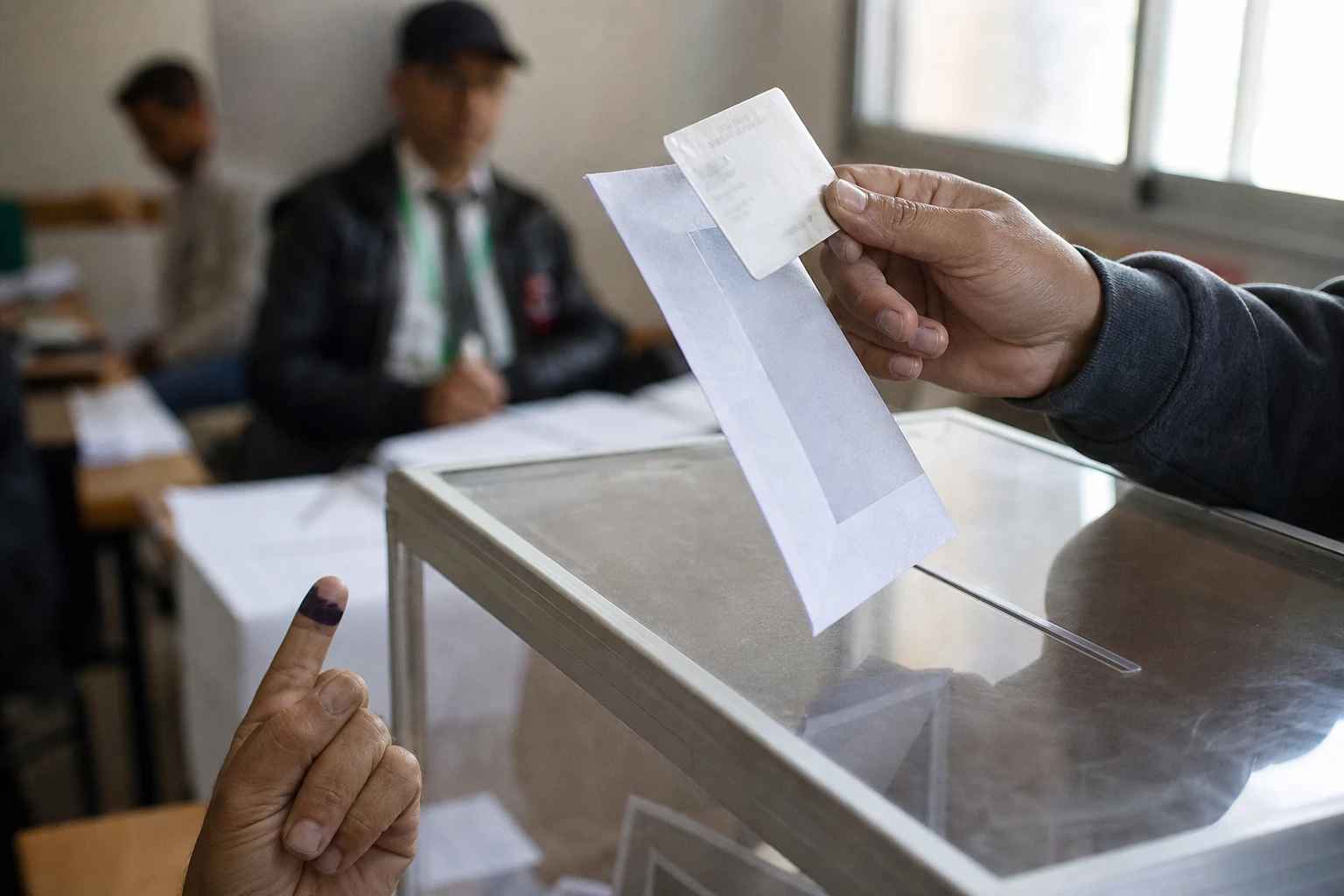
In Morocco, the vote of Moroccans living abroad is often judged by a symbolic measure: does their real political weight match their place in society? As the 23 September legislative election approaches, the answer hinges on a very practical tool: online proxy voting. It is a technical advance. But above all, it is a test of trust between Rabat and a diaspora based in major cities across Europe, North America and the Gulf.
The Kingdom has already brought several public services online. Here, the stakes are more sensitive. They concern electoral participation, voters’ mobility and the administration’s ability to make a right exercised from a distance easier to use without changing its nature. The vote remains in person. The ballot is still cast at a polling station. But the entry point is now electronic.
What Morocco’s electoral framework provides
The electoral timetable is now set. The exceptional revision of the electoral rolls closed on 10 July. It brought the electorate to 15,801,162 registered voters, according to statistics from the interior ministry. Candidate registration opened on 31 August and runs until 9 September. Polling stations will open on 23 September from 8am to 7pm. In the meantime, the proxy platform is due to close at noon on 22 September.
The reform is based on Organic Law No. 53.25, which amends Organic Law No. 27.11 on the House of Representatives. Article 72 sets out the procedure for voting by proxy. The Constitutional Court ruled that the text complied with the Constitution in its decision No. 259/25, issued on 24 December 2025. The constitutional basis is clear: Article 17 recognises the full citizenship of Moroccans living abroad, including the rights to vote and stand for election, while leaving the arrangements for exercising these rights to legislation. The 2011 Constitution states this explicitly.
In practice, the service does not create online voting. It produces a proxy document. The person granting the proxy enters their identity details, national identity card number, voter registration number and the details of the chosen voter. After verification, they download the generated document and send it to their proxy by email or post. On election day, the proxy presents their national identity card and the authorisation to the polling-station president. The vote is therefore still cast entirely in the voting booth, under the ordinary rules of Moroccan elections.
A useful advance, but still incomplete for the diaspora
The reform responds to a longstanding demand. For many Moroccans around the world, the difficulty is not only the right to vote. It is the logistics. Appointing a proxy already requires finding a voter who is available, reachable and willing to go to the polls. The rule remains strict: the proxy need not be a family member or belong to the same constituency, but can represent only one voter living outside Morocco. The system therefore limits the pooling of proxies.
The system nevertheless has a very practical weakness. The vote is cast at the polling station where the person granting the proxy is registered, not at the proxy’s polling station. If both are assigned to the same station, the proxy votes first for themselves and then on behalf of the other voter. If they are assigned to different stations, the proxy must travel to the other voter’s polling station, which may be far from their own home. In other words, digitisation eases the administrative step but does not remove the geographical constraint. For part of the diaspora, this is real progress. For others, the barrier remains high.
The debate could have gone further. For several years, diaspora associations have called for direct voting at consulates and embassies, or for constituencies dedicated to Moroccans living outside the Kingdom. That option has not been adopted for this election. Yet Moroccans around the world have previously had a different form of representation: from 1984 to 1992, five constituencies abroad sent MPs to the House of Representatives. Since then, institutional representation has mainly been channelled through the Council of the Moroccan Community Abroad, an advisory body, and through MRE candidates on local, regional or national lists in Morocco.
What the reform’s success really measures
The real issue is not just the number of proxies submitted. It is whether they are actually used. So far, the interior ministry has published no interim figures on the platform: neither the number of proxies issued, nor a breakdown by country of residence, nor the number of applications rejected or incomplete. Without these data, it is impossible to assess how well Moroccans abroad have taken up this new tool.
Another benchmark is also missing: the exact number of Moroccans living abroad who are registered on the general electoral rolls. Public statistics on the electorate do not visibly distinguish this population. This gap makes any serious measurement of MRE participation difficult. We know, then, that the tool exists. We do not yet know how many people are using it. For a reform intended to ease access to the vote, this statistical silence matters as much as the system itself.
Morocco finds itself at a familiar crossroads for democracies with large diasporas. On one hand, it seeks to maintain civic ties with citizens living far from its territory. On the other, it must preserve a procedure that is simple, verifiable and compatible with the local organisation of elections. The chosen solution is cautious. It does not overhaul the electoral system. It makes limited improvements without challenging the territorial basis of voting.
Across the continent, this issue extends beyond Morocco. It is a reminder that the political participation of African diasporas is becoming a major institutional concern, increasingly present in electoral reforms, constitutional debates and policies for engagement with citizens abroad. For Morocco, a country oriented towards Africa and connected to millions of citizens beyond its borders, the question will remain open beyond 23 September: how can voting be made easier without changing the nature of the election, and how can that progress be measured transparently?