Algeria
 Egypt
 Libya
 Morocco
 Sudan
 Tunisia
 Benin
 Burkina Faso
 Cabo Verde
 Côte d'Ivoire
 Ghana
 Guinea
 Guinea-Bissau
 Liberia
 Mali
 Mauritania
 Niger
 Nigeria
 Senegal
 Sierra Leone
 The Gambia
 Togo
 Cameroon
 Central African Republic
 Chad
 DR Congo
 Equatorial Guinea
 Gabon
 Republic of the Congo
 São Tomé and Príncipe
 Burundi
 Comoros
 Djibouti
 Eritrea
 Ethiopia
 Kenya
 Madagascar
 Malawi
 Mauritius
 Mozambique
 Rwanda
 Seychelles
 Somalia
 South Sudan
 Tanzania
 Angola
 Botswana
 Eswatini
 Lesotho
 Namibia
 South Africa
 Zambia
 Zimbabwe
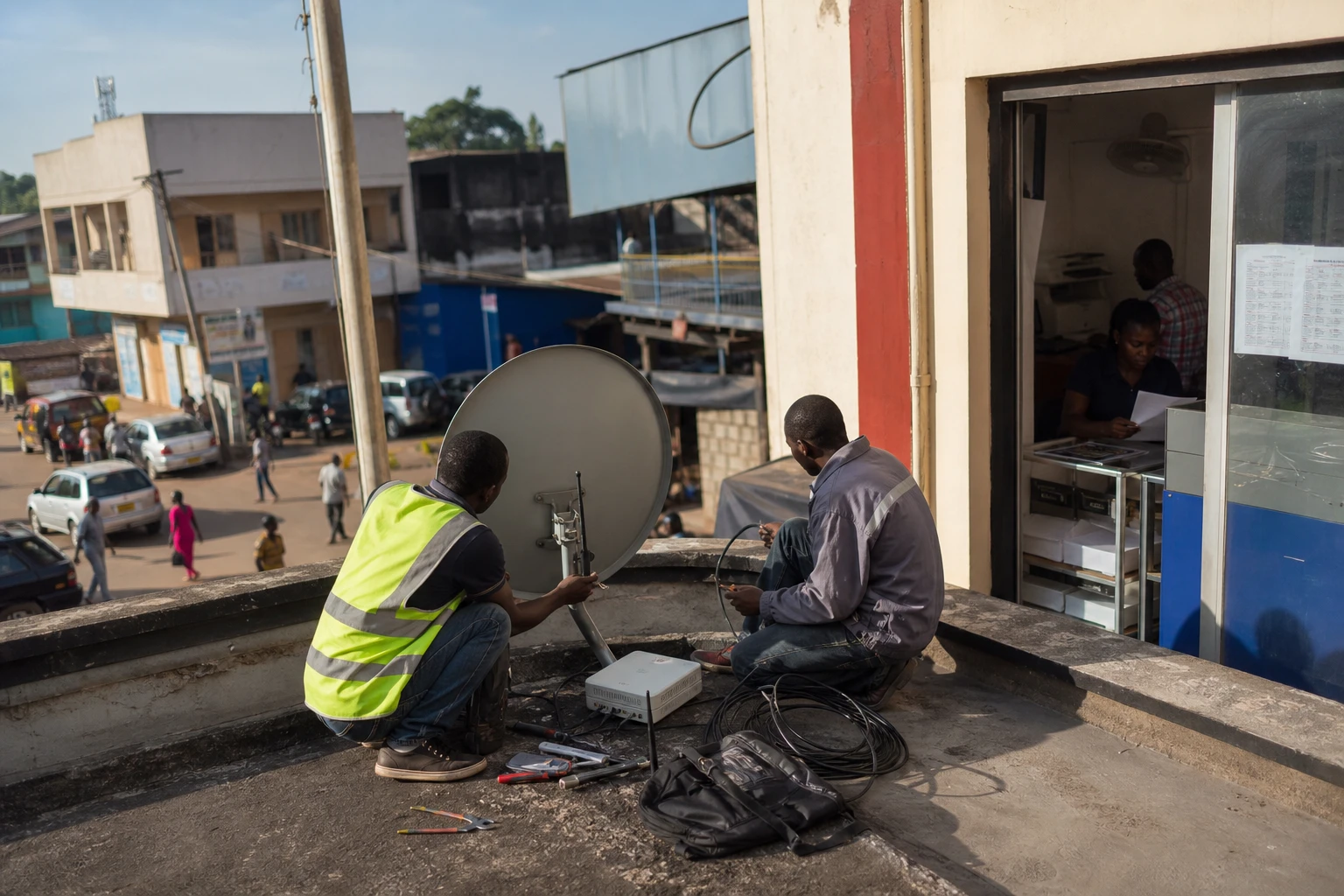
In Kampala, the new competition will hinge less on promises than on practical use
In connected neighbourhoods of Kampala and in more remote areas, the real question is no longer whether the internet exists. It is who can afford it, where it actually reaches and what it can be used for in everyday life. Uganda’s market is not empty. It is already crowded with mobile services, fibre and business solutions, while the digital divide between urban centres and less-served areas remains stark.
Starlink’s arrival therefore changes the debate. The satellite service is not entering a competitive vacuum. It is joining a Ugandan market where telecoms operators have already cut prices, expanded their networks and rolled out a range of packages for households, small and medium-sized businesses and institutions. The main innovation is its promised coverage, useful where fibre is too expensive to lay or cannot keep pace with demand.
A regulated, crowded sector now open to satellite
On 15 May 2026, Uganda formalised an operational agreement with Starlink, signed by the Uganda Communications Commission, the national regulator, and the US company in the presence of President Yoweri Kaguta Museveni in Entebbe. Uganda’s technology ministry later confirmed that the country had cleared the final regulatory hurdles to allow operations to begin.
This framework matters. In January 2026, the UCC said that no provider could offer telecommunications services without authorisation, following a period of tensions over unauthorised use of the Starlink network. The matter was therefore dealt with through the regulatory process rather than by an unregulated entry into the market. In a country where telecoms regulation also concerns network security, public revenues and consumer protection, this oversight was to be expected.
The backdrop is clear. The UCC says Uganda had more than 15 million internet users in 2024, while mobile internet subscriptions reached 17 million in the third quarter of 2025. The country also has 45.7 million active mobile subscriptions and 35.6 million mobile money subscriptions. In other words, access is growing, but usage remains constrained by affordability, digital skills and actual coverage.
This trend is part of the East African Community, the regional integration bloc in East Africa, where countries are seeking to facilitate the flow of data, services and payments. For Kampala, the stakes are therefore not merely commercial. They also concern the country’s digital competitiveness in a region where online services, remote working, distance learning and financial solutions depend on reliable connectivity.
Prices put Starlink beyond the urban mass market
The crux of the issue is economic. According to the price list published for Uganda, Starlink charges a monthly subscription of about 204,000 to 285,000 Ugandan shillings, or roughly $54 to $75.5, excluding the connection kit. This places the service at the top end of the local market, making it better suited to affluent households, small and medium-sized businesses, NGOs and organisations outside well-covered areas than to the urban mass market.
| Service | Advertised monthly price | Editorial assessment |
|---|---|---|
| Starlink in Uganda | 204,000 to 285,000 UGX | Satellite connectivity, kit must be purchased separately |
| MTN WakaNet fibre | 110,000 to 595,000 UGX | Fibre and router packages, with lower prices for automatic renewals |
| Airtel broadband | 50,000 to 300,000 UGX | More affordable bundles and home solutions depending on usage |
MTN Uganda, by comparison, offers WakaNet fibre from 110,000 Ugandan shillings on its homepage, with fibre packages listed at 130,000, 195,000, 295,000 and 595,000 shillings, depending on speed. With automatic renewal, prices fall to 110,000, 150,000 and 300,000 shillings for higher speeds. Fibre installation is advertised as free, widening the gap with a satellite service that requires an upfront equipment purchase.
Airtel Uganda is taking a different approach. Its website lists monthly data offers ranging from 10,000 to 150,000 shillings, depending on volume, while its broadband service features home packages costing 100,000, 200,000 and 300,000 shillings for 50, 120 and 200 gigabytes over 30 days. The operator also says it offers home Wi-Fi equipment designed for multiple devices. For many urban households, this flexibility remains a decisive advantage over a more expensive and less flexible satellite package.
The comparison is not just about price. It is about the balance between coverage, reliability and purchasing power. Starlink may appeal to businesses on the outskirts, remote schools, healthcare facilities or households seeking a backup connection. But for the average Kampala consumer, the monthly cost and the purchase of the kit may remain a clear barrier.
What satellite connectivity really changes for Uganda and East Africa
Starlink’s potential advantage lies mainly in rural areas, islands, secondary roads and towns where fibre is slow to arrive. The UCC acknowledges that networks depend on a combination of infrastructure, including satellites, fibre backhaul and base stations, and that coverage gaps persist in hard-to-reach areas. In this context, satellite does not displace terrestrial networks; it complements them.
For the Ugandan government, there are two priorities. On the one hand, attracting a new player increases competitive pressure and may push operators to improve service quality. On the other, Kampala wants to prevent a strategic service from entering through a regulatory grey area. The message since May 2026 has therefore been one of controlled openness, consistent with local rules and the country’s digital sovereignty.
For established operators, Starlink’s arrival creates an uneven form of competition. MTN and Airtel sell flexible packages, sometimes supported by the mobile money ecosystem, with extensive commercial networks and payment options suited to irregular incomes. Starlink, by contrast, is betting on technical reliability and the promise of coverage. The use cases and customers are not the same.
Across the continent, the Ugandan case reflects a broader trend. African governments are increasingly balancing two priorities: expanding digital coverage and safeguarding their regulatory frameworks. In the Horn of Africa, as elsewhere on the continent, satellite services do not replace fibre. They are becoming another link in a market where the contest is now about real access, the final bill and regulatory trust. Uganda, with Kampala as its decision-making centre, has simply entered this new phase more clearly.