Algeria
 Egypt
 Libya
 Morocco
 Sudan
 Tunisia
 Benin
 Burkina Faso
 Cabo Verde
 Côte d'Ivoire
 Ghana
 Guinea
 Guinea-Bissau
 Liberia
 Mali
 Mauritania
 Niger
 Nigeria
 Senegal
 Sierra Leone
 The Gambia
 Togo
 Cameroon
 Central African Republic
 Chad
 Equatorial Guinea
 Gabon
 Republic of the Congo
 São Tomé and Príncipe
 Burundi
 Comoros
 Djibouti
 Eritrea
 Ethiopia
 Kenya
 Madagascar
 Malawi
 Mauritius
 Mozambique
 Rwanda
 Seychelles
 Somalia
 South Sudan
 Tanzania
 Uganda
 Angola
 Botswana
 Eswatini
 Lesotho
 Namibia
 South Africa
 Zambia
 Zimbabwe
A school year opening under different conditions
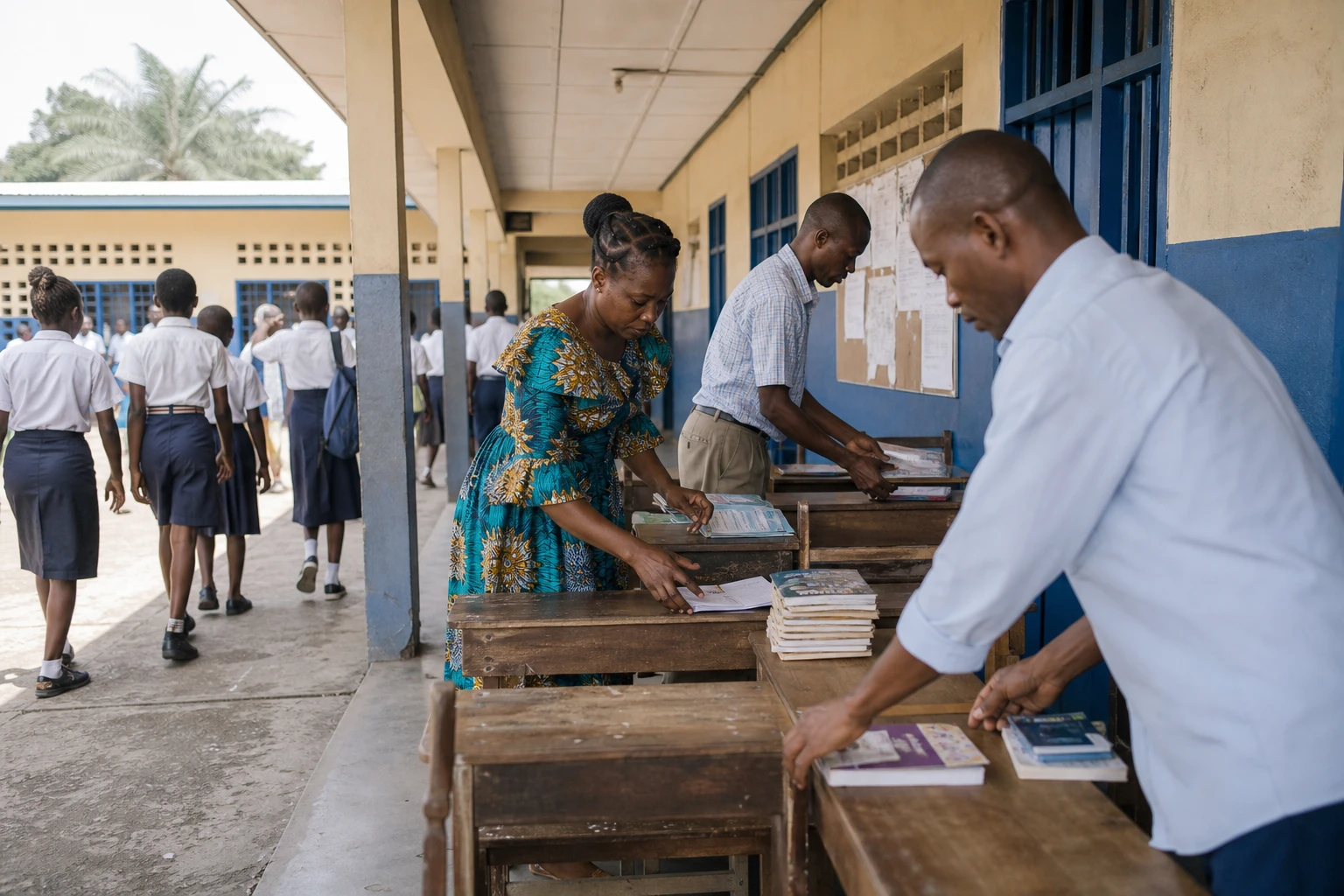
In the Democratic Republic of the Congo, the start of the school year is no longer a uniform event. On 1 September 2026, pupils are returning to class in Kinshasa in relatively normal conditions, while others in the east face a more fragile schedule, shaped by an epidemic, a planned strike and a war that continues to weigh on schools. The country has one calendar. On the ground, realities remain very different.
The Congolese government is nevertheless maintaining the reopening across the country. The Minister of State for National Education and New Citizenship, Raïssa Malu Dinanga, has stressed that schools should reopen everywhere conditions allow. In the same vein, the executive is highlighting free public primary education, an achievement that has become central to the country’s social debate, as well as the expansion of school canteens as a way of keeping children in education.
Ebola’s impact across six eastern provinces
The first constraint is public health. The Congolese health ministry is maintaining surveillance measures for the 17th Ebola virus disease epidemic, with situation reports published on 28 and 29 August 2026. The precise cumulative total varies according to the report consulted, but the available figures point to an already serious outbreak, with several thousand confirmed cases and a heavy concentration in Ituri. The province remains the epicentre, and health authorities report the spread of the disease across several eastern provinces, including Ituri, North Kivu, Haut-Uélé, Tshopo, South Kivu and Bas-Uélé.
As of 30 July, the World Health Organization said that 17,863 contacts had been identified and monitored in affected areas, with active follow-up rates varying by province. This figure matters because contact tracing remains one of the most effective tools for breaking chains of transmission. In other words, the school year is not being shaped solely in classrooms. It also depends on health teams’ ability to identify cases quickly, isolate them quickly and share information quickly.
In response to the risk, the education ministry has planned a graduated response. Areas classified as green will operate normally. Orange areas will step up health surveillance. Red, high-risk areas may temporarily switch to a light form of distance learning, using worksheets, radio or television, depending on available resources. This approach avoids a nationwide shutdown, but also reveals a simple reality: Congolese schools are now operating to different schedules, depending on health maps and the logistical capacity of each territory.
The teachers’ dispute remains unresolved
Public health concerns are compounded by social tensions. The Syndicate of Teachers of Congo, Syeco, has called for a boycott of the start of the school year and urged parents to keep their children at home. The union is calling, among other things, for teachers’ monthly salaries to be raised to $500, for unpaid teachers to be put on the payroll, for newly recruited teachers to be paid, and for better retirement, healthcare and pay conditions.
The issue goes beyond wages alone. In the DRC, teachers are often at the heart of several conflicting demands: to provide free education, absorb the rising cost of living and maintain continuity of public services in provinces where the state struggles to reach the most remote villages. The ministry says it is continuing discussions on regular pay and social protection. But the test on the ground will be concrete: how many teachers will actually be in class on Tuesday, and in which provinces will the call to strike be heeded?
The start of the school year also has a positive dimension. The Congolese government is highlighting the gradual launch of school canteens. In Kalemie, the Prime Minister’s Office recalled in March 2026 the national school feeding strategy for 2025-2030, approved in August 2025, and the support provided by the World Food Programme to 78 primary schools. In a country where the journey to school, the cost of a meal or the fatigue of the day can cause a child to drop out, these canteens are no mere ornament. They are becoming a tool for equity and keeping children in school.
Bukavu, Goma and schools under de facto authority
The third reality is security. In territories and cities controlled by AFC/M23, the start of the school year does not depend solely on Kinshasa’s calendar. In Bukavu, officials linked to the movement met education stakeholders on 31 August to prepare for the reopening, while a governor appointed by AFC/M23 banned schools from requiring families to buy uniforms and supplies on school premises. The message is clear: the de facto authorities are seeking to organise the reopening and control the costs most visible to families.
But the central issue remains that of practical sovereignty. In Goma and Bukavu, the Congolese government suspended academic activities on 20 August at several public higher education institutions because of the security situation, while providing for exceptions for final-year students. In primary and secondary education, Kinshasa continues to pay teachers, including in areas where its administrative authority is contested. This creates an unusual situation: the state still funds part of the system, while local organisation of school life is partly beyond its direct control.
This situation has a very tangible impact. For urban families, the start of the school year often means immediate spending on supplies, uniforms and transport. For rural households, the risks are even greater: long distances, limited access to healthcare, and sometimes a lack of teachers or functioning schools. In Bukavu, the ACP even reported a surge in activity at markets in the days before schools reopened. Education remains a powerful social marker. But access to it is now negotiated in the context of war, prices and insecurity.
What this school year says about the DRC and the region
At its heart, this school year tells the story of the DRC as it is today: a country trying to preserve its public policies amid overlapping crises. Education intersects with health, security and the state’s budgetary capacity. The east of the country is where these tensions converge, and provinces affected by Ebola or armed conflict are becoming testing grounds for public administration under pressure.
The implications also extend beyond the country. In Central Africa and the Great Lakes region, the DRC remains a demographic and strategic pivot. Schools that keep going, even imperfectly, limit disruption to education, protect girls from dropping out and preserve a minimum of social stability. Schools that fail, by contrast, deepen inequalities between provincial capitals and outlying areas. What happens next will therefore depend on three very concrete developments: the ability to contain Ebola, the true scale of the teachers’ movement, and changes in territorial control in the east.