Algeria
 Egypt
 Libya
 Morocco
 Sudan
 Tunisia
 Benin
 Burkina Faso
 Cabo Verde
 Côte d'Ivoire
 Ghana
 Guinea
 Guinea-Bissau
 Liberia
 Mali
 Mauritania
 Nigeria
 Senegal
 Sierra Leone
 The Gambia
 Togo
 Cameroon
 Central African Republic
 Chad
 DR Congo
 Equatorial Guinea
 Gabon
 Republic of the Congo
 São Tomé and Príncipe
 Burundi
 Comoros
 Djibouti
 Eritrea
 Ethiopia
 Kenya
 Madagascar
 Malawi
 Mauritius
 Mozambique
 Rwanda
 Seychelles
 Somalia
 South Sudan
 Tanzania
 Uganda
 Angola
 Botswana
 Eswatini
 Lesotho
 Namibia
 South Africa
 Zambia
 Zimbabwe
Niamey seeks to turn oil into an industrial lever
In northern Niger, wells, terminals and refineries no longer tell only a story of extraction. They also point to a strategy for controlling the oil chain, from the subsoil to the sale of crude, with an increasingly prominent Algerian partner. For Niamey, the goal is straightforward: produce more, but above all retain more value on Nigerien territory.
This shift is taking place as Niger seeks to consolidate its economic sovereignty following its break with ECOWAS, which took effect on 29 January 2025, and amid a Sahelian context in which alliances are quickly being reshaped. Niamey is now more inclined to look towards the Alliance of Sahel States, while bilateral relations with Algiers have become more prominent in economic diplomacy.
Agreements that go beyond exploration
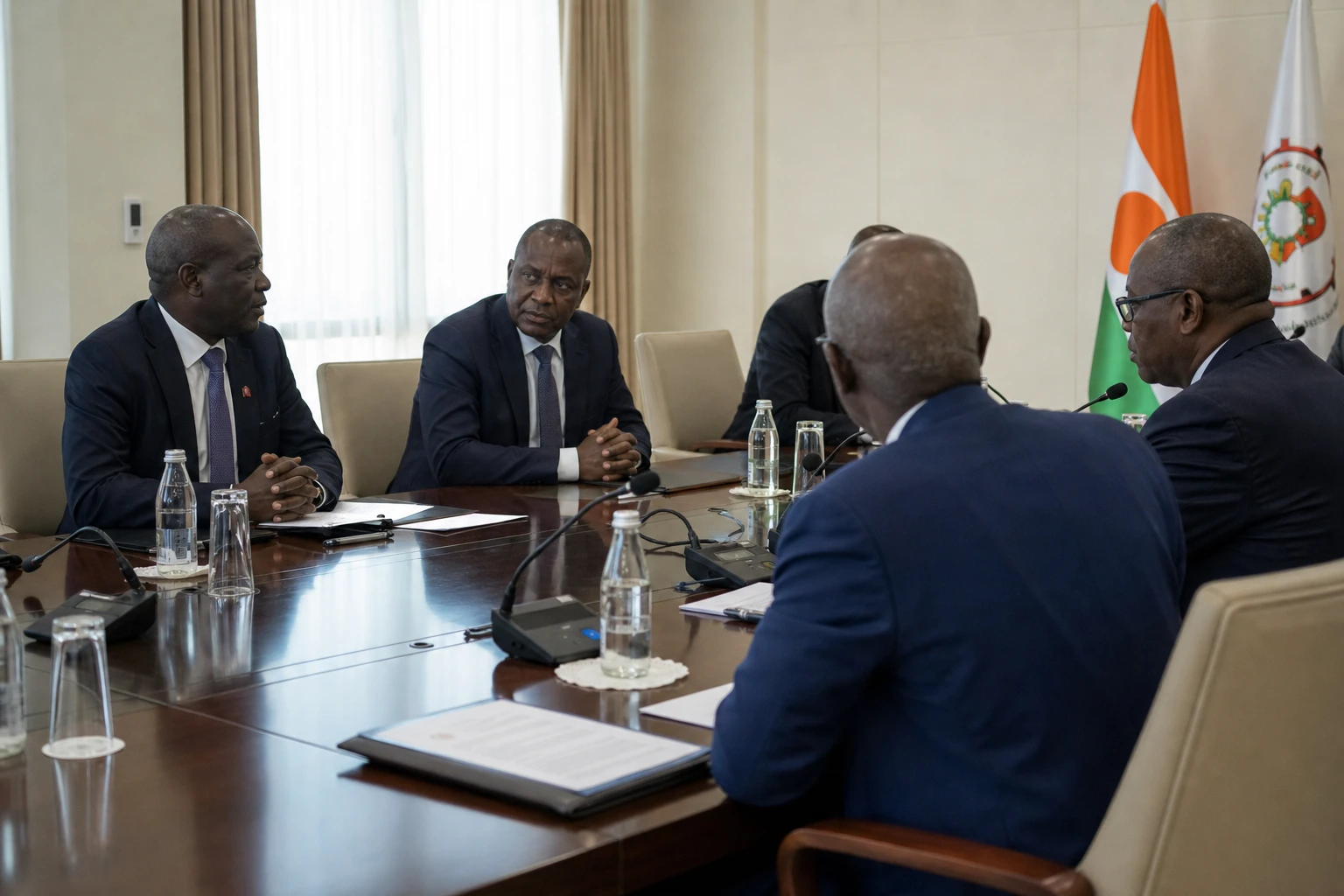
On 29 August 2026 in Algiers, Algerian Minister of Energy and Mines Mohamed Arkab received Ali Seibou Hassane, chief executive of Sonidep, Niger’s national oil company. The talks focused on developing the Bilma block, described as a priority project in energy cooperation between the two countries.
Bilma is in the Diffa region and extends towards Agadez. Nigerien authorities cite potential output of more than 20,000 barrels per day for around 20 years. At this stage, this is potential announced by Niamey, not established production. Sonatrach is to revise the feasibility study before moving on to a development plan.
This step adds to other projects already under way. On 13 August, ENAFOR, a Sonatrach subsidiary, began drilling the Kafra Sud-Est 1 exploration well in the Agadez region, about 85 kilometres from the southern Algerian border. The company had prepared the site for drilling to a depth of up to 3,900 metres. Meanwhile, African partners reported that the operation was part of efforts to strengthen technical capacity and bilateral cooperation.
On 2 June, three memorandums of understanding had already been signed between Sonatrach subsidiaries and Sonidep. Enageo is working on the acquisition and processing of seismic data. ENAFOR is to set up a drilling joint venture with Sonidep. Naftal, meanwhile, is studying the distribution of petroleum products and the manufacture, storage and distribution of bitumen. In other words, Algiers is no longer entering Niger through the subsoil alone. It is also moving downstream, where margins are generated and the domestic market secured.
Refining, logistics and the domestic market take centre stage
The most tangible cooperation can already be seen in the flows. On 14 August, Sonatrach and Sonidep loaded the first jointly marketed cargo of Nigerien crude at the Sèmè terminal in Benin. On 15 August, Sonatrach also announced the first deliveries of Jet A1 aviation fuel to Niger from the Adrar refinery, under a contract signed with Sonidep. These two operations show that the relationship is no longer theoretical: it is beginning to affect the actual movement of petroleum products.
Downstream, Algiers and Niamey are also working to modernise the Zinder refining system, with the aim of increasing local capacity and securing supplies to the Nigerien market. Discussions are also under way on setting up a bitumen supply centre in Zinder and supplying Jet A1 and road fuels. This approach is crucial for a landlocked country such as Niger, where transport weighs heavily on prices and product availability.
The projects under discussion are not limited to hydrocarbons. They also build on talks launched in January 2025 about a new refinery and a petrochemical complex in Dosso. A more recent agreement, signed in August 2026 between the Nigerien state and the ZIMAR group, also provides for a 100,000-barrel-per-day refinery and a petrochemical complex in Dosso. The growing number of projects reveals a Niger testing several ways to reduce its dependence on imports of finished products.
Political rapprochement serves shared interests
The diplomatic thaw between Algiers and Niamey is as important as the projects themselves. Relations had become strained after the change of power in Niger in July 2023, particularly over Algerian mediation and the management of migration flows. Since then, contacts have resumed. Niger’s presidency notes that head of state Abdourahamane Tiani was sworn in on 26 March 2025 for a five-year transition. In this context, economic diplomacy has gained weight.
For Niger, this cooperation offers expertise, equipment and access to regional markets. For Algeria, it opens a corridor of influence in the Sahel and bolsters the African presence strategy promoted by Sonatrach. The Algerian state-owned group nevertheless remains heavily dependent on hydrocarbons: according to the IMF, they accounted for an average of 92% of Algerian exports and 43% of budget revenues over the 2018-2022 period. This explains Algiers’ interest in partnerships that extend its expertise beyond its borders.
Niger, for its part, is moving ahead amid rapidly changing figures. The World Bank estimates that growth could remain strong in 2026 and 2027 as oil production ramps up, reaching close to 106,000 barrels per day at plateau. Other estimates from the same institution also point to a sharp rise in production and exports through the Niger-Benin pipeline. This explains why every agreement on exploration, refining or marketing matters so much to public finances and local markets alike.
At the regional level, this sequence points to a broader trend: Sahelian states are seeking technical partners able to move quickly, without waiting for the institutional delays of former integration frameworks. Niger’s departure from ECOWAS on 29 January 2025 accelerated this reshaping. In this new landscape, energy agreements are instruments of sovereignty, but also tools for projecting influence across the region. Bilma, Kafra, Zinder and Dosso are therefore not isolated names. They are already forming a political and industrial geography that Niamey and Algiers want to make enduring.