Algeria
 Egypt
 Libya
 Morocco
 Sudan
 Benin
 Burkina Faso
 Cabo Verde
 Côte d'Ivoire
 Ghana
 Guinea
 Guinea-Bissau
 Liberia
 Mali
 Mauritania
 Niger
 Nigeria
 Senegal
 Sierra Leone
 The Gambia
 Togo
 Cameroon
 Central African Republic
 Chad
 DR Congo
 Equatorial Guinea
 Gabon
 Republic of the Congo
 São Tomé and Príncipe
 Burundi
 Comoros
 Djibouti
 Eritrea
 Ethiopia
 Kenya
 Madagascar
 Malawi
 Mauritius
 Mozambique
 Rwanda
 Seychelles
 Somalia
 South Sudan
 Tanzania
 Uganda
 Angola
 Botswana
 Eswatini
 Lesotho
 Namibia
 South Africa
 Zambia
 Zimbabwe
A village defined by more than its façades and tourist reputation
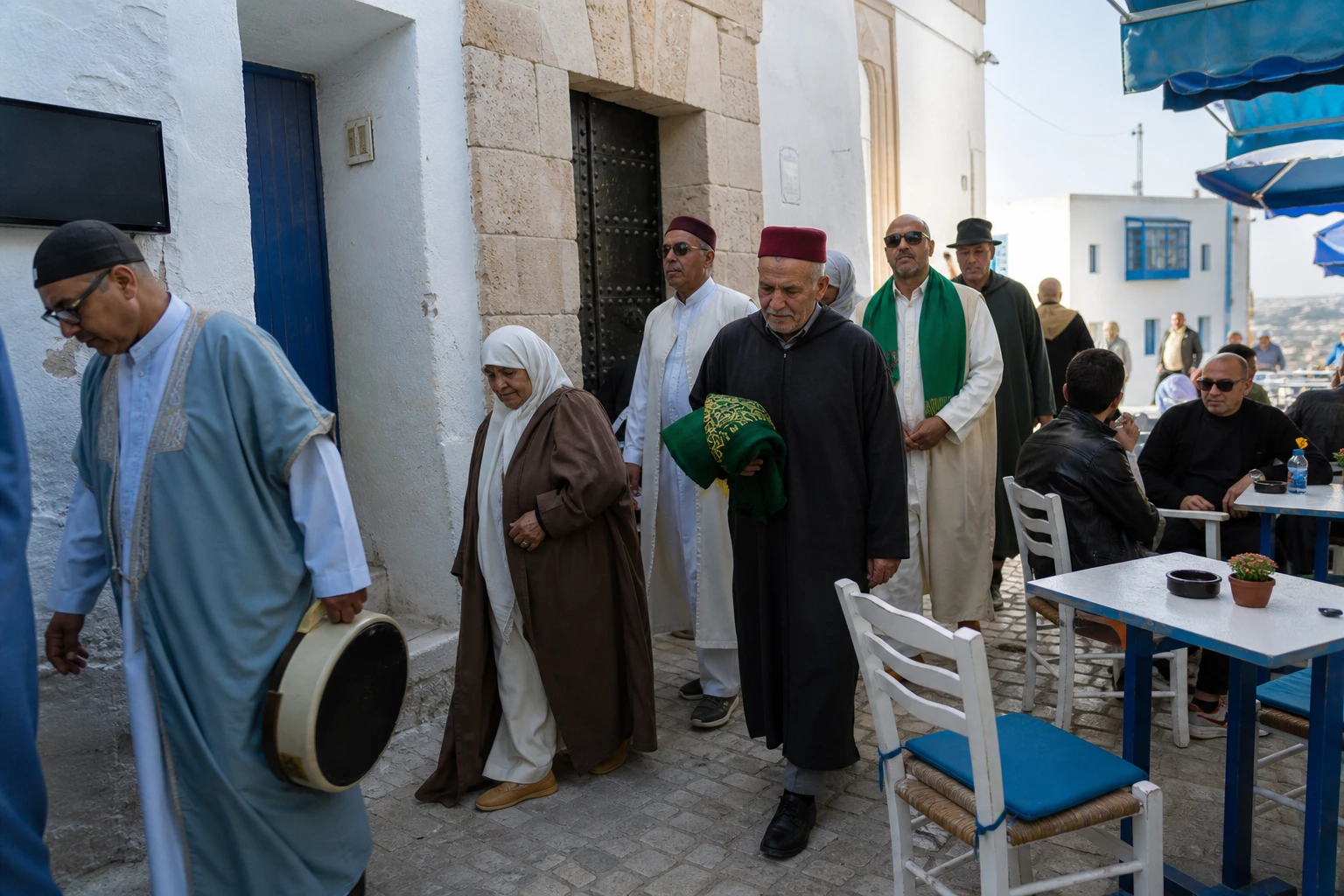
In Sidi Bou Saïd, in the northern suburbs of Tunis, the eye is often drawn to the blue doors and white walls. But the heart of the place beats elsewhere: in an active Sufi memory, sustained by rites of neighbourliness, devotion and transmission. The Kharja, the annual procession of the brotherhoods, is a reminder that this Tunisian village is not merely a Mediterranean backdrop; it is also a living space of spirituality and social life.
This perspective has taken on particular significance since the Village of Sidi Bou Saïd was inscribed on UNESCO’s World Heritage List, a decision taken unanimously on 25 July 2026 at the 48th session of the World Heritage Committee in Busan, Republic of Korea. The organisation recognised a site shaped around the tomb of a Sufi master from the 12th-13th century, as well as by harmonious architecture and living traditions that are still practised.
In Tunis, local heritage forms part of a wider heritage policy
For Tunisia, this recognition comes against an already rich heritage landscape. The country now has ten World Heritage properties, according to UNESCO, placing it among the Arab and African states with the greatest representation on the list. From Tunisia’s perspective, the issue is not limited to cultural visibility. It also concerns legal protection, urban management and the place of heritage in the cultural and tourism economy.
The nomination dossier was prepared by the Tunisian authorities with the Ministry of Cultural Affairs, the National Heritage Institute and the Ministry of Foreign Affairs. The process began after authorisation was granted in February 2024, and the dossier was formally submitted in 2025 before being examined by UNESCO in July 2026. This sequence points to a more structured state strategy than a simple heritage spotlight.
UNESCO’s description emphasises a point that is often overlooked: Sidi Bou Saïd developed around the sanctuary of a Sufi saint, and the site remains associated with religious practices that are still alive. The listing therefore protects more than houses and views over the Gulf of Tunis. It also recognises continuity between urban planning, worship and social practices.
The Kharja, a procession linking religion, neighbourhood and memory
The Kharja is a Sufi procession organised each year by Muslim brotherhoods in honour of a saint. In Sidi Bou Saïd, it mainly involves the Aissawa brotherhood and traditionally takes place in August, in the village’s narrow streets. Accounts describe a similar sequence: songs, invocations, ritual movements, and the presence of residents and visitors, with a strong collective dimension.
For a long time, this rite gave Sidi Bou Saïd its own calendar, distinct from the ordinary tourist schedule. It brings together families, worshippers, artisans and curious onlookers. It also stages a popular memory in which baraka—that is, the blessing attributed to the saint—is combined with hospitality, exchange and religious song. Several Tunisian and Mediterranean sources highlight this social dimension, describing the Kharja as an event that goes beyond worship alone.
UNESCO has recognised this spiritual depth in the village’s nomination, highlighting the persistence of Sufi traditions and their influence across a wider geographical area. In other words, the Kharja is not folklore added after the fact. It is part of the fabric that has shaped the village, its public image and its historical continuity.
What the listing changes in practice
For residents, the listing could strengthen protection of the built fabric and curb some property pressures. Sidi Bou Saïd already benefited from an established preservation framework, including a 1915 beylical decree cited in the UNESCO dossier, followed by a 1985 text. The new inscription adds an international layer to this Tunisian foundation. It also makes long-term management of the site essential, since heritage sites can quickly become fragile when they attract too many visitors.
For the local economy, the impact could be real but ambivalent. International recognition attracts more visitors, supporting accommodation, restaurants, crafts and cultural activities. But this visibility can also increase pressure on the narrow streets, residential life and neighbourhood balance. In Sidi Bou Saïd, the question is therefore not simply how to welcome more people. It is how to preserve a lived-in place, rather than a mere heritage backdrop.
The Kharja itself lies at the heart of this balance. If the festival gains a wider audience, it could strengthen the transmission of the brotherhoods and raise the profile of Tunisian Sufism. But it must remain true to its original character: a community rite, not a performance for a picture postcard. That is where the difference between cultural promotion and folklorisation lies.
A significance that extends beyond Tunis and speaks to the rest of the continent
For Africa, this inscription is a reminder that the continent’s heritage is not limited to major archaeological sites or natural landscapes. It also includes living traditions, brotherhoods, forms of religious social life and intimate architecture. Tunisia thus joins a wider movement in which African states are seeking recognition for their places of memory as cultural assets in their own right.
The case of Sidi Bou Saïd is also of interest to the Mediterranean and North African region. It shows how a site can bring together Sufi spirituality, urban protection and international appeal without losing its local character. For Tunis, the challenge now will be to balance conservation, visitor numbers and transmission. Only then can the Kharja remain a living tradition, rather than a memory frozen under a global label.