Algeria
 Libya
 Morocco
 Sudan
 Tunisia
 Benin
 Burkina Faso
 Cabo Verde
 Côte d'Ivoire
 Ghana
 Guinea
 Guinea-Bissau
 Liberia
 Mali
 Mauritania
 Niger
 Nigeria
 Senegal
 Sierra Leone
 The Gambia
 Togo
 Cameroon
 Central African Republic
 Chad
 DR Congo
 Equatorial Guinea
 Gabon
 Republic of the Congo
 São Tomé and Príncipe
 Burundi
 Comoros
 Djibouti
 Eritrea
 Ethiopia
 Kenya
 Madagascar
 Malawi
 Mauritius
 Mozambique
 Rwanda
 Seychelles
 Somalia
 South Sudan
 Tanzania
 Uganda
 Angola
 Botswana
 Eswatini
 Lesotho
 Namibia
 South Africa
 Zambia
 Zimbabwe
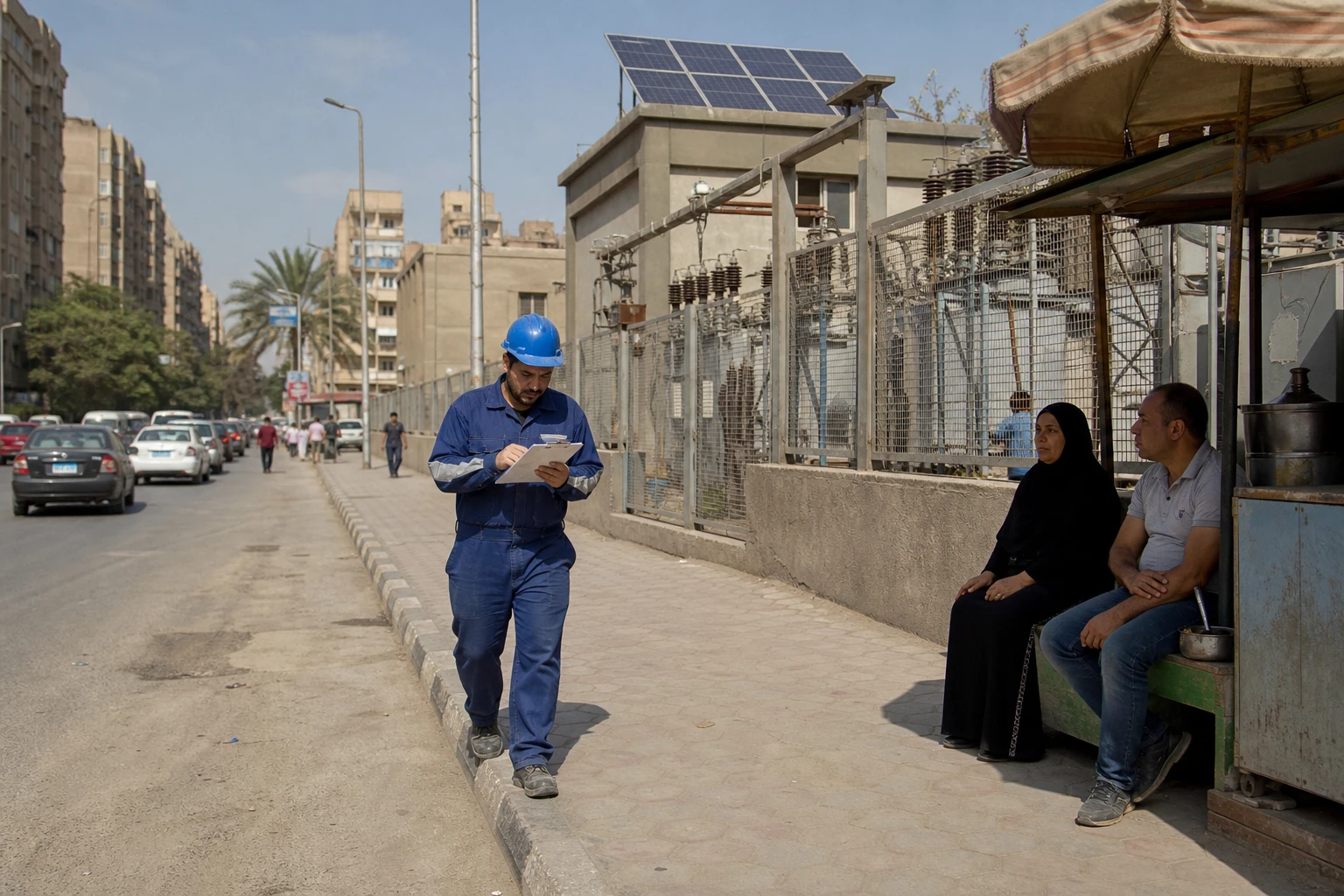
Electricity storage is no longer a subject for technicians. In Egypt, it is becoming a central part of energy policy. The more solar and wind power the country adds, the more it needs batteries capable of absorbing surpluses and then returning the power when demand rises.
It is in this context that Cairo is accelerating the development of a sector that is still young in the region. The Egyptian government is targeting a 45% share of renewables in the electricity mix by 2028, and is now linking that goal to large-scale storage capacity. The logic is simple: an electricity transition depends not only on generation, but also on grid stability.
An electricity transition scaling up
For several months, Egypt has been promoting an energy strategy built around three priorities: more renewables, a modernised grid and storage solutions. This approach reflects the priorities of the Ministry of Electricity and Renewable Energy, as well as discussions with European partners on strengthening power lines, substations and interconnections.
In June 2026, the European Union and Egypt announced a €690 million financing package to modernise the Egyptian electricity grid and better integrate solar and wind generation. The project is intended to help connect 22 GW of renewable capacity by 2030. This step confirms that the challenge is no longer simply to build power plants, but to make the entire system more flexible.
The country is also advancing its regional agenda. Egypt wants to consolidate its position as an energy hub between Africa, the Mediterranean and Europe. It is promoting electricity interconnections while keeping low-carbon electricity exports and, in time, green hydrogen in its sights. This ambition is supported by several public policies and platforms, including national initiatives focused on renewable hydrogen and green investment.
The framework is therefore in place: the challenge is not theoretical. It concerns security of supply, electricity costs, managing peaks in consumption and the country’s industrial credibility. As solar projects in the Eastern Desert and wind farms on the Red Sea expand, Egypt’s grid must learn to accommodate more variable generation. That is where storage becomes strategic.
What the project discussed with Huawei entails
At a meeting held on 23 August 2026, Egypt’s Minister of Electricity and Renewable Energy, Mahmoud Esmat, reviewed progress on a project with Huawei’s head in Egypt, Benjamin Houwei, covering the local manufacture of battery energy storage systems, or BESS, and the installation of several standalone plants with a combined capacity of 4,000 MWh. A BESS is a system that stores electricity and later feeds it back into the grid.
According to information released publicly, the teams also discussed regulatory requirements, technical commitments and feasibility studies carried out at several locations on the national grid. The aim is to place the units where they can relieve pressure on the system most effectively, particularly during peak hours. The project also includes local manufacturing, a sign that Cairo wants not only to import technology, but also to develop an industrial base on its own territory.
The minister defended this approach, describing BESS as one of the pillars of grid stability and the quality of electricity supply. The message is consistent with the course already announced by the Egyptian authorities. In May 2026, the presidency confirmed the target of generating 45% of electricity from clean sources by 2028, while referring to battery projects connected to the national grid in several governorates.
The figures cited for capacity under development show the scale of the task. Egyptian authorities said that renewable capacity already in operation or under development exceeded 25,000 MW in 2025. Other public documents have since set out a rapid increase in installed and planned capacity, alongside an expansion of grid batteries to support the next wave of solar and wind power.
What is at stake for Egypt and beyond
For Egypt, storage is about more than technology. It affects the real economy. A more stable grid means fewer power cuts for manufacturers. Distributors can manage peaks more effectively. Renewable projects become more profitable. And fuel imports can eventually be curbed. This is a matter of bills, but also of energy sovereignty.
There is also an industrialisation opportunity. Local production of batteries and BESS can create skilled jobs, attract suppliers and develop expertise in power electronics, grid engineering and maintenance. For a country the size of Egypt, this is no small matter. It is a way to move from being an equipment market to becoming a regional platform for services and manufacturing.
For households, the expected impact is less visible, but decisive. Better management of peaks can ease pressure on electricity supply, especially during heatwaves, when air conditioning drives up demand. For industrial zones and new green hydrogen projects, batteries are also a safety net that reassures investors. Without a reliable grid, major clean-energy projects move more slowly.
Co-operation with Huawei is also part of broader competition among suppliers. Across the continent, major Chinese, European, South Korean and Gulf companies are positioning themselves in smart grids, batteries and solar equipment. Egypt, for its part, is seeking to retain control over project management while making use of available finance and technology. It is a pragmatic approach, less ideological than contractual.
Across Africa, the signal is clear. The energy transition will depend not only on installed megawatts, but on the ability of grids to absorb these new volumes. Egypt is joining a trend seen in several African countries that are combining solar power, storage and interconnections to secure their electricity systems. In this race, Cairo wants to be seen as a regional laboratory at the crossroads of North Africa, the Middle East and the Mediterranean.
The next test will be tangible: turning discussions into an industrial project and then connecting the first units to the grid within the announced deadlines. If this goes ahead, Egypt will have reached an important milestone. It will no longer simply be adding capacity. It will begin to organise a new electricity architecture that is more flexible, more connected and better suited to an economy that wants to produce, export and maintain an uninterrupted power supply.