Egypt
 Libya
 Morocco
 Sudan
 Tunisia
 Benin
 Burkina Faso
 Cabo Verde
 Côte d'Ivoire
 Ghana
 Guinea
 Guinea-Bissau
 Liberia
 Mali
 Mauritania
 Niger
 Nigeria
 Senegal
 Sierra Leone
 The Gambia
 Togo
 Cameroon
 Central African Republic
 Chad
 DR Congo
 Equatorial Guinea
 Gabon
 Republic of the Congo
 São Tomé and Príncipe
 Burundi
 Comoros
 Djibouti
 Eritrea
 Ethiopia
 Kenya
 Madagascar
 Malawi
 Mauritius
 Mozambique
 Rwanda
 Seychelles
 Somalia
 South Sudan
 Tanzania
 Uganda
 Angola
 Botswana
 Eswatini
 Lesotho
 Namibia
 South Africa
 Zambia
 Zimbabwe
An exporting country faces a more volatile market
When a strait becomes congested, the energy landscape can shift quickly. For Algeria, this upheaval has chiefly underscored a simple reality: an oil and gas exporter can benefit from an international shock, but only if its volumes keep pace, its facilities hold up and domestic demand does not absorb everything. The country therefore remains exposed to a familiar sectoral equation: sell more without undermining local supply.
In the Algerian context, this period is also part of a broader strategy. In recent months, Sonatrach has sent multiple signals of diversification towards Europe and Asia, with a first LNG cargo to Germany on 2 July 2026 and a natural gas contract with Germany’s VNG due to start on 1 January 2027. Algeria is thus seeking to secure markets beyond its immediate neighbours, while remaining an energy pillar of the Mediterranean basin.
The trend does not affect Algiers alone. It also reaches its African neighbours. Algeria belongs to OPEC, not to an African regional organisation such as ECOWAS or SADC, but its energy policy resonates across the African Union and in the Maghreb and Sahel countries that depend on imports of fuel or liquefied petroleum gas. The issue is therefore as continental as it is national.
The shock originating in the Strait of Hormuz changed market dynamics. A report by the Centre for Research on Energy and Clean Air, published on 26 August 2026, estimates that global importers paid an additional $330 billion for crude oil, petroleum products and LNG transported by sea between March and August 2026. The same document describes it as the biggest sustained oil shock since the 1990 Gulf War.
Against this backdrop, nine African fossil fuel exporters earned additional revenues. CREA estimates the continent’s net gain at $21.6 billion, including $18.1 billion for Nigeria, Angola, Libya and Algeria combined. The report does not give an exact breakdown for each of the latter three countries in its publicly available extract. The figures for individual countries should therefore be treated with caution.
For Algeria, the clearest signal comes from gas. According to data reported this week by several specialist media outlets and cross-checked against industry information, national production reached 54.01 billion cubic metres in the first half of 2026, up from 51.81 billion a year earlier, an increase of 4.2%. Gas exports, including pipeline gas and LNG, reached 23.97 billion cubic metres, up 2.4%.
But this increase does not automatically translate into a surge in foreign sales. Domestic consumption also rose, reaching 28.49 billion cubic metres in the first half of 2026, 6.3% higher than a year earlier. In other words, some of the production effort is first used to supply the domestic market, power generation and industrial needs. This is a structural constraint that is often underestimated in analyses focused solely on exports.
LNG, meanwhile, fell by 6.5% to 4.47 million tonnes, mainly because of maintenance work at liquefaction plants, according to cross-checked industry sources. Here, too, the detail matters: higher pipeline volumes partly offset the decline in LNG, but not fully. Algeria is therefore making progress on several fronts, balancing the domestic market, long-term contracts and spot opportunities.
What the window opened by Hormuz really changes
The effect on oil is more direct. On 2 August 2026, OPEC confirmed a collective increase of 188,000 barrels per day for seven countries, including Algeria, to take effect in September 2026. Several African and international sources specify that Algeria’s quota was raised by 6,000 barrels per day, to 1.001 million barrels per day. The decision extends the gradual easing of voluntary cuts agreed in 2023.
The message is clear: Algiers can benefit from firmer prices, but only within set limits. OPEC+ continues to speak of market stability and compensation for volumes produced above quotas. For Algeria, the increase is useful in the short term. It improves potential revenues without turning the country into an automatic major beneficiary of a geopolitical shock that remains, above all, a source of uncertainty.
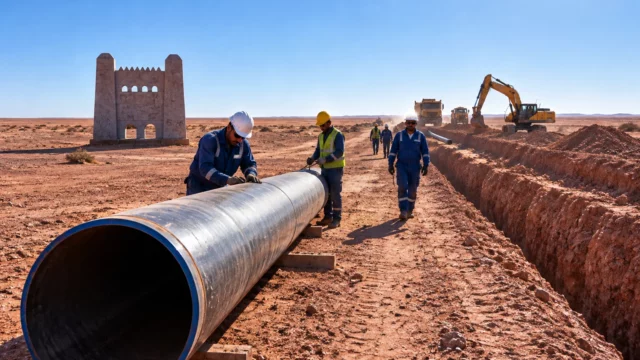
The case of LPG shipments to India illustrates this new commercial geography. Reuters, cited by several publications, reports that Indian Oil Corporation has finalised an agreement with Sonatrach for deliveries in 2027. The arrangement reportedly provides for monthly cargoes of 45,000 to 55,000 tonnes, with Indian imports of Algerian origin already resuming in June 2026. This gives Algeria a more visible relationship with a major Asian market seeking to diversify its supplies.
This commercial breakthrough matters to Algiers, but also to the way the African energy sector is viewed. It shows that an African producer can secure markets beyond the Europe-Mediterranean axis, provided it has the infrastructure, logistics chain and sufficiently flexible contracting policy. Conversely, the continent’s importing countries, such as Egypt, Morocco and South Africa, face higher bills when prices rise. CREA puts Egypt’s net additional costs over the period studied at $5.2 billion, South Africa’s at $3.5 billion and Morocco’s at $2.2 billion.
The continental impact is therefore twofold. On the one hand, Algeria is strengthening its role as a reliable exporter at a time when some buyers are seeking to reduce their dependence on the Gulf. On the other, the crisis is a reminder that Africa is not a homogeneous bloc in energy markets: a handful of exporting countries gain, while many importers pay more. This divide, more than the price level alone, is what should be watched in the coming months, as the next OPEC+ meetings approach and Sonatrach seeks to secure new Asian contracts.