Algeria
 Egypt
 Libya
 Morocco
 Sudan
 Tunisia
 Benin
 Burkina Faso
 Cabo Verde
 Côte d'Ivoire
 Ghana
 Guinea
 Guinea-Bissau
 Liberia
 Mali
 Mauritania
 Niger
 Nigeria
 Sierra Leone
 The Gambia
 Togo
 Cameroon
 Central African Republic
 Chad
 DR Congo
 Equatorial Guinea
 Gabon
 Republic of the Congo
 São Tomé and Príncipe
 Burundi
 Comoros
 Djibouti
 Eritrea
 Ethiopia
 Kenya
 Madagascar
 Malawi
 Mauritius
 Mozambique
 Rwanda
 Seychelles
 Somalia
 South Sudan
 Tanzania
 Uganda
 Angola
 Botswana
 Eswatini
 Lesotho
 Namibia
 South Africa
 Zambia
 Zimbabwe
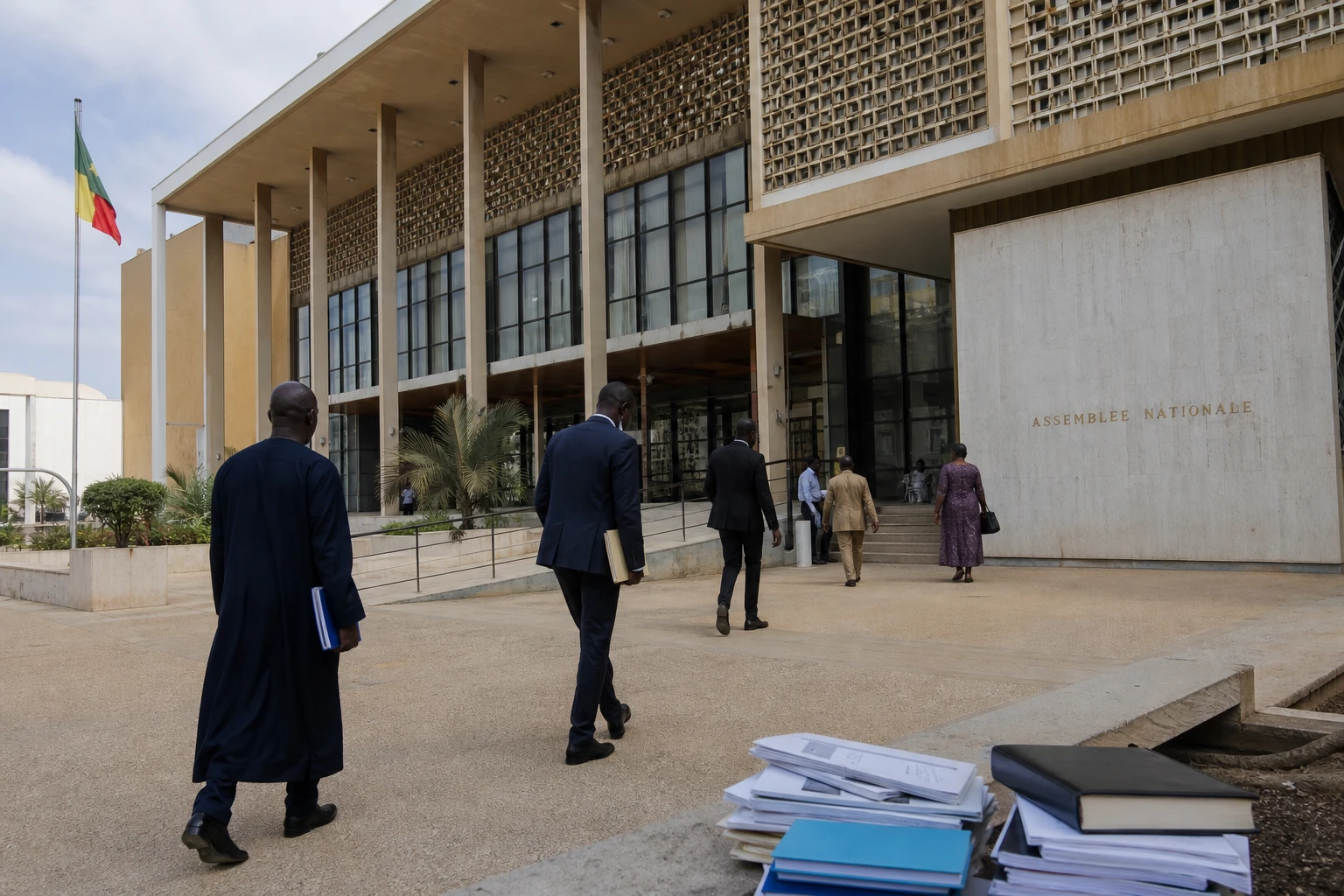
In Senegal, the battle for budget transparency is no longer just rhetoric
In Dakar, the debate over special funds has taken on a very concrete dimension: it is no longer merely about promising better governance, but about deciding who can oversee public funds that have long remained beyond parliamentary scrutiny. As Senegalese people await strong signals on the management of public money, the Constitutional Council’s decision has brought a straightforward question back to the fore: how far does the power of the law extend, and where does the domain reserved for regulation begin?
Senegal is also emerging from an intense institutional period. The Constitutional Council was recently reorganised with the appointment of a new president, while the National Assembly and the executive have advanced a series of texts on institutional and public finance reform. In this landscape, every legal ruling has immediate political weight because it touches on the separation of powers, the credibility of transparency pledges and Parliament’s real ability to exercise oversight.
What the ruling says and why it blocked the bill
On 25 August 2026, Senegal’s Constitutional Council declared inadmissible bill No. 36/26 on the legal framework for special funds. According to the highest court, the procedures for committing, liquidating, authorising, paying, accounting for and auditing these funds fall within a domain that the organic law assigns to the regulatory power, rather than the domain of legislation covered by Article 67 of the Constitution. The Council therefore considered that the text encroached on prerogatives governed by the legislation on public finances currently in force.
The process began a few days earlier. On 18 August, on the eve of the bill’s consideration in plenary session, Prime Minister Ahmadou Al Aminou Lô petitioned the Constitutional Council to challenge it. In its statement of 10 August, the government argued that certain provisions fell within the regulatory power under Articles 67 and 76 of the Constitution. The Council endorsed this interpretation and put on hold the parliamentary initiative brought by the PASTEF-Les Patriotes majority group.
In its statement, the PASTEF parliamentary group said it wanted to « see the bill through », while maintaining that the goal of transparency would not be abandoned. This response confirms that the issue goes beyond budgetary technicalities. It touches on the fault line between a majority seeking to signal a break with opaque practices and an executive that controls the timetable or legal framework when it considers a bill unsuitable.
Sensitive funds in a state seeking to establish its financial discipline
Special funds, often equated in public debate with political funds or special funds, are used by the heads of institutions and for certain specific state expenses. They are not new. The real issue is their opacity, oversight and place within a coherent budget framework. In Senegal, the organic law on finance laws adopted in 2020 nevertheless strengthened oversight by the National Assembly and the Court of Auditors, as part of a results-based management approach.
This issue comes at a time when Senegal’s public finances are already under severe strain. The 2025 general budget provided for more than 6,364 billion CFA francs in payment appropriations, with margins already squeezed by salaries and debt. In this context, every hard-to-understand allocation fuels greater demands for justification. Transparency is therefore not just a moral rallying cry; it is becoming a tool for fiscal sustainability and institutional trust.
The case is also part of a broader political trajectory. Since 2024, Senegal has seen a reshaping of institutional power relations, with a highly assertive parliamentary majority, an executive seeking to take back control of state reform, and a public closely watching pledges of accountability. The proposal to regulate special funds was part of this agenda for change. Its legal rejection nevertheless serves as a reminder that a political majority is not always enough to overcome the limits set by financial law.
For the institutions, the stakes are twofold. On the one hand, the executive preserves room for manoeuvre that it considers necessary for certain sensitive expenditure. On the other, Parliament and some civil society groups want these funds removed from the grey area in which they are almost entirely beyond public debate. For citizens, the case sums up a wider problem: transparency in state finances is measured not only by the publication of laws, but by the ability to effectively oversee the most discretionary spending.
Regional implications beyond Senegal
In West Africa, Senegal holds a particular position. A member of ECOWAS and WAEMU, it is often presented as an institutional testing ground for the region. How it handles the issue of special funds could therefore serve as a reference point, or a warning, for other states also seeking to strengthen oversight of public spending without disrupting the functioning of their institutions.
The next moment to watch will be as much political as legal. PASTEF has already announced its intention to continue regulating special funds, but through other channels. The question now is whether this reform will return in the form of a regulatory text, a new legislative proposal or a broader amendment linked to public finance reform. In Dakar, the case goes beyond special funds alone: it tests Senegal’s ability to turn a promise of transparency into a lasting oversight mechanism.