Egypt
 Libya
 Morocco
 Sudan
 Tunisia
 Benin
 Burkina Faso
 Cabo Verde
 Côte d'Ivoire
 Ghana
 Guinea
 Guinea-Bissau
 Liberia
 Mali
 Mauritania
 Niger
 Nigeria
 Senegal
 Sierra Leone
 The Gambia
 Togo
 Cameroon
 Central African Republic
 Chad
 DR Congo
 Equatorial Guinea
 Gabon
 Republic of the Congo
 São Tomé and Príncipe
 Burundi
 Comoros
 Djibouti
 Eritrea
 Ethiopia
 Kenya
 Madagascar
 Malawi
 Mauritius
 Mozambique
 Rwanda
 Seychelles
 Somalia
 South Sudan
 Tanzania
 Uganda
 Angola
 Botswana
 Eswatini
 Lesotho
 Namibia
 South Africa
 Zambia
 Zimbabwe
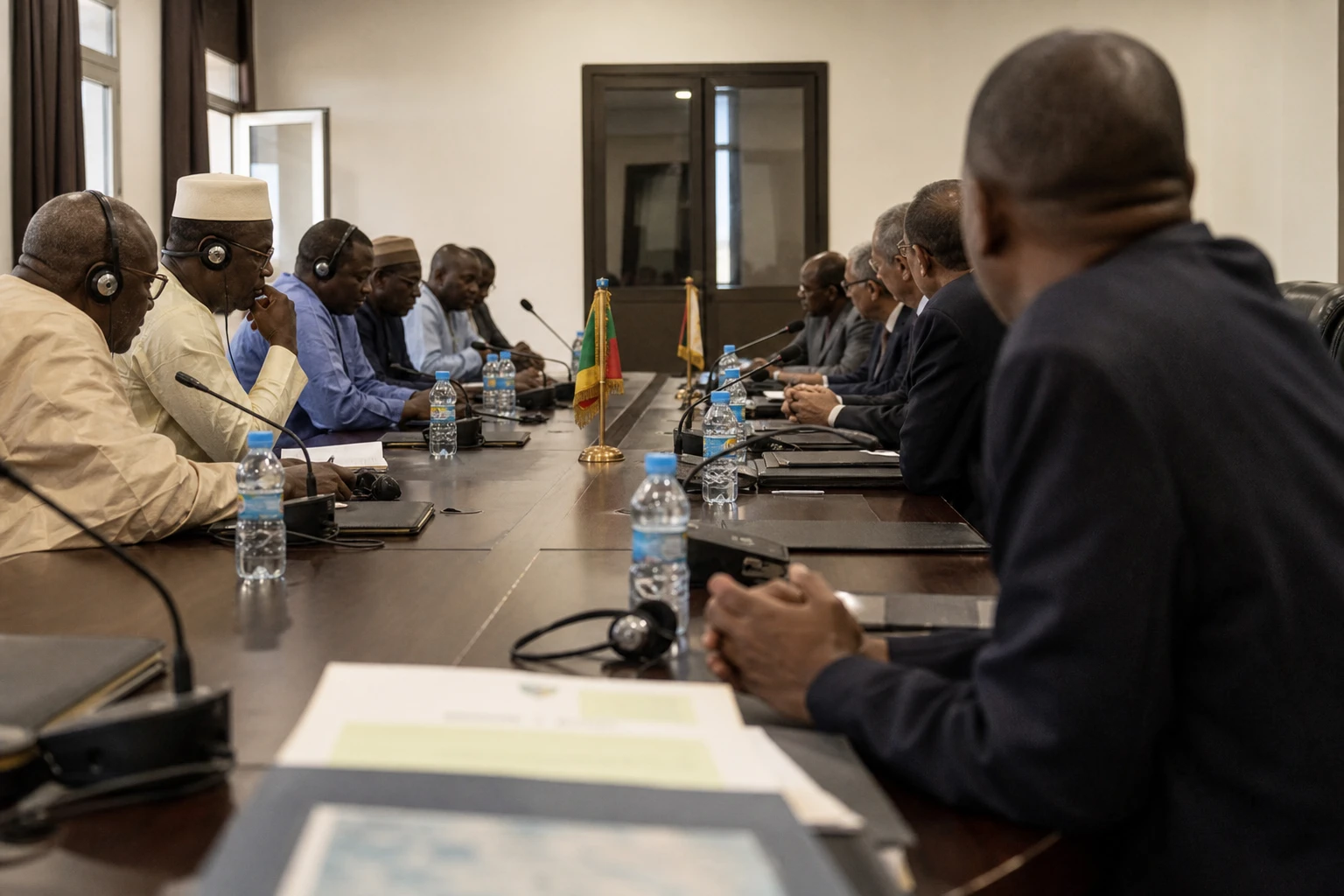
Bamako and Algiers return to the table as neighbours
When a Sahelian country seeks to reopen a diplomatic channel with its northern neighbour, it is about more than protocol. Security, trade routes, fuel and room for manoeuvre are also at stake for a Malian state that remains under heavy pressure in its northern regions. Malian Prime Minister Abdoulaye Maïga’s visit to Algiers this Monday, 24 August 2026, falls into this category: a dialogue that Bamako wants to make more substantive than mere statements of courtesy.
The regional context goes a long way towards explaining the visit. Mali is no longer part of the ordinary framework of ECOWAS, having formally withdrawn on 29 January 2025 after a prolonged period of political tensions in West Africa. At the same time, the question of northern Mali remains far from a simple solution, despite the end of the UN mediation linked to MINUSMA and the waning momentum of the framework established by the Algiers process.
What was said in Algiers
Arriving in Algiers at the head of a large delegation, Abdoulaye Maïga was received by Algerian President Abdelmadjid Tebboune. Mali’s prime minister’s office described the trip as a working visit, undertaken on the instructions of Malian head of state Assimi Goïta and carrying a message to his Algerian counterpart.
After the meeting, Mali’s prime minister said that Assimi Goïta was expected to make an official visit to Algeria soon. The two capitals also highlighted their desire to inject fresh momentum into bilateral relations, which have been damaged by several months of diplomatic tensions. The visit was preceded by a telephone conversation between the two prime ministers on 9 August 2026, which had already paved the way for renewed dialogue.
Algeria’s stated message remains one of partnership between neighbours. The idea is not new. Algiers has long claimed a facilitating role in northern Mali, particularly around the 2015 Agreement for Peace and Reconciliation. But the agreement was weakened by mutual accusations, followed by Mali’s decision to reject its relevance in its previous form.
Security, roads and energy: the key issues
Security remains the most sensitive lens through which to view the relationship. For Bamako, the north remains a strategic area where the state wants to reassert control without becoming trapped in a cycle of permanent escalation. For Algiers, Mali’s stability matters directly, as it also affects the security of its southern border and the credibility of its Sahel policy. In this equation, discussions are not only about weapons but also about movement, control of routes and the state’s effective presence.
Infrastructure is also on the agenda. The Trans-Saharan Highway, conceived as a corridor linking Algiers to Lagos via Mali, remains a major project for trade between the Sahel and the Maghreb. The African Development Bank notes that the Malian branch of this corridor is part of a network spanning several thousand kilometres, designed to improve connections between landlocked countries and Mediterranean ports. This is a very tangible issue for Mali: less isolation, better access to markets and potentially lower logistics costs for both the formal economy and informal trade.
Hydrocarbons were also discussed, according to information released around the visit. Here too, the stakes go beyond sectoral co-operation alone. For a country such as Mali, facing supply pressures, any improvement in energy flows can directly affect cities, transport and the price of essential goods. For Algeria, this kind of issue helps consolidate regional influence based on energy, corridors and neighbourly diplomacy.
Implications for West Africa and the Sahel
This rapprochement concerns more than two capitals. It says something about the ongoing realignment in the Sahel and West Africa. Since leaving ECOWAS, Bamako has been seeking other forms of co-operation that are closer, more bilateral and less exposed to institutional power struggles in the sub-region. Algiers, for its part, is seeking to remain a stabilising force between the Maghreb and the Sahel, at a time when traditional regional solutions are struggling to deliver lasting results.
The visit can therefore be seen as a test. A test of trust between two states that have been through a period of mutual suspicion. A test of credibility for Algiers, which wants to become a useful interlocutor again on the Mali issue. And, finally, a test for Bamako, which must show that a change in diplomatic tone can produce more than a joint statement. The coming months will show whether the return to dialogue opens the way to substantive work on security, roads and energy, or merely closes a period of tension without changing the underlying balance of power.