Algeria
 Egypt
 Libya
 Morocco
 Sudan
 Tunisia
 Benin
 Burkina Faso
 Cabo Verde
 Côte d'Ivoire
 Ghana
 Guinea
 Guinea-Bissau
 Liberia
 Mali
 Mauritania
 Niger
 Nigeria
 Senegal
 Sierra Leone
 The Gambia
 Togo
 Cameroon
 Central African Republic
 Chad
 Equatorial Guinea
 Gabon
 Republic of the Congo
 São Tomé and Príncipe
 Burundi
 Comoros
 Djibouti
 Eritrea
 Ethiopia
 Kenya
 Madagascar
 Malawi
 Mauritius
 Mozambique
 Rwanda
 Seychelles
 Somalia
 South Sudan
 Tanzania
 Uganda
 Angola
 Botswana
 Eswatini
 Lesotho
 Namibia
 South Africa
 Zambia
 Zimbabwe
A waterway under pressure
In Congo-Kinshasa, the river is more than just a backdrop. It carries goods, families, healthcare and rumours. When an epidemic takes hold along it, the entire organisation of riverside cities is shaken, from Kisangani to Kinshasa. It was in this context that the Congolese authorities launched the ‘Congo River Ebola-Free’ initiative on 20 August 2026, a programme designed to reduce the risk of the virus spreading along the country’s main river corridor.
The choice of this corridor is no coincidence. In the east of the Democratic Republic of the Congo, an outbreak of Ebola virus disease caused by the Bundibugyo virus has already reached a worrying threshold. The World Health Organization said the initiative aims in particular to prevent the disease spreading to major riverside urban centres, including Mbandaka and Kinshasa, as well as to neighbouring countries, especially the Republic of the Congo and the Central African Republic.
An outbreak that requires a broader response
This latest step comes amid the 17th Ebola virus disease epidemic, declared in May 2026 in the Democratic Republic of the Congo and Uganda, following confirmation of the Bundibugyo virus. Congolese health authorities and the WHO then activated emergency mechanisms, strengthening surveillance, contact tracing, care, and infection prevention and control.
In Kinshasa, the official message is clear: the task is no longer just to treat cases in affected areas, but to break possible chains of transmission before they reach transport hubs. The Ministry of Health has published daily situation reports on this 17th outbreak, a sign of surveillance that is now much more structured than at the start of the epidemic.
At the regional level, the logic is the same. In May 2026, the health ministers of DR Congo, Uganda and South Sudan met in Kampala with support from Africa CDC, the WHO and other partners to co-ordinate the cross-border response. This co-ordination is crucial, because disease respects neither administrative borders nor diplomatic channels.
What monitoring boats changes
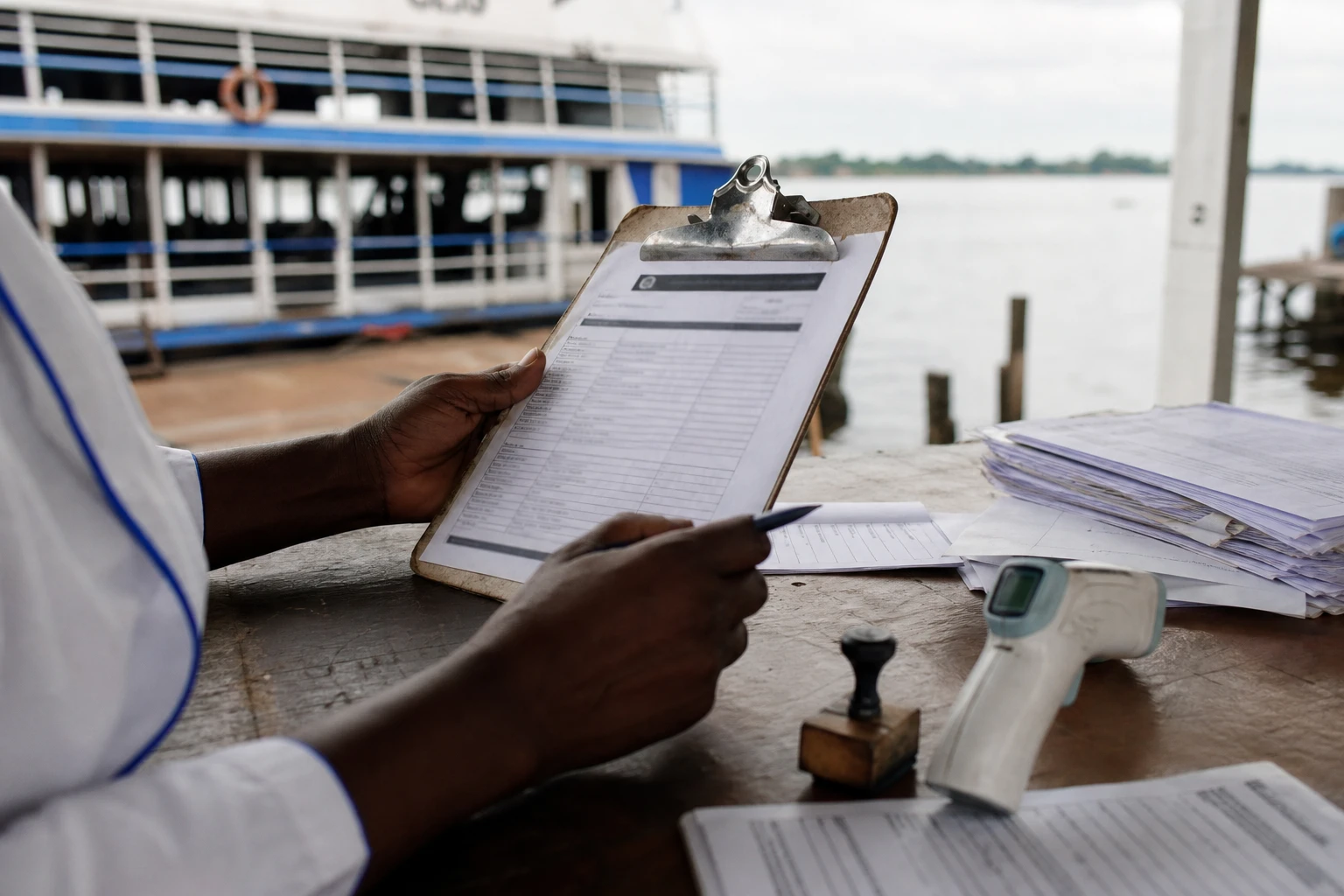
The programme announced on the Congo River is based on a simple idea: monitor crossing points more closely to identify risks earlier and prevent a suspected case from travelling beyond its area of origin. The WHO says the initiative is receiving inter-agency support involving the IOM, UNICEF and the WFP, with catalytic funding of US$9 million through OCHA Funds.
In practice, that means greater vigilance in ports, on quays and aboard the boats that connect entire communities every day. It also means more systematic checks, better reporting of community alerts and a faster ability to isolate a suspected case. The WHO says the strategy is part of a broader approach to epidemic preparedness, going beyond Ebola alone.
For residents, the difference is tangible. Travellers, traders, fishers and small transport operators depend on this waterway. If surveillance is too burdensome, it can slow already fragile exchanges. If it is too weak, it allows an epidemic to gain ground. The challenge is therefore to keep trade flowing while protecting riverside communities. It is also a test of trust between the authorities, health teams and the populations whose livelihoods depend on the river.
The regional dimension matters just as much. The Congo River links areas of movement between DR Congo, the Republic of the Congo and the Central African Republic. In a context of frequent cross-border movement, an outbreak in Kisangani can quickly become a concern for Brazzaville, Bangui or towns in between if surveillance falters. The Congolese authorities are therefore stressing the need to prevent the disease spreading to densely populated urban centres, where the response would be more complex and costly.
A challenge for DR Congo and Central Africa
DR Congo is no stranger to this situation. After the end of the 16th epidemic was announced in December 2025, the country had already redirected part of its surveillance system towards a broader integrated system. But the current outbreak shows that long-term preparedness is not always enough to contain a rapidly spreading disease across a territory that is both vast and highly mobile.
The country also pays the price for its geography. The east is exposed to cross-border dynamics with Uganda, while the central part of the country depends on the river to link remote areas. This makes river surveillance a public health issue, but also a matter of logistical governance. At national level, it involves health services as much as port authorities, local administrations and community networks.
The continental implications are clear. Repeated Ebola outbreaks in Central Africa continue to push regional institutions to work more closely together, whether Africa CDC, the WHO or bilateral mechanisms between riverine states. The issue is also a reminder that an effective response is not limited to hospitals: it extends to ports, markets, secondary roads and landing points, where economic life unfolds and early warning signs emerge.
In the coming days, attention will focus on three points: the programme’s actual ability to cover the main landing points, developments in reported cases in the affected provinces and co-ordination with neighbouring countries. That is where the effectiveness of ‘Congo River Ebola-Free’ will be decided: not in its announcement, but over time.