
 Algeria
 Egypt
 Libya
 Morocco
 Sudan
 Tunisia
 Benin
 Burkina Faso
 Cabo Verde
 Côte d'Ivoire
 Ghana
 Guinea
 Guinea-Bissau
 Liberia
 Mali
 Mauritania
 Niger
 Nigeria
 Senegal
 Sierra Leone
 The Gambia
 Togo
 Cameroon
 Central African Republic
 Chad
 Equatorial Guinea
 Gabon
 Republic of the Congo
 São Tomé and Príncipe
 Burundi
 Comoros
 Djibouti
 Eritrea
 Ethiopia
 Kenya
 Madagascar
 Malawi
 Mauritius
 Mozambique
 Rwanda
 Seychelles
 Somalia
 South Sudan
 Tanzania
 Uganda
 Angola
 Botswana
 Eswatini
 Lesotho
 Namibia
 South Africa
 Zambia
 Zimbabwe
An epidemic already extending beyond the health sphere
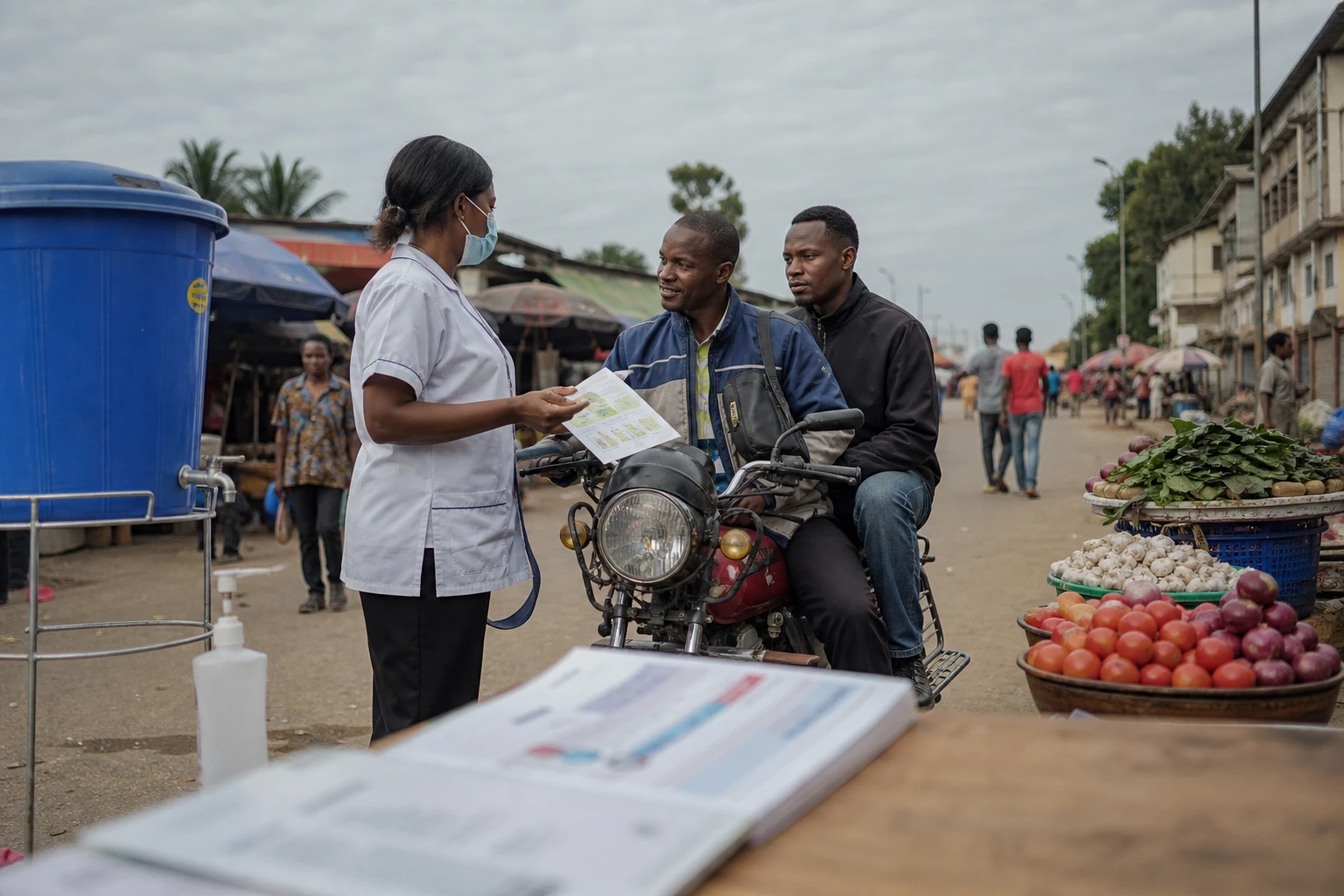
In eastern Democratic Republic of the Congo, Ebola is not simply a medical crisis. It is also a matter of mobility, trust and the continuity of the state. When response teams arrive more slowly than the virus, every journey, every market and every mining track becomes a point of contact to monitor.
The current outbreak is in Ituri, a border province where exchanges with Uganda remain intense. This corridor is important to the local economy, but it complicates contact tracing, especially in rural areas and gold-mining sites. Africa CDC and the WHO carried out a joint mission there in early August to strengthen a “community-led” response and better coordinate efforts between Bunia and Kinshasa.
What the figures show today
Congolese authorities declared the country’s 17th Ebola outbreak on 15 May 2026, caused by the Bundibugyo strain. On its surveillance portal, the Ministry of Public Health, Hygiene and Social Welfare confirms that the outbreak has remained active since that date. The Public Health Emergency Operations Centre regularly publishes reports on its progress.
On 6 August, the WHO and Africa CDC said that the DRC had reported 3,973 confirmed cases, 1,801 deaths and 776 recoveries across 51 health zones in five provinces. Four days later, other figures cited by the authorities and international media put the total at more than 4,000 cases and more than 2,000 deaths, illustrating above all the speed of the spread and the fluid nature of the data during an active outbreak.
Following the WHO emergency committee meeting on 18 August, Director-General Tedros Adhanom Ghebreyesus maintained the international alert level first activated in May. The organisation considers the risk “very high” in the DRC, “high” in Uganda and “high” for neighbouring countries connected by cross-border exchanges, while assessing the risk as low for the rest of Africa and globally.
Why the response is struggling to outpace the virus
Bundibugyo ebolavirus is no abstract threat. It spreads through contact with bodily fluids, and its early symptoms resemble an ordinary fever. That is precisely what delays diagnosis. Congolese Health Minister Samuel Roger Kamba has said that patients may remain in the community before their condition deteriorates, and can therefore infect others.
The problem is not only biological. In Ituri, insecurity, population displacement and constant journeys to markets, rivers and mining sites sustain the spread of the virus. The WHO also stresses a very practical point: contact tracing remains inadequate, with a rate of 75% recorded in early August, well below the operational target of 95% needed to break chains of transmission.
Distrust makes the task even harder. Response teams have reported vandalised ambulances and an injured nurse in northern Ituri. Such incidents reveal a central issue: without local buy-in, epidemiological surveillance remains incomplete. For healthcare workers, the risk is immediate. For residents, the consequences are twofold: delayed care and fear of being isolated, sometimes far from healthcare facilities.
Congolese authorities say they have adapted the response. The National Institute of Public Health and the ministry have issued more reports, while the government has launched trials and research into diagnostic tools and treatment options. The European Union has also announced €2.5 million in material support for screening. But simply adding up resources is not enough if teams’ access, trust and the speed of detection remain fragile.
A Congolese challenge, but also a regional one
The DRC is not facing this outbreak alone. Neighbouring Uganda has already recorded an imported case in this border corridor, before declaring its own outbreak over on 28 July 2026, after 20 confirmed cases and two deaths. This matters because it shows that rigorous surveillance can contain an epidemic, provided action is taken early and contacts are followed through to the end.
For Central and East Africa, the outbreak is a reminder of the importance of cross-border health networks, coordination between states and laboratory capacity. Africa CDC declared the outbreak a continental public health security emergency on 18 May, a phrase that captures the stakes: a local outbreak can quickly become a regional test.
In Kinshasa, the issue therefore goes beyond crisis communications. It touches on the effective presence of the state in the east of the country, the role of provincial structures and the ability of institutions to work with communities, including motorcycle taxi drivers, religious representatives and local leaders, who are often crucial to gaining access to patients. That is where the next stage will be decided: in the coming days, the WHO is due to issue new recommendations, while the Congolese authorities will have to prove that the response can gather pace without losing the population along the way.



