Algeria
 Egypt
 Libya
 Morocco
 Sudan
 Tunisia
 Benin
 Burkina Faso
 Cabo Verde
 Côte d'Ivoire
 Ghana
 Guinea
 Guinea-Bissau
 Liberia
 Mali
 Mauritania
 Niger
 Nigeria
 Sierra Leone
 The Gambia
 Togo
 Cameroon
 Central African Republic
 Chad
 DR Congo
 Equatorial Guinea
 Gabon
 Republic of the Congo
 São Tomé and Príncipe
 Burundi
 Comoros
 Djibouti
 Eritrea
 Ethiopia
 Kenya
 Madagascar
 Malawi
 Mauritius
 Mozambique
 Rwanda
 Seychelles
 Somalia
 South Sudan
 Tanzania
 Uganda
 Angola
 Botswana
 Eswatini
 Lesotho
 Namibia
 South Africa
 Zambia
 Zimbabwe

A debate that goes beyond legal technicalities
In Dakar, the question is not simply who must declare their assets. It touches on something more sensitive: public trust. In a country where the fight against corruption has become a powerful political marker, every transparency rule is also a test of the institutions’ credibility. Senegalese people want to know whether the same requirements apply to everyone, with no grey areas at the top of government. This expectation carries all the more weight because financial transparency is among the reforms championed by the executive since Bassirou Diomaye Faye became president and Ousmane Sonko prime minister.
The regional context also matters. In West Africa, ECOWAS has often called for more accountable institutions, while public pressure over the governance of public resources has grown in several capitals. In Senegal, this debate is part of a broader sequence: reform of OFNAC, publication of the names of those required to declare their assets, then constitutional revision. In other words, Dakar is not debating an administrative detail, but the architecture for overseeing power.
What the current laws say
Senegalese law is not starting from scratch. Article 37 of the Constitution already stipulates that the newly elected President of the Republic must submit a written declaration of assets to the Constitutional Council, which makes it public. The rest of the framework was strengthened by Law No. 2024-02 of 30 January 2024, which expanded the scope of those required to file declarations and specified the procedures for OFNAC, the National Office for the Fight against Fraud and Corruption, to monitor compliance and publish lists. A bill published in October 2024 then tightened the rules further, expanding the categories of people required to declare their assets, providing for the periodic publication of those who have complied or defaulted, and strengthening sanctions.
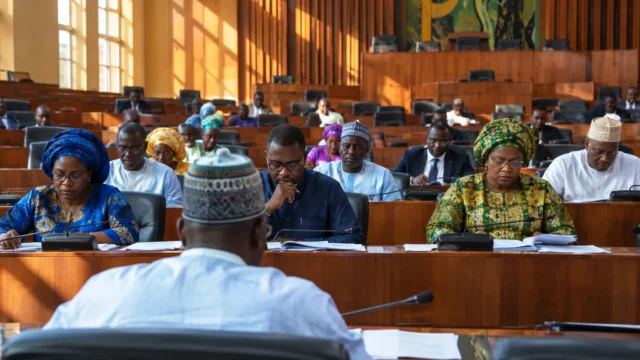
This framework explains the heart of the controversy. The text considered by the National Assembly in June and July 2026 concerned a revision of the Constitution, with one article focused on the head of state’s declaration of assets. On 24 July 2026, the National Assembly forwarded the matter for an opinion, stating that a bill to amend Article 37 had been introduced by MP Amadou Ba No. 2. The same parliamentary statement mentioned other initiatives: rules governing special credits, and commissions of inquiry into land issues and certain state property transactions.
In the chamber, the debate took on a clearly political dimension. Some Pastef MPs defended maintaining strict oversight, while others challenged the method or the legal scope of certain amendments. The Law Committee had already adopted the constitutional revision on 26 June 2026, following tense exchanges over transparency, the president’s party leadership and the end of his term. The government subsequently called for broad national consultation. This back-and-forth shows that transparency is not dividing only the ruling party and the opposition; it is also raising questions about the consistency of a government built on a promise of change.
Why extending the requirement to the prime minister and National Assembly president changes the stakes
The most sensitive point is the extension of the requirement to the prime minister and the president of the National Assembly. Legally, some MPs argued that a constitutional article devoted to the president could not, on its own, cover other senior officials. Politically, the argument is broader: if transparency is to become a rule at the highest level, it must be set out unambiguously. Otherwise, it fuels suspicions that it applies more to opponents than allies. This reservation was voiced even within the ruling majority, a sign that the president’s camp is alert to questions of form as well as substance.
The leader of the Pastef parliamentary group, for his part, argued that the prime minister and the president of the National Assembly were already covered by the law on asset declarations. OFNAC has indeed published provisional lists of those required to declare their assets, distinguishing between those who have filed declarations and those who have not. This changes how the issue is viewed: the question is not only whether to create a new obligation, but how to make an existing framework clear, as it is sometimes perceived by the public as opaque. In an administration where trust also depends on rules being made public, clarity is almost as important as sanctions.
For the government, the stakes are twofold. On the one hand, it must show that the promised change in governance goes beyond rhetoric. On the other, it must avoid the reform being seen as an internal political manoeuvre or a weapon in the positioning of figures from the same camp. In present-day Senegal, where the prime minister’s office has regained influence and the National Assembly is seeking to take the initiative, sharing the burden of transparency is also a way of sharing symbolic power. In practice, public declarations of assets by senior officials could reassure some urban voters, who pay close attention to accountability, but they would also expose officials more to politically motivated interpretations of their wealth.
A Senegalese issue with West African reach
This issue resonates beyond Dakar. In West Africa, several countries have seen demand for transparency become a central concern, not only for civil society but also for parliaments seeking to regain control over oversight of the executive. Senegal, often presented as one of the region’s most stable democracies, is being watched closely because its institutional choices often serve as a point of reference. A robust, clear and consistent reform could strengthen that role. Conversely, a reform seen as incomplete or overly political would weaken the signal sent to the sub-region.
The timetable also matters. The National Assembly’s extraordinary session, opened for 15 days, is to consider several bills, including one on rules governing special credits, sometimes called the presidency and prime minister’s secret funds. This timing is not incidental. It links the question of assets to that of the state’s discretionary resources. In other words, Senegal’s debate is not only about what leaders own, but also what they can spend outside ordinary oversight. This is where an important part of the culture of accountability is at stake.
The vote scheduled for Tuesday 18 August is therefore becoming a political moment that goes well beyond a simple parliamentary ballot. If it confirms the commitment to transparency, it will further embed the new majority in a system of public oversight of officials. If it runs up against legal ambiguities or internal compromises, it will serve as a reminder that in Senegal, as elsewhere, cleaning up public life depends not only on stated principles but also on the precision of the mechanisms adopted. In a region where citizens are demanding answers with increasing insistence, that precision has become a requirement of government.
Read Senegal’s constitutional framework on asset declarations