Algeria
 Egypt
 Libya
 Morocco
 Sudan
 Tunisia
 Benin
 Burkina Faso
 Cabo Verde
 Côte d'Ivoire
 Ghana
 Guinea
 Guinea-Bissau
 Liberia
 Mali
 Mauritania
 Niger
 Nigeria
 Senegal
 Sierra Leone
 The Gambia
 Togo
 Cameroon
 Central African Republic
 Chad
 Equatorial Guinea
 Gabon
 Republic of the Congo
 São Tomé and Príncipe
 Burundi
 Comoros
 Djibouti
 Eritrea
 Ethiopia
 Kenya
 Madagascar
 Malawi
 Mauritius
 Mozambique
 Rwanda
 Seychelles
 Somalia
 South Sudan
 Tanzania
 Uganda
 Angola
 Botswana
 Eswatini
 Lesotho
 Namibia
 South Africa
 Zambia
 Zimbabwe
At Plaine Savo, hunger follows fear
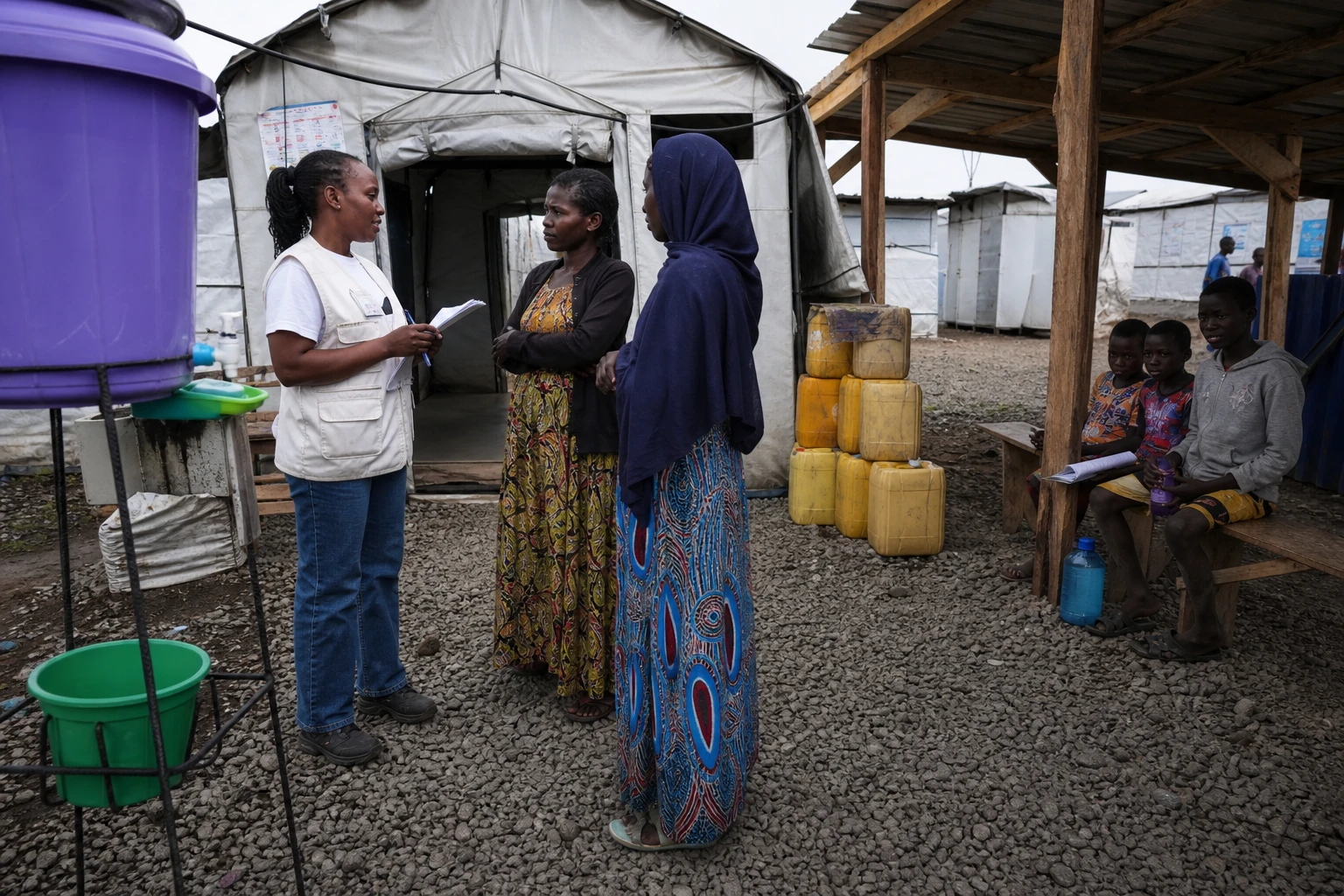
In the east of the Democratic Republic of the Congo, a displacement camp is never just a place of shelter. It often becomes a space of constrained survival, where people count the days, meals and risks. At Plaine Savo, in Djugu territory, Ituri, this reality is now being compounded by two overlapping crises: armed violence and an Ebola outbreak that is further weakening families already uprooted from their homes. Ituri remains one of the country’s most exposed provinces, alongside North Kivu and South Kivu, at the heart of the Great Lakes crisis.
The Plaine Savo site, near Bule, now hosts a population far beyond its initial capacity. Humanitarian sources put the figure at around 70,000 people in April 2026, while other assessments point to a rapid rise in the number of displaced people in the area. This demographic pressure is due less to a single movement than to successive waves of flight triggered by fighting, attacks by armed groups and persistent insecurity along farming routes.
A territory caught between armed fronts and a health crisis
Ituri is not isolated from the rest of eastern Congo. It shares with North Kivu the same geography of forced displacement, blocked roads and disrupted markets. The province is also close to Uganda, giving security developments an immediate regional dimension. The presence of Ugandan forces in some border areas has altered the pressure on certain armed groups, but has not brought lasting calm. In this landscape, civilians often find themselves caught between several armed actors and shifting lines of control.
The current Ebola outbreak adds another layer of vulnerability. As of 17 June 2026, the World Health Organization had confirmed 896 cases and 232 deaths in DR Congo, with Ituri the main epicentre of the outbreak. Later, on 1 July 2026, the WHO reported 1,460 confirmed cases and 452 deaths in the country, with a continued high concentration in Ituri. This development directly affects displacement, as health teams must work in areas where people’s movement is already hampered by insecurity.
In this context, displacement sites become places where risks are concentrated. In June 2026, UNHCR warned that the outbreak threatened displaced communities in eastern Congo, precisely because these populations often have limited access to water, healthcare and health information. The warning is significant: when humanitarian aid, public health and security all deteriorate at once, families are left with almost no room to manoeuvre.
Nearby fields, but out of reach
The heart of the crisis at Plaine Savo is not just shelter. It is food. Humanitarian workers and organisations on the ground describe acute food insecurity, linked to displaced people’s inability to reach their fields or usual places of work. MSF said that around 70,000 people were living in the camp in April 2026, and that access to drinking water and sufficient food remained severely inadequate. It is a simple but decisive indicator: as long as families cannot farm or trade freely, the camp offers no protection from hunger.
Malnutrition then becomes a direct consequence of the security blockade. Medical staff in the area say they are seeing rising cases among children and adults alike, as meals become scarcer and less varied. This trend reflects what humanitarian agencies have described for years in eastern DR Congo: insecurity drives families from their land, cuts off informal incomes, disrupts local markets and turns reaching the fields into a risky undertaking. The subsistence economy, so important in Ituri, is thus being broken just a few kilometres from the places where crops are grown.
The consequences extend beyond the camp. When adults hesitate to go out to find food, they also make fewer trips to health centres, markets and schools. Children pay a heavy price. So do older people. And women, often responsible for collecting water and providing food for the household, bear a greater share of the risk in an area where sexual violence and attacks on roads remain threats documented by humanitarian workers.
What Plaine Savo reveals about DR Congo today
Plaine Savo says something broader about the Democratic Republic of the Congo: long-running crises coexist, overlapping rather than following one another. An epidemic outbreak does not end a local war. A military operation does not automatically reopen fields. A ceasefire declared by an armed group guarantees neither safe roads nor a return to normal activity. In Ituri, as elsewhere in the east of the country, civilians live with the gap between announcements, realities on the ground and the slow return to normality.
The issue is also regional. Stabilising Ituri directly affects the Great Lakes region, the Ugandan border and, more broadly, African crisis-management mechanisms, from security cooperation to cross-border health responses. When Ebola is spreading in an area with intense movement, coordination between Kinshasa, Kampala, provincial authorities, the WHO and humanitarian organisations is essential. Without it, forced displacement can fuel the spread of the virus, while fear of infection further increases mistrust of aid teams.
In the coming weeks, attention will remain focused on the course of the Ebola outbreak, humanitarian access in Ituri and the security actors’ actual ability to protect civilians without confining them further. For those displaced at Plaine Savo, the question remains simple: go out to live, or stay in to survive. In this part of DR Congo, that equation is no slogan. It sums up daily life.