Algeria
 Egypt
 Libya
 Morocco
 Sudan
 Tunisia
 Benin
 Burkina Faso
 Cabo Verde
 Côte d'Ivoire
 Ghana
 Guinea
 Guinea-Bissau
 Liberia
 Mali
 Mauritania
 Niger
 Nigeria
 Sierra Leone
 The Gambia
 Togo
 Cameroon
 Central African Republic
 Chad
 DR Congo
 Equatorial Guinea
 Gabon
 Republic of the Congo
 São Tomé and Príncipe
 Burundi
 Comoros
 Djibouti
 Eritrea
 Ethiopia
 Kenya
 Madagascar
 Malawi
 Mauritius
 Mozambique
 Rwanda
 Seychelles
 Somalia
 South Sudan
 Tanzania
 Uganda
 Angola
 Botswana
 Eswatini
 Lesotho
 Namibia
 South Africa
 Zambia
 Zimbabwe
When a neighbourhood idea becomes a prototype
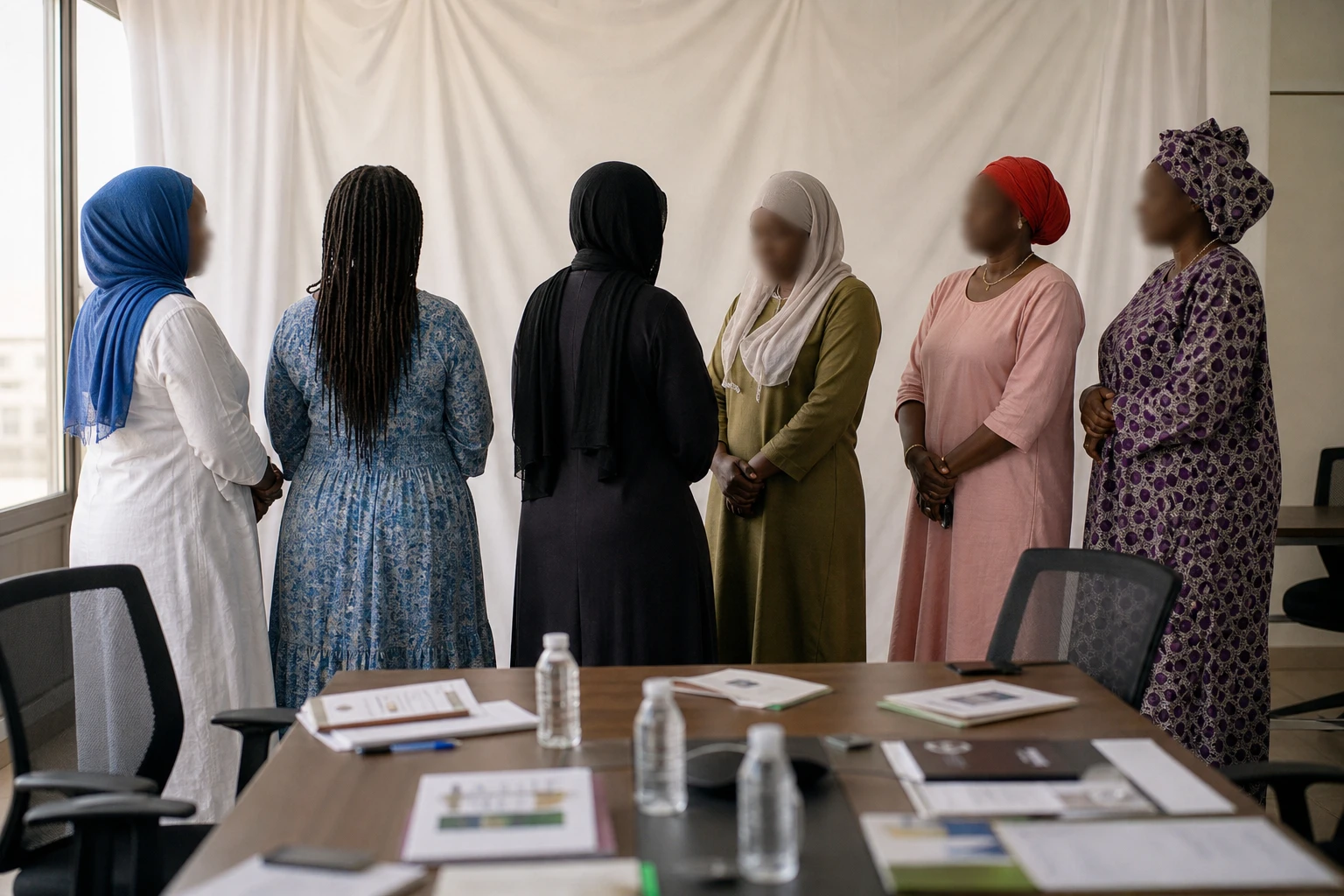
In Dakar, development is not driven solely by major plans and official announcements. It also takes shape in workshops where women test, refine and start again until an idea works in everyday life. That is what Africana Lab, a programme supporting women-led civic initiatives in Senegal, Mali and Mauritania, demonstrates.
In the Senegalese capital, five project leaders spent a week working on their proposals. One of them, Fido Textile, is exploring how to turn coconut fibres into textile material. Others are developing a community kitchen to better include people with intellectual disabilities, as well as washable sanitary pads that are more affordable and sustainable. The aim was not to produce a statement, but to take an idea from intuition to its first practical use.
Dakar, Bamako, Nouakchott: a shared approach to support
Africana Lab is not an isolated project in Dakar. It is designed as a network with Bamako and Nouakchott, two other capitals in West Africa. The approach is based on feminist civic labs, with a simple principle: start with needs expressed by women, test a local response, then connect the experiences. In this programme, facilitators and project partners play a central role, helping to clarify needs, assess feasibility and narrow the gap between an idea and real-world conditions.
The regional co-ordination team stresses the point: women’s concerns in Dakar may overlap with those in Bamako or Nouakchott. Sharing experiences matters in West Africa, where local projects often remain fragile when they are isolated. Connecting them makes it possible to pool methods, share mistakes and avoid every team having to start from scratch.
The initiative is also part of a broader institutional context. Senegal has made the social and solidarity economy a national priority, an approach also highlighted by the ministry responsible for microfinance and the social and solidarity economy. In other words, community and civic groups are not working on the fringes of public debate; they are engaging with a national policy that seeks more inclusive forms of economic activity.
What these projects say about women’s real economy
This is far from a marginal issue. Senegal’s National Agency of Statistics and Demography says that women own 61.9% of non-agricultural informal production units. The study also notes that these activities are concentrated mainly in trade, and that access to finance and a lack of equipment are their chief obstacles. In this context, a prototyping workshop is not simply a creative exercise: it responds to an existing women’s economy that often lacks the tools it needs.
The social impact is just as clear. A community kitchen for people with intellectual disabilities is not merely a social innovation; it concerns inclusion, dignity and the role of local services in neighbourhoods. A washable sanitary pad, meanwhile, touches on health, purchasing power and household autonomy. As for textiles made from coconut fibres, they offer a way to add value locally to materials that are often underused, with potential applications in furnishings or clothing.
Funding for this first phase comes from Spanish co-operation. This matters because it highlights the growing role of Euro-African partnerships in social economy projects, while also underscoring the need to keep local roots at the centre. Co-operation produces lasting results only when the people concerned design, test and refine the solutions themselves, rather than receive an imported model.
A West African perspective beyond Dakar
What is happening in Dakar goes well beyond a workshop. First, Senegal is part of a region where issues such as mobility, financing for small initiatives and women’s empowerment are also discussed at the level of ECOWAS, which recently strengthened its partnership with AECID on resilience, inclusion and regional integration in West Africa. Grassroots projects therefore resonate with regional policy frameworks.
Second, Dakar remains a capital where institutions, associations, creatives, entrepreneurs and international partners meet. The city concentrates resources, but it also concentrates expectations. For women launching a project, the obstacle is not just the initial idea; it is access to proof of concept, a first customer, a first testing space and initial technical support. This is precisely where this kind of lab can make a difference.
The next steps will be decisive for the five teams supported in Dakar, which are due to continue developing their projects until November 2026 before seeking new technical and financial partners. A documentary film is also planned to accompany the project’s dissemination. Across the continent, the challenge is clear: to develop forms of social innovation conceived with women, by women and for women, recognising them as agents of change rather than reducing them to beneficiaries.