Algeria
 Egypt
 Libya
 Morocco
 Sudan
 Tunisia
 Benin
 Burkina Faso
 Cabo Verde
 Côte d'Ivoire
 Ghana
 Guinea
 Guinea-Bissau
 Liberia
 Mali
 Mauritania
 Niger
 Nigeria
 Senegal
 Sierra Leone
 The Gambia
 Togo
 Cameroon
 Central African Republic
 Chad
 Equatorial Guinea
 Gabon
 Republic of the Congo
 São Tomé and Príncipe
 Burundi
 Comoros
 Djibouti
 Eritrea
 Ethiopia
 Kenya
 Madagascar
 Malawi
 Mauritius
 Mozambique
 Rwanda
 Seychelles
 Somalia
 South Sudan
 Tanzania
 Uganda
 Angola
 Botswana
 Eswatini
 Lesotho
 Namibia
 South Africa
 Zambia
 Zimbabwe
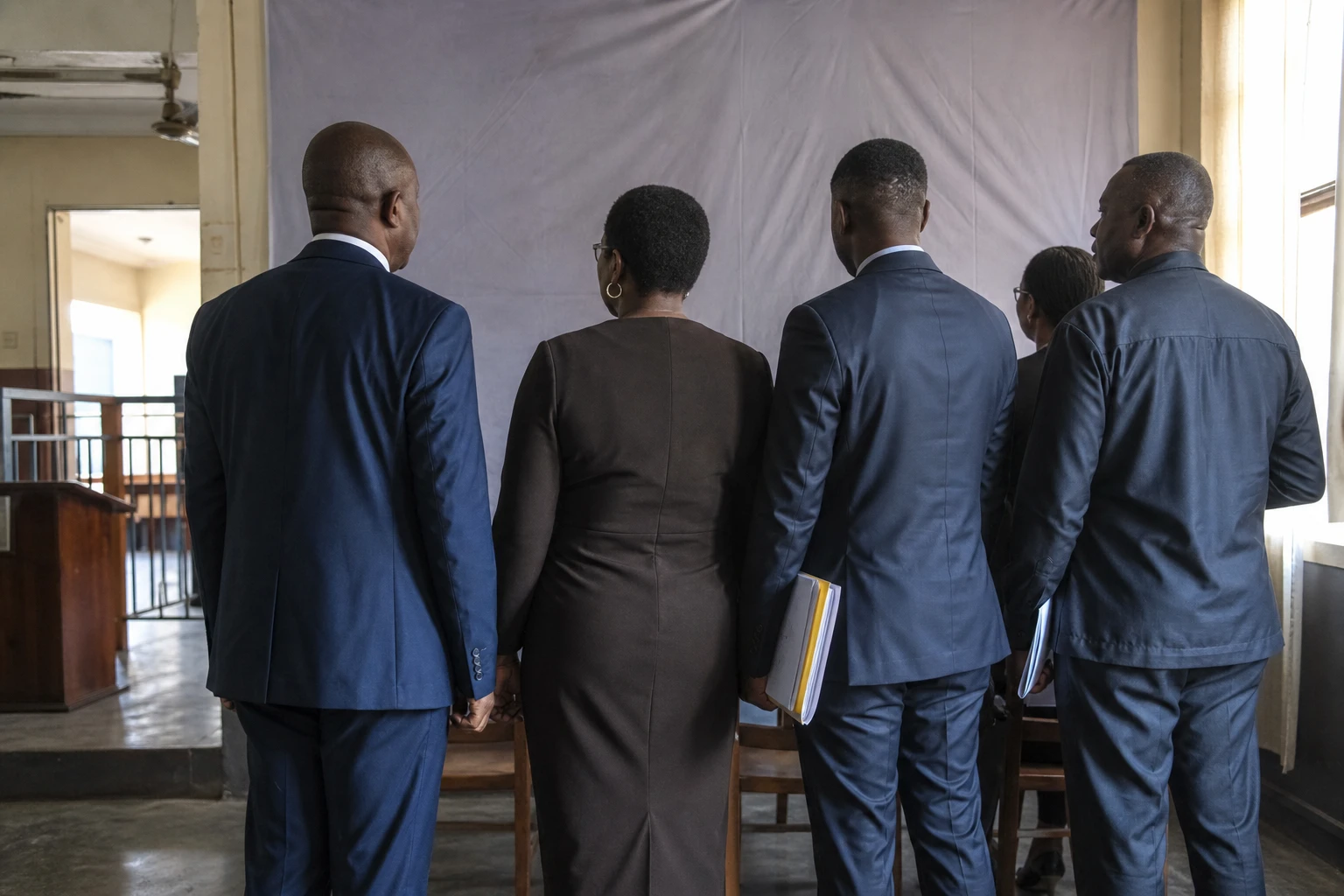
When military justice summons its highest-ranking officers
In Kinshasa, a trial does more than open a criminal case. It also puts the chain of command, security services and the way the Congolese state treats its own men in uniform to the test. In the case involving army general Christian Tshiwewe Songesha and several officers, the defence is not merely disputing the allegations. It is first challenging the legality of the arrests and investigation themselves.
The case comes as the Democratic Republic of the Congo is engaged on several fronts at once: the war in the east, reform of military justice and the reorganisation of specialised services attached to the presidency. In this context, every proceeding involving senior officers becomes a political signal as well as a judicial act.
What the case reveals about the National Cyber Defence Council
The heart of the debate is a service that is still relatively new in the Congolese security architecture: the National Cyber Defence Council, or CNC, established in August 2023 within the office of the president of the Republic. Presidential documents describe the body as an agency for coordination and protection in the digital sphere, intended to support the 2022-2025 national cybersecurity strategy.
In this case, however, defence lawyers accuse it of acting beyond that remit by carrying out arrests, detentions and questioning that they contest. Human rights organisations have also documented arbitrary arrests and detentions attributed to the CNC in 2026, sometimes without any immediate judicial oversight. The United Nations Joint Human Rights Office has also reported deprivations of liberty by several services, without a judge’s supervision or sufficient access to a lawyer.
In its submissions, the defence argues that the body has no authority to arrest, prosecute or detain citizens. It maintains that a cyber defence service, by definition, advises and coordinates; it does not replace either the judicial police or the military prosecutor’s office. This distinction is decisive, as it determines the validity of procedural acts and, ultimately, the strength of the trial.
The charges before the High Military Court
The case was opened on 4 June 2026 before the High Military Court in Kinshasa. Ten people were then facing prosecution, including Christian Tshiwewe, former chief of staff of the Armed Forces of the DRC, and several senior officers. The charges are serious: conspiracy, treason, apology for terrorism, spreading false rumours, disobeying orders, desertion abroad, unlawful possession of weapons and munitions of war, and inciting military personnel to commit acts contrary to duty and discipline.
At this stage, the military court has not yet ruled on the merits. On 21 July 2026, the defence requested the provisional release of General Tshiwewe. It also argued that he had been deprived of his liberty without a duly served official record and without a clear procedural framework. The High Military Court subsequently adjourned the case until 30 July for the defendants’ lawyers to continue filing their written submissions.
This sequence follows a series of hearings already marked by procedural objections. Defence counsel are challenging how the evidence was gathered, the status of some officials involved in questioning, and the legality of searches said to have been conducted without a warrant. In Congolese law, military justice is governed by the Military Judicial Code, which sets out, among other things, the organisation and jurisdiction of the High Military Court.
A trial with implications for the army, the presidency and public opinion
For the authorities, cases of this kind serve the imperative of discipline. The FARDC, heavily engaged in the east, have for several months been signalling their determination to punish breaches of discipline, information leaks and conduct deemed contrary to military discipline. Several recent cases have already brought officers before military courts, sometimes over disobeying orders in operational zones.
But the Tshiwewe case touches on a more sensitive level. The former chief of staff is no mere subordinate. For a time, he embodied the backbone of the Congolese military command. A trial involving him and other high-ranking officers therefore requires the state to show that no rank places anyone above the law. At the same time, it raises a difficult question for the presidency: how far can a service attached to the executive branch intervene in domestic security cases without blurring the lines between intelligence, investigation and detention?
For the public, the stakes are tangible. Military justice seen as swift but irregular undermines trust. A process seen as legally watertight but opaque also fuels suspicion. The balance between these two risks is a delicate one. The defendants’ families, serving military personnel and civilian observers are therefore watching not only the final outcome, but also how the Court handles the objections raised, the rights of the defence and the transparency of the actions taken.
Significance beyond Kinshasa
The case extends beyond the DRC because it is unfolding in a region where security, command and civilian oversight of the armed forces remain central issues. The DRC is part of Central Africa, works with the African Union and keeps a close eye on regional mechanisms mobilised around the Great Lakes crisis. In this context, every signal Kinshasa sends on the rule of law matters, including to its African partners and to international institutions monitoring security and human rights.
The case also reflects a broader trend observed in 2025 and 2026: a growing number of proceedings targeting military personnel, opposition figures or people accused of collusion, amid war in the east and political tensions in Kinshasa. As the state seeks to tighten discipline, the question becomes one of the legal framework. That is where the case’s continental significance lies: the DRC will show whether or not a state at war can prosecute its own senior officers without weakening the basic guarantees of a fair trial.
The next steps will therefore unfold on two fronts. In the immediate term, before the High Military Court, with the examination of procedural objections and defence submissions. More broadly, in the Congolese debate over the precise role of the presidency’s specialised services, the place of military justice and the boundary between state security and the rights of those facing justice.