Algeria
 Egypt
 Libya
 Morocco
 Sudan
 Tunisia
 Benin
 Burkina Faso
 Cabo Verde
 Côte d'Ivoire
 Ghana
 Guinea
 Guinea-Bissau
 Liberia
 Mali
 Mauritania
 Niger
 Nigeria
 Senegal
 Sierra Leone
 The Gambia
 Togo
 Cameroon
 Central African Republic
 Chad
 Equatorial Guinea
 Gabon
 Republic of the Congo
 São Tomé and Príncipe
 Burundi
 Comoros
 Djibouti
 Eritrea
 Ethiopia
 Kenya
 Madagascar
 Malawi
 Mauritius
 Mozambique
 Rwanda
 Seychelles
 Somalia
 South Sudan
 Tanzania
 Uganda
 Angola
 Botswana
 Eswatini
 Lesotho
 Namibia
 South Africa
 Zambia
 Zimbabwe
A fragmented market, but a strategic priority
In the Democratic Republic of the Congo, the question is no longer simply who has a phone. It is where the network really holds up, and where it still stops at the edge of cities. In a vast country of dense urban areas, mining corridors and extensive rural territories, connectivity remains a marker of development as tangible as electricity or roads.
It is in this context that shared telecoms towers are taking centre stage. They allow several operators to lease the same infrastructure instead of each building its own. The model cuts costs, speeds up deployment and makes expansion into areas that are less profitable in the short term more feasible, particularly beyond Kinshasa and the major urban centres.
The announced financing and what it means on the ground
On 4 August, the Emerging Africa & Asia Infrastructure Fund, or EAAIF, announced a $32.8 million senior secured loan to Eastcastle Infrastructure DRC. The transaction is part of a larger $179 million facility intended to refinance the commitment made in 2023 and support the expansion of the Congolese subsidiary’s network.
The stated aim is very tangible: to build 728 new passive telecoms towers. Eastcastle’s active portfolio is expected to grow from 1,072 to 1,800 sites. The company also says it plans to place 70% of the new infrastructure in rural and underserved areas. In other words, places where the lack of shared towers is still holding back the arrival or expansion of mobile operators.
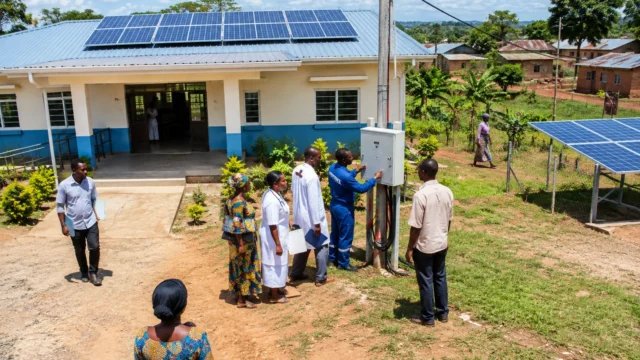
The financing is not only for masts. It is also intended to help install solar panels and upgrade sites with lithium batteries. There is a dual purpose: to secure power for antennas in a country where the electricity grid remains unreliable, and to reduce dependence on diesel, which is costly and vulnerable to supply disruptions.
The private sector’s message is clear. Peter Lewis, co-founder and director of Eastcastle Infrastructure Ltd, welcomed the collaboration with EAAIF to expand the tower network while tackling a major bottleneck in DR Congo. Such financial partnerships are not new: in June 2023, IFC announced a $60 million loan to Eastcastle, supplemented by $34 million from Standard Bank South Africa, to help the group exceed 1,000 towers in the country.
Why DR Congo remains under-connected despite demand
The latest figures from ARPTC, the Congolese regulator for posts and telecommunications, show a market in motion, but still far from uniform coverage. In the fourth quarter of 2025, mobile internet penetration reached 33%. Meanwhile, mobile money continued to grow, with a penetration rate of 30.60%.
These figures confirm a reality that is often misunderstood: the challenge is not simply buying a smartphone. It is also the quality and proximity of the network. The country has users, but not yet enough infrastructure to ensure a consistent experience everywhere. This gap between adoption and coverage is driving demand for shared towers, especially in provinces far from major routes.
In its analysis of DR Congo, the GSMA had already highlighted how expanding mobile infrastructure and reforming public policy could unlock some of the country’s digital growth. In 2025, the organisation estimated that targeted reforms could connect millions more Congolese people and increase the digital sector’s contribution to GDP. Although such projections should be treated with caution, they confirm one thing: the connectivity divide weighs directly on both the formal and informal economies.
Practical effects for operators, households and the economy
For mobile operators, the shared-tower model reduces upfront investment and operating costs. It enables them to expand coverage more quickly without tying up substantial capital in competing infrastructure. In a market dominated by a handful of national players and intense competition over data, this flexibility can make the difference between a token presence and a real one in certain provinces.
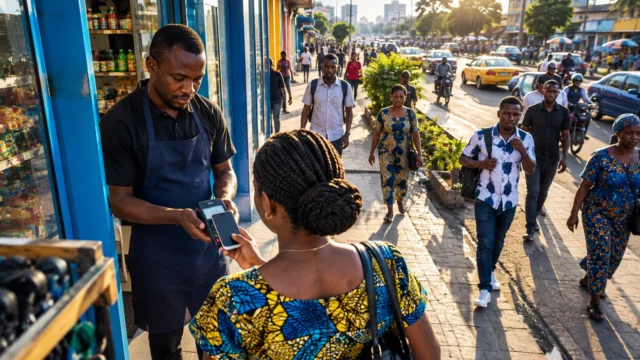
For households, the stakes go beyond access to social media or calls. Better coverage opens up access to information, mobile financial services, administrative procedures and local business activities. In rural areas, it can also support more efficient local markets, where electronic payments and the flow of information help reduce some losses of time and income.
For the Congolese state, the issue touches on several priorities at once: digital inclusion, tax revenue, economic competitiveness and regional development. The administration is seeking to modernise the sector, while operators are calling for a regulatory framework that safeguards investment. Between them, ARPTC remains a key arbiter. Its role is not limited to publishing statistics; it also shapes the conditions for competition and service quality.
Regional significance for Central Africa
This new financing goes beyond the case of a single company. It says something broader about Central Africa: connectivity is advancing, but still depends heavily on the ability to mobilise patient capital, secure power for sites and share infrastructure. In a sub-region where needs are enormous and margins often slim, this type of financing arrangement is becoming an instrument of industrial transformation as much as a telecoms tool.
DR Congo is therefore at the crossroads of several continent-wide trends: the digitalisation of services, the growth of mobile money, the search for energy-efficient infrastructure and the rise of blended financing combining development funds and private capital. The next signal to watch is not a slogan, but the actual pace of deployment of the 728 announced towers, and whether they reach the least-served areas. That is where the political and economic value of this financing will be measured.