
 Algeria
 Egypt
 Libya
 Morocco
 Sudan
 Tunisia
 Benin
 Burkina Faso
 Cabo Verde
 Côte d'Ivoire
 Ghana
 Guinea
 Guinea-Bissau
 Liberia
 Mali
 Mauritania
 Niger
 Nigeria
 Senegal
 Sierra Leone
 The Gambia
 Togo
 Cameroon
 Central African Republic
 Chad
 Equatorial Guinea
 Gabon
 Republic of the Congo
 São Tomé and Príncipe
 Burundi
 Comoros
 Djibouti
 Eritrea
 Ethiopia
 Kenya
 Madagascar
 Malawi
 Mauritius
 Mozambique
 Rwanda
 Seychelles
 Somalia
 South Sudan
 Tanzania
 Uganda
 Angola
 Botswana
 Eswatini
 Lesotho
 Namibia
 South Africa
 Zambia
 Zimbabwe
A decision that reaches beyond the cobalt sector
In Kinshasa, the battle is no longer just about how much is mined, but what remains in the country once the ore has been brought to the surface. In the Democratic Republic of the Congo, the state is seeking to regain control of the mining value chain, at a time when copper and cobalt remain central to public revenue, exports and relations with major international operators.
The issue is strategic for the Congolese because it affects local processing, industrial jobs and public finances. It also concerns the mining region of Katanga, where several copper-cobalt deposits are concentrated, and neighbouring countries integrated into the same logistics networks, foremost among them Zambia.
What Kinshasa has decided
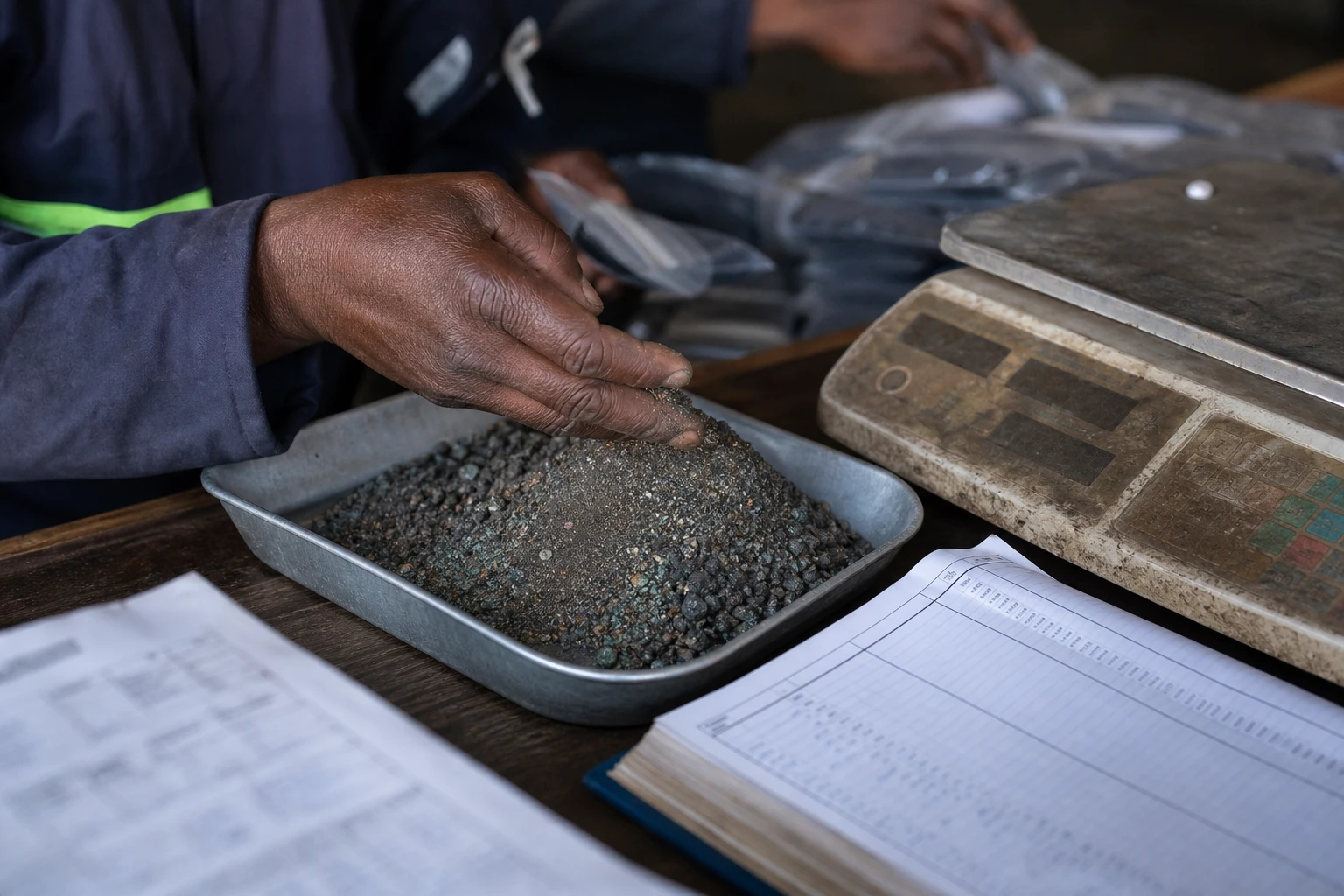
Since March 2025, the Congolese government has suspended cobalt exports, then extended the restrictions to certain strategic products, including mixed copper-cobalt concentrates. An interministerial circular note dated 6 March 2025 explicitly banned the export of several marketable mining products for a renewable period of four months.
Government texts subsequently confirmed a broader policy: to curb the export of poorly processed minerals, strengthen traceability and encourage more refining activity within the country. At its meeting on 21 March 2025, the Council of Ministers listed the temporary suspension of cobalt exports among measures to regulate the sector.
This policy did not come out of nowhere. In September 2025, the Authority for the Regulation and Control of Strategic Mineral Substances, ARECOMS, had already extended the freeze on cobalt exports before moving to a quota system. The aim was to gain better control over outgoing volumes and avoid sudden market swings.
The government has also sought to broaden its fiscal toolkit. Recent work by the Ministry of Mines points to stronger traceability and oversight mechanisms for the sector, with particular attention to the marketing of mining by-products.
Why the measure changes the sector’s balance
The DRC remains a central player in the global market. Reference sources note that the country dominates global cobalt production and ranks among the leading copper producers. The USGS also notes that the DRC accounts for a major share of mined cobalt production, while 2025-2026 data confirm that Chinese groups control a large share of local extraction.
In practical terms, banning copper and cobalt concentrates forces companies to rethink their routes to market. Major players such as CMOC, Glencore, Zijin Mining and Ivanhoe Mines are operating in an environment where exports of raw or minimally processed ore are now more tightly regulated. This could accelerate some industrial investment, but may also create short-term operational tensions.
For the Congolese state, the aim is clear: to capture more value locally. Every additional stage of treatment, concentration, refining or processing increases the share that can remain in the DRC in the form of taxes, wages, subcontracting and local purchases. It is also a way to reduce dependence on external markets, which often buy the raw material before processing it elsewhere.
But the measure carries a risk. At sites where copper and cobalt are produced together, an overly rigid restriction can slow the flow of stocks, disrupt production chains and weigh on the revenues of companies as well as those of some mining provinces. In its 2025 communications, the Congolese Ministry of Mines itself acknowledged the need to balance economic sovereignty with predictability for operators.
For local communities, the stakes are different. In the short term, the benefits will depend on the government’s ability to turn this policy into jobs, infrastructure and visible public services. Without genuine local processing, tighter restrictions may remain a bargaining tool with mining groups rather than a driver of shared development.
A regional, then continental, impact
Kinshasa’s decision also has regional implications. The copper belt running through southern DRC and Zambia feeds interconnected industrial flows. A restriction on concentrates could therefore reshape trade routes, export ports and the choices between local processing and regional exports.
Across Africa, the message is broader. As the global energy transition increases demand for cobalt and copper, the DRC is making clear that it no longer wants to be just a supplier of raw materials. The debate echoes that in many African countries about mining sovereignty, processing at home and the continent’s place in global value chains.
The next point to watch is how the policy is implemented. The market will be monitoring any one-year exemptions provided for by the mining administration, the arrangements for taxing by-products, and how ARECOMS, the Ministry of Mines and private operators translate these rules into practice. In the DRC, that is often where the difference between a political announcement and lasting reform is decided.



