
 Algeria
 Egypt
 Libya
 Morocco
 Sudan
 Tunisia
 Benin
 Burkina Faso
 Cabo Verde
 Côte d'Ivoire
 Ghana
 Guinea
 Guinea-Bissau
 Liberia
 Mali
 Mauritania
 Niger
 Nigeria
 Senegal
 Sierra Leone
 The Gambia
 Togo
 Cameroon
 Central African Republic
 Chad
 Equatorial Guinea
 Gabon
 Republic of the Congo
 São Tomé and Príncipe
 Burundi
 Comoros
 Djibouti
 Eritrea
 Ethiopia
 Kenya
 Madagascar
 Malawi
 Mauritius
 Mozambique
 Rwanda
 Seychelles
 Somalia
 South Sudan
 Tanzania
 Uganda
 Angola
 Botswana
 Eswatini
 Lesotho
 Namibia
 South Africa
 Zambia
 Zimbabwe
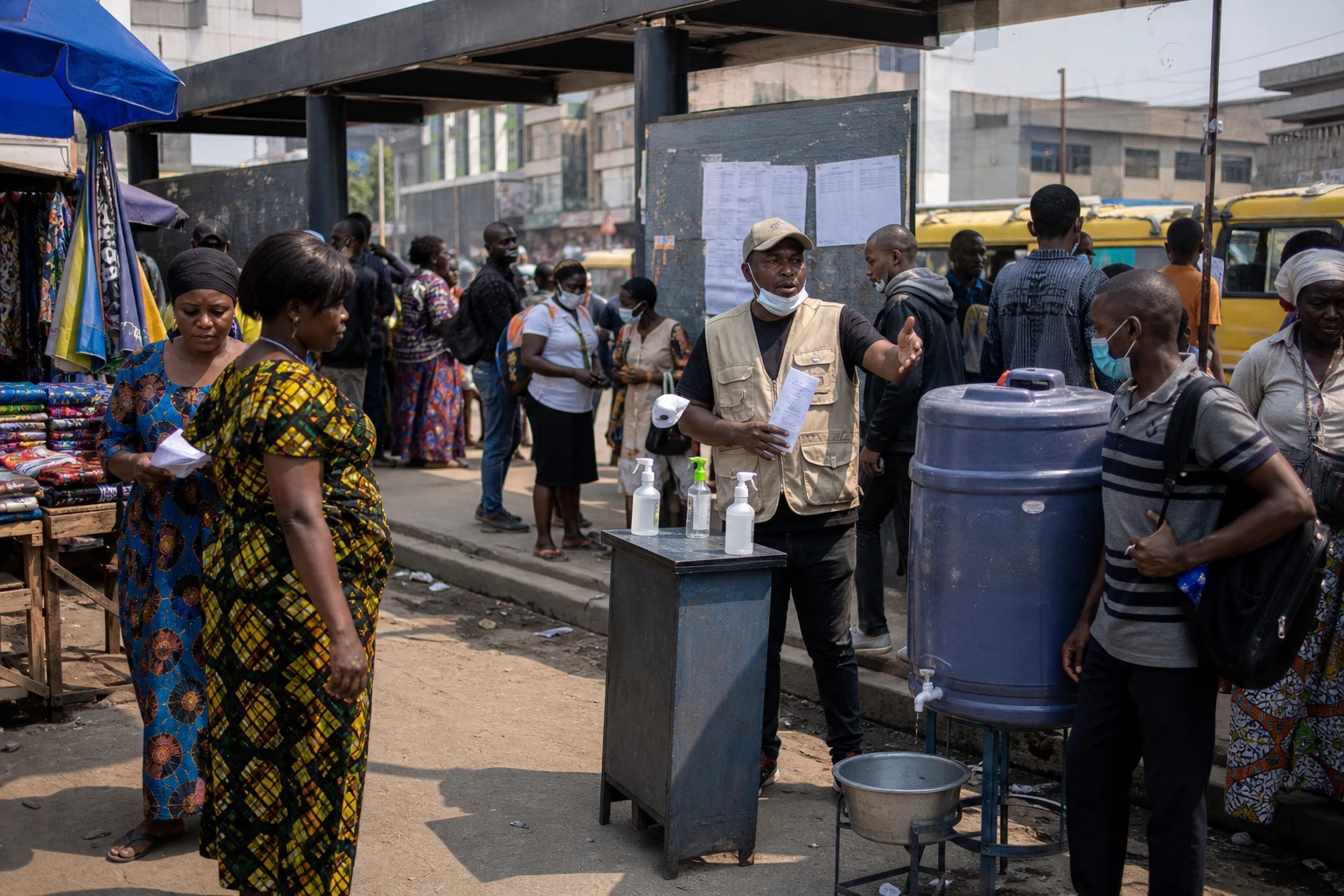
Kinshasa keeps moving, but vigilance remains high
In the Congolese capital, markets open, transport services run and offices operate. For now, nothing suggests a city paralysed by Ebola. Yet Kinshasa knows that an epidemic starting in the east can quickly become a national concern in a country where distances, roads and population movements complicate the health response. The challenge is therefore not only medical. It is also logistical, social and political.
The Democratic Republic of the Congo is no stranger to Ebola crises. The country has already faced several outbreaks, including the major 2018-2020 epidemic in North Kivu, Ituri and South Kivu, long described as the worst in its history before being surpassed in scale by the previous wave, according to the WHO. This experience still weighs on the health authorities. It explains the speed of prevention messaging, checks at entry points and alert systems put in place in Kinshasa, a capital of nearly 22 million people and the country’s central hub.
An outbreak centred in the east, a capital under surveillance
At the time described by the authorities, transmission remained concentrated mainly in the east of the country. This is where the bulk of the response is taking place: contact tracing, rapid isolation of suspected cases, clinical care and targeted vaccination where available. Kinshasa, meanwhile, had reported no cases. But its role is critical, as the city is home to government administrations, major hospitals, the international airport and a significant share of the human flows from the provinces.
This geography explains the alert without panic. In a densely populated megacity, a single imported case may be enough to trigger a chain of transmission that is difficult to contain. Hence the awareness campaigns on hand hygiene, prompt reporting of symptoms and avoiding risky contact. The idea is simple: break the virus’s spread before it finds favourable conditions in the capital.
Residents interviewed say they have changed some of their habits. Crowded places are causing greater concern. Disinfectant products and masks are more visible in homes and shops alike. This response is not merely individual. It also reflects a form of collective learning, shaped by previous epidemics and the constant flow of health information through neighbourhoods.
Figures should be treated with caution, but the trend is confirmed
Figures published by the Congolese authorities and reported by the WHO over the course of the epidemic varied according to when cases were consolidated. The source text cites 3,674 confirmed cases and 1,621 deaths at a given date. Official consolidated figures published later by the WHO put the toll for the 2018-2020 epidemic at 3,470 cases, including 2,287 deaths, with 1,171 survivors. This difference is a reminder of the need for caution: during an active outbreak, statistics change quickly and may be revised as confirmations come in.
What has not changed, however, is the overall trend. The epidemic was the country’s longest and one of the most difficult to contain, notably because of insecurity in the east, attacks on health facilities, mistrust among some communities and population displacement. The WHO also noted that cases continued to emerge in areas where contact tracing remained incomplete, increasing the risk of spread from scattered hotspots.
For Kinshasa, the key point is different: the capital is not affected, but it remains vulnerable. Entry points, the airport, referral hospitals and epidemiological surveillance services act as filters. The Congolese government therefore has an interest in maintaining a high level of alert there, even in the absence of cases, because the window for response is short.
What Ebola reveals about the state, its territories and the region
This epidemic says a great deal about the DRC. First, it exposes the gap between the capital and the eastern provinces, where access to healthcare is more fragile and insecurity complicates interventions. It also shows that public health depends as much on laboratories as on roads, community networks and trust between the population and the authorities. Finally, it highlights the persistent tension between a highly visible political centre and peripheral areas that often bear the brunt of a health crisis first.
Regionally, the DRC is part of a porous health landscape. The eastern provinces have links with Uganda, Rwanda, Burundi and South Sudan, while trade and family networks regularly cross borders. This requires Kinshasa to work with neighbouring countries as well as African regional health-coordination bodies. In the east of the continent, an epidemic never stops at an administrative boundary.
For Central Africa, the episode is also a strategic reminder. Health security is no longer a technical issue reserved for ministries. It affects the stability of cities, economic activity, the movement of goods and the continuity of public services. In Kinshasa and across the rest of the country, the real question is therefore this: how can ordinary life keep moving without allowing the virus to gain ground? The answer will depend on the speed of detection, the quality of public communication and the state’s ability to hold the capital and provinces together.



