Algeria
 Egypt
 Libya
 Morocco
 Sudan
 Tunisia
 Benin
 Burkina Faso
 Cabo Verde
 Côte d'Ivoire
 Ghana
 Guinea
 Guinea-Bissau
 Liberia
 Mali
 Mauritania
 Niger
 Nigeria
 Sierra Leone
 The Gambia
 Togo
 Cameroon
 Central African Republic
 Chad
 DR Congo
 Equatorial Guinea
 Gabon
 Republic of the Congo
 São Tomé and Príncipe
 Burundi
 Comoros
 Djibouti
 Eritrea
 Ethiopia
 Kenya
 Madagascar
 Malawi
 Mauritius
 Mozambique
 Rwanda
 Seychelles
 Somalia
 South Sudan
 Tanzania
 Uganda
 Angola
 Botswana
 Eswatini
 Lesotho
 Namibia
 South Africa
 Zambia
 Zimbabwe
A new party, but not yet a new equation
In Dakar, the political battle is no longer being fought only between a president and a former ally. It also bears on a question of very real importance to Senegalese people: who will carry through Parliament the budgetary and tax reforms needed to put public finances on a sound footing? Since 25 July 2026, Bassirou Diomaye Faye has had his own political formation, Kiiraay – the Republican Patriots, presented in Dakar as a vehicle to protect institutions and organise his camp.
The move comes as Senegal remains engaged in a delicate effort to restore its public finances. The International Monetary Fund said in June 2026 that the overall budget deficit had fallen from 13.4% of GDP in 2024 to 6.4% in 2025, but that fiscal vulnerabilities and debt remained high. The BCEAO, too, sees persistent pressure on public finances in the WAEMU, where states are seeking to broaden their revenue base while limiting the cost of borrowing.
The launch of Kiiraay does not, by itself, change the institutional balance of power. In the National Assembly, PASTEF holds 130 of the 165 seats, according to the Inter-Parliamentary Union’s database. In other words, Senegal’s president is building his own political apparatus without, for now, having a parliamentary majority directly aligned with him.
Political dispute shifts towards institutions
The split between Bassirou Diomaye Faye and Ousmane Sonko did not begin this weekend. It deepened in May 2026, when the president dismissed the prime minister, amid an already tense climate over the direction of reforms and discipline at the top of the state. Since then, each has been rebuilding his base. The head of state is seeking to bring together local elected officials, political figures and supporters from civil society. PASTEF, meanwhile, retains its parliamentary backbone and a strong capacity to mobilise its activists.
The dispute has also taken on a legal dimension. On 9 July 2026, the Constitutional Council received a presidential challenge to a constitutional amendment passed by the National Assembly. The case, listed on the institution’s website, shows that the stand-off is no longer confined to personal alliances: it now touches on the balance of powers, Parliament’s role and the president’s place in party politics.
In this context, Kiiraay has a straightforward political purpose: to give Bassirou Diomaye Faye an identifiable camp capable of backing his choices without relying on PASTEF’s structures. This is a familiar response in systems where the executive wants to free itself from a party that has grown too powerful. But in Senegal, this realignment is taking place just as the government must preserve the confidence of markets, regional partners and lenders.
The stakes are very real. The government must raise more revenue, manage debt more effectively and finance public investment without sharply increasing the pressure on households and businesses. In June, the IMF noted that the fiscal adjustment relies chiefly on rationalising expenditure, but that vulnerability remains high. The BCEAO, for its part, points out that WAEMU states continue to turn to the regional market to meet their financing needs. For Senegal, that means every tax reform, finance bill and decision on borrowing has an immediate bearing on schools, roads, energy and public services.
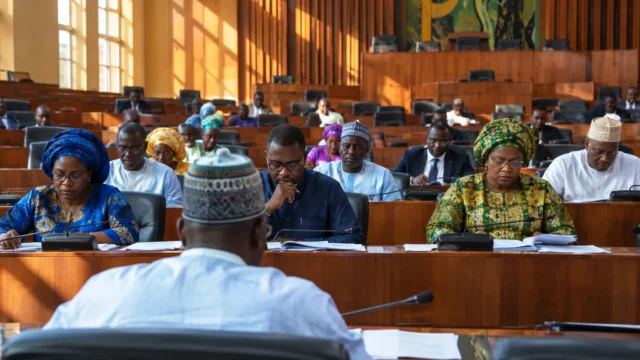
Parliament is therefore the decisive arena. It votes on the budget, examines finance bills and can slow, amend or accelerate reforms. Until the president consolidates his own base, he will have to work with an Assembly in which PASTEF remains dominant. The real test will not be only political; it will be legislative and budgetary.
What this realignment says about Senegal and the region
Beyond the rivalry between two figures who emerged from the same political cycle, the affair says something broader about Senegal’s transition. The country remains one of West Africa’s most closely watched institutional centres, within ECOWAS, at a time when several states in the sub-region have experienced disruptions to the transfer of power, tensions over the rule of law or financing difficulties. In Dakar, stability is therefore measured not only by the absence of a visible crisis, but by institutions’ ability to absorb disagreement at the top without stalling public action.
The continental significance is much the same. Senegal is being watched as a test of governance: can deep reforms be pursued while managing an autonomous parliamentary majority and a fragmented political alliance? If Kiiraay takes hold, Bassirou Diomaye Faye will gain a tool for enforcing government discipline. If PASTEF maintains its autonomy without ending co-operation, the country could retain a form of functional duality. But if the rivalry intensifies, economic projects will be slowed just as the Treasury needs to refinance the state and reassure its partners.
For now, one thing is certain: in Dakar, the debate over political loyalty has moved out of the corridors. It has entered the institutions, the legislation and the budget. That is where, in the coming months, the strength of the new presidential camp and Senegal’s ability to carry out reforms without being drawn into a permanent power struggle will be tested.