Algeria
 Egypt
 Libya
 Sudan
 Tunisia
 Benin
 Burkina Faso
 Cabo Verde
 Côte d'Ivoire
 Ghana
 Guinea
 Guinea-Bissau
 Liberia
 Mali
 Mauritania
 Niger
 Nigeria
 Senegal
 Sierra Leone
 The Gambia
 Togo
 Cameroon
 Central African Republic
 Chad
 DR Congo
 Equatorial Guinea
 Gabon
 Republic of the Congo
 São Tomé and Príncipe
 Burundi
 Comoros
 Djibouti
 Eritrea
 Ethiopia
 Kenya
 Madagascar
 Malawi
 Mauritius
 Mozambique
 Rwanda
 Seychelles
 Somalia
 South Sudan
 Tanzania
 Uganda
 Angola
 Botswana
 Eswatini
 Lesotho
 Namibia
 South Africa
 Zambia
 Zimbabwe
A name known on both sides of the Mediterranean, and cases that intersect
In Sevran, Seine-Saint-Denis, two deaths in a month were enough to bring the spotlight back on the same circle. In Casablanca, then Tangier, the name of French-Moroccan rapper Maes was added to an already weighty case. Between France and Morocco, the affair points to something broader: the way artistic careers, local rivalries and legal proceedings end up meeting in the same place — the criminal courts.
The starting point is straightforward. In France, investigators are looking into several violent incidents in Sevran over the past few years. In Morocco, Maes, whose real name is Walid Georgey, was sentenced at first instance to seven years in prison, and the case was then sent to appeal in Tangier in spring 2026. The rapper therefore remains at the centre of two distinct timelines, closely linked by the same names, neighbourhoods and transnational geography.
Sevran, Tangier, Rabat: three settings, one legal case
Sevran is not just a backdrop here. For several years, the Seine-Saint-Denis town has seen episodes of violence linked to drug trafficking and settling of scores. In the case being followed by Paris’s specialised interregional court, the French justice system is treating these incidents as organised crime. This is precisely the kind of jurisdiction that makes it possible to bring cases together when links between victims, suspects, locations and alleged masterminds extend beyond a single town.
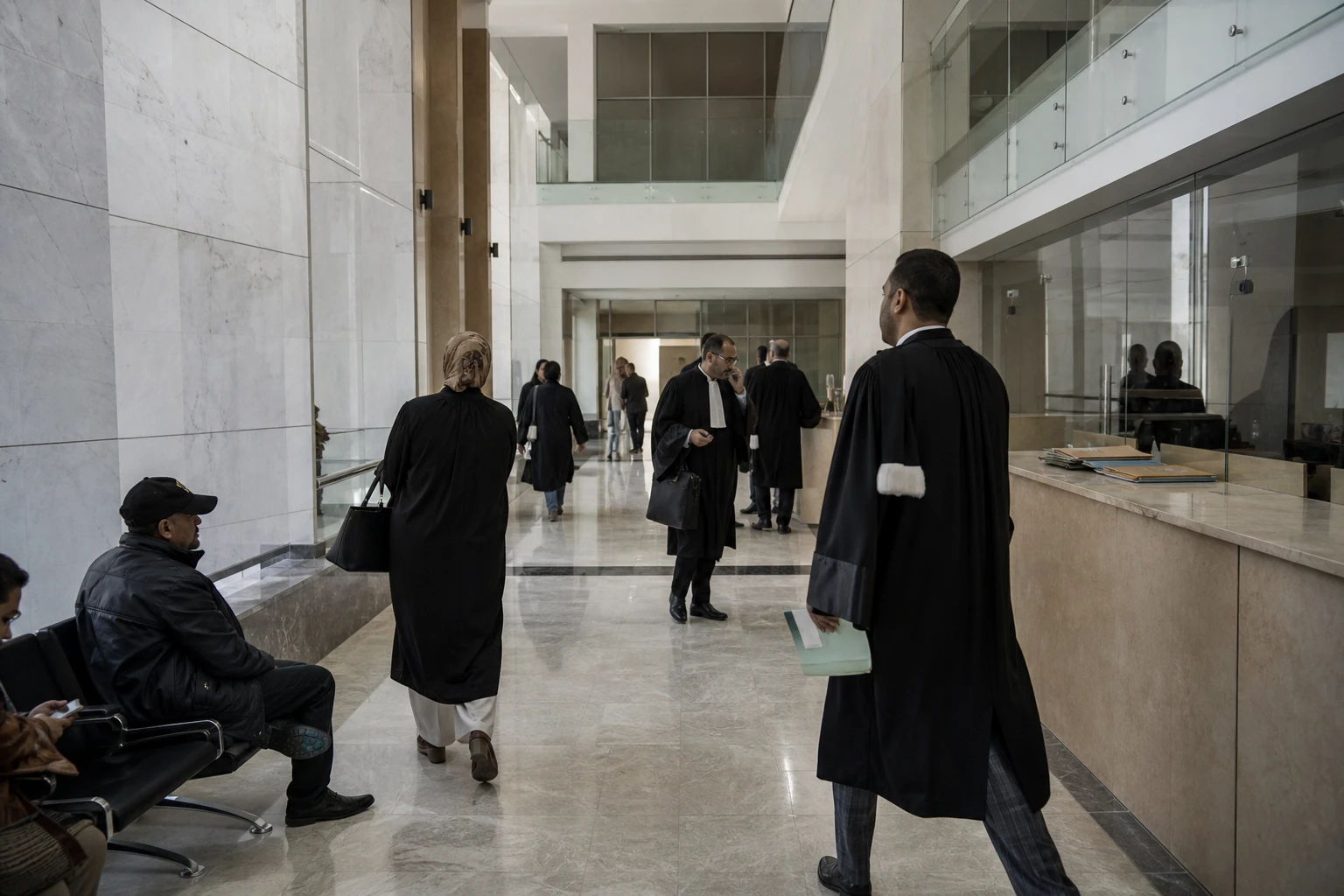
In Morocco, the Maes case falls within a different judicial sphere, but not a different world. The rapper was arrested in Casablanca in January 2025, then sentenced in Tangier to seven years in prison for offences linked, according to information reported by the Moroccan press, to an attempted kidnapping and unlawful confinement. The appeal hearing was adjourned until 14 May 2026 to allow the defence to be summoned. The sequence is a reminder that the Moroccan justice system, in Rabat as in Tangier, also deals with cases involving celebrity, international movement and allegations of serious violence.
Established facts: two deaths, different circumstances, the same environment
The first death concerns Imran B., 20. He was fatally injured on the night of 31 May 2026, near the Arc de Triomphe in Paris, amid violence that followed Paris Saint-Germain’s Champions League victory. The Paris public prosecutor’s office opened a judicial investigation into murder on 5 June 2026, after the victim was declared brain-dead during the day. Initial information points to a knife attack amid urban chaos, but sources close to the case have also raised the possibility of a premeditated act.
The second death concerns Ali O., 29. He was killed in Sevran shortly before 5am while in his vehicle. According to reported information, several men fired automatic weapons, and around 30 projectiles were found at the scene. The victim is described as close to the Maes clan, originally from Sevran and already known to the justice system for drug-trafficking offences. At this stage, the two cases remain separate. But investigators have not ruled out the possibility that they form part of the same series of reprisals between rival groups.
What these cases reveal about the mechanics of violence
The central question is not only who carried out the attacks. It is also about networks, loyalties and spheres of influence. In Sevran, the justice system is seeking to establish whether the incidents in spring and summer 2026 extend a long-running turf war. The case file refers to an opposition between a circle linked to Maes and a rival Beaudottes clan, with several cases already being handled by Paris’s JIRS. In this context, an artist’s name is not proof, but it can become a point of reference for investigators reconstructing social networks.
For residents, the impact is very real. Violent deaths affect not only those targeted. They weigh on journeys, local shops, early-morning outings, parents, teenagers and workers crossing neighbourhoods. In Sevran, public space becomes more precarious when gunfire erupts outside homes or in streets used by passers-by. For institutions, by contrast, each new incident adds to the pressure on criminal investigators, prosecutors and specialist magistrates, already dealing with lengthy, complex and often interconnected cases.
A Moroccan and pan-African resonance
The case also has significance in Morocco. First, because Maes is a French-Moroccan whose music career is followed on both sides of the Mediterranean. Second, because his imprisonment in Morocco, confirmed by several Moroccan and French sources, puts the kingdom back in a central institutional role: that of a state that tries and detains a defendant, and hears an appeal in a case followed beyond its borders. The fact that a hearing was adjourned in Tangier shows that the case is neither closed nor settled.
The continental significance is broader still. In an African space where the movement of artists, capital, diasporas and legal disputes is becoming increasingly dense, this kind of case is a reminder that a public profile can quickly become transnational. Morocco, a North African country, appears here as a judicial and cultural hub connected to France, but also to a highly active Maghrebi rap scene, with ElGrandeToto one of its most visible figures. Musical projects bringing together Maes and the Casablanca artist continue to keep them in the public eye, despite Maes’s imprisonment. The next points to watch are the progress of the appeal in Tangier and developments in the Paris investigations into the deaths in Sevran.